A key component of adaptation planning is to clarify your objectives and to understand how climate change is likely to affect you, your organisation and its stakeholders.
Using decision support - C-CADS
June 05, 2025
At a glance
In Step 1 of C-CADS, you will determine the framing and scope for your planning effort and assess the extent to which your area of interest is likely to be affected by climate change.
This information will help you to determine whether to begin the process of adaptation. You will be guided on how to gain support from senior management of your organisation, other stakeholders and the community.
We will explore important governance and engagement that can help to strengthen and broaden your organisation’s commitment to climate adaptation planning and that your engagement with stakeholders and community is effective.
Purpose
This step will help you to:
clarify your objectives, identify the specific area or sector that you need to focus on and determine the resources needed to address your adaptation challenge
establish a vision and set goals for your adaptation challenge
develop a deeper appreciation of the nature and scale of the challenge you face
design a structured process to effectively respond to that challenge
establish organisation and governance structures to help you to achieve your identified goals
engage both internal and external to ensure that you have strong support within your organisation, and other stakeholders and community.
Introduction to Step 1
Climate change is happening; with observable impacts already occurring around the work, and is likely to lead to significant changes over time. Even with efforts to mitigate emissions, some level of climate change is now avoidable and so is considered as locked-in.
As a result, there is a need to consider and plan for actions to reduce the adverse consequences that may arise, and to identify and harness any beneficial opportunities.
To be most effective your adaptation planning needs to follow a flexible, iterative process. This will enable you to appreciate the effects of climate change on your area of interest and to produce a fit-for-purpose plan – that is, a plan that is supported by your organisation and stakeholders, and that aligns and integrates with existing strategies and plans of your organisation.
We provide guidance and support to:
identify key climate-related challenges
determine and implement effective adaptation actions that are flexible and cost effective
determine and monitor thresholds, and implement actions when specific triggers are reached, which will help to avoid unnecessary costs and better support effective stakeholder engagement.
In this section, we focus on the beginning of your adaptation planning journey – or the continuation of the planning cycle following evaluation and review of a previous iteration.
We provide information to identify the challenges of climate change and to determine whether you need to act. This initiates the process of a call to action for adaptation planning for your organisation and your stakeholders, and helps to ensure you have in place the leadership, management and engagement, and the organisational structures to effectively address climate impacts.
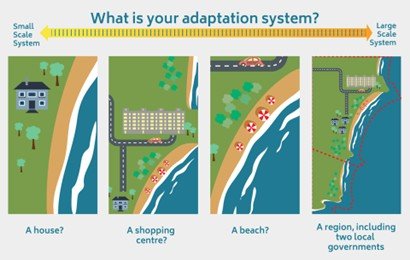
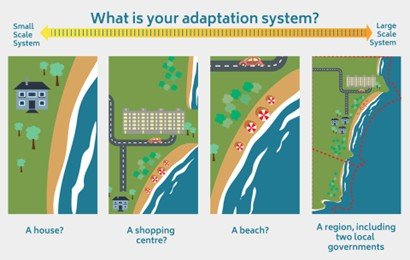
Figure 1: Two examples of different scales or 'systems' of adaptation. Determining the scale of your challenge is important at this early stage.
Selecting the appropriate framing and scope for an adaptation plan
Selecting the appropriate scope and framing for your adaptation plan is a critical early step in the adaptation planning process. Doing this early in the process helps you to define the context, position and scope for your adaptation initiative and clarifies who should be involved in developing, owning and implementing the plan.
Key considerations include
Who should be involved
Climate change impacts often cross organisational and jurisdictional boundaries, so collaboration is essential.
Will you involve only people in your organisation? Should other organisations be involved? What stakeholders should you consider?
What is the appropriate scale
When defining your scope, to ensure you are working at a manageable scale, it is important to determine the appropriate scale and extent of your adaptation plan or project. This includes not only the geographic area but also the environmental, ecological, and social-economic dimensions relevant to your objectives.
Have you determined the biophysical and social-economic landscape that is relevant to your adaptation goals?
Will you need to consider the extent of native vegetation, wetlands and other biodiversity?
What is the extent of the adaptation system
Framing includes considering the extent of your adaptation ‘system’. Adaptation planning can be done at a project level, requiring a fit-for-purpose approach that can be defined at this early stage.
Are you developing a plan for a specific focus (such as a particular beach, or business interest)? Or for a broader area that spans across multiple local government boundaries?
How will you frame your plan?
The process of developing a thoughtful framing of your adaptation plan will help you to determine the approach and scope.
It will also help you to identify when to consider interdependent areas and issues. For example, how will your plan consider direct and indirect effects from climate change and non-climate drivers and risks?
It will also help you to consider significant opportunities, and which will assist with engaging stakeholders.
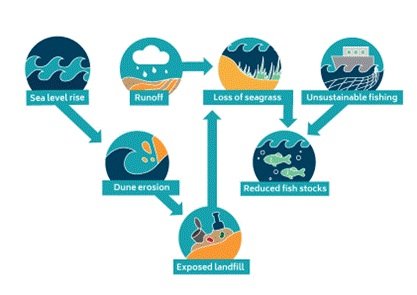
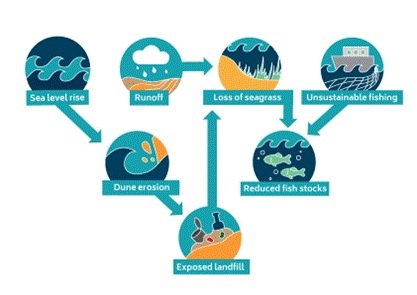
Figure 2: Consider the complexity of your system of interest by understanding the various drivers and pressures and direct and indirect effects of climate change.
For example:
sea-level rise leads to loss of beaches and dunes exposing coastal landfill
rainfall causes runoff of sediment which impacts seagrass habitats and loss of fish stocks
unsustainable commercial and recreational fishing practices also reduce fish stocks.
Understanding and addressing complex risks is an important consideration of climate risk management
Figure 2: Consider the complexity of your system of interest by understanding the various drivers and pressures and direct and indirect effects of climate change.
For example:
sea-level rise leads to loss of beaches and dunes exposing coastal landfill
rainfall causes runoff of sediment which impacts seagrass habitats and loss of fish stocks
unsustainable commercial and recreational fishing practices also reduce fish stocks.
Understanding and addressing complex risks is an important consideration of climate risk management
Figure 2: Consider the complexity of your system of interest by understanding the various drivers and pressures and direct and indirect effects of climate change.
For example:
sea-level rise leads to loss of beaches and dunes exposing coastal landfill
rainfall causes runoff of sediment which impacts seagrass habitats and loss of fish stocks
unsustainable commercial and recreational fishing practices also reduce fish stocks.
Understanding and addressing complex risks is an important consideration of climate risk management
Box 1: examples of selecting an appropriate scale.
Commercial development
An investor may be considering an adaptation plan for a shopping centre.
Their primary interest is in the development itself. However, a more effective plan would also consider the surrounding area, including access routes to ensure that staff and customers can reach the centre during flood events.
Coastal management
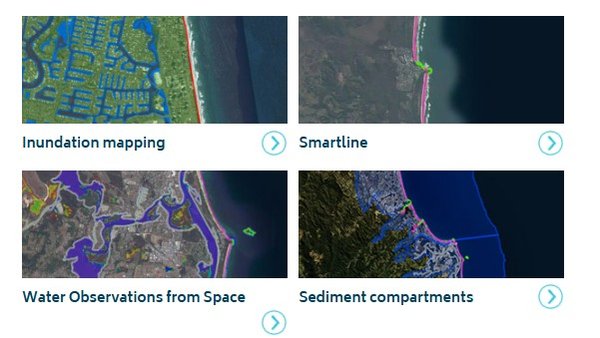
Coastal manager considering an adaptation plan for a beach should consider sediment compartments to ensure that they are operating at a scale that reflects the sediment dynamics of the area.
Neglecting sediment dynamics can lead to poor planning decisions – such as developing in areas prone to beach erosion – when more stable alternatives may exist nearby. For example, within the same coastal compartment, some areas may be experiencing erosion while others are accreting and are far less likely to face future erosion risks.
Understanding these dynamics is essential for better informed planning. More information available here Explaining coastal sediments.
1.2 Identify barriers to adaptation plan and process
Several barriers may constrain or halt your organisation’s climate adaptation planning.
Key barriers include organisational issues, including:
A lack of capacity, which may include:
a lack of technical expertise across key areas in the organisation
insufficient funding to support adaptation initiatives - especially as adaptation has to compete for resources (and attention) with many other important issues and responsibilities.
Organisational culture, which can hinder or prevent decision making on adaptation, which may include poor internal communication between departments that makes it difficult to develop a holistic or organisation-wide approach to respond to climate risks.
Lack of leadership, which may reflect and help shape the organisational culture. Leadership needs to come from senior management, but can also come from staff or the community members who advocate for change and build grassroots support for change.
You can identify barriers within your own organisation that are or will affect progress. As a start, you can talk to others in the organisation about what they think are the stumbling blocks: senior people might have a different perspective to junior staff.
Once you have selected the appropriate scope and identified and considered barriers, the next step is to articulate clearly what you aim to achieve through climate change planning adaptation.
This clarity of purpose will guide your early efforts and help you to communicate your intent when you engage with internal and external stakeholders.
Your vision should provide a broad aspirational picture of what you hope to achieve
Your goals should outline the specifics that are needed to achieve your vision. These may reflect the stakeholder and community values that you have identified at this stage.
You vision and goals are not fixed – they can and should evolve as you progress through your journey and gather more input.
They are likely to change once you engage iteratively with stakeholders, and as you work through the adaptation planning process.
You should check existing plans and monitor other planning processes underway in your organisation. Do any of these need to be reconsidered? Are they aligned with or assimilated into your plan?
1.4 Understand climate change, its impacts and opportunities
Climate change continues to present complex challenges for coastal managers. Rising sea levels, a warming climate, and increasing variability in rainfall are expected to intensify existing issues and introduce new ones. Unfortunately, past responses to extreme weather events – such as floods, heatwaves, and bushfires –have often fallen short.
To effectively adapt to future risks, it is essential to reflect on the strengths and weaknesses of past and current responses. These past events offer valuable, tangible examples that can be used to engage communities, stakeholders, and decision-makers in meaningful, non-confrontational conversations about future adaptation.
By highlighting both successful and inadequate responses, you can foster a shared understanding of what has worked, what has not, and how strategies may need to evolve – especially if such events become more frequent or severe. This approach builds trust and lays the groundwork for more informed, collaborative adaptation planning.
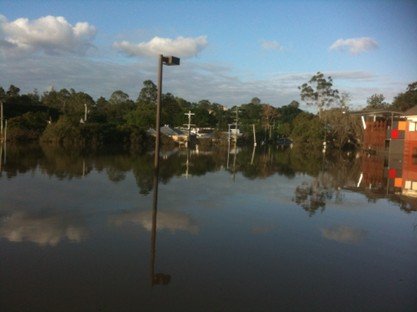
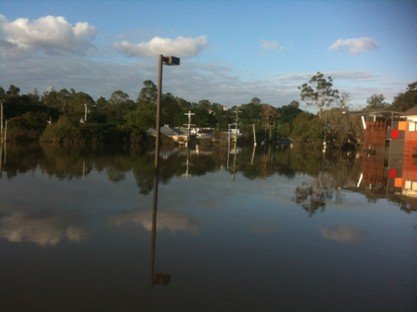
Figure 4: Historical flooding in the Brisbane River estuary. This flooding was not related to climate change, but illustrates past challenges of estuarine flooding. Lessons can be learned from these events that will increase our resilience to such events in the future.
Figure 4: Historical flooding in the Brisbane River estuary. This flooding was not related to climate change, but illustrates past challenges of estuarine flooding. Lessons can be learned from these events that will increase our resilience to such events in the future.
Figure 4: Historical flooding in the Brisbane River estuary. This flooding was not related to climate change, but illustrates past challenges of estuarine flooding. Lessons can be learned from these events that will increase our resilience to such events in the future.
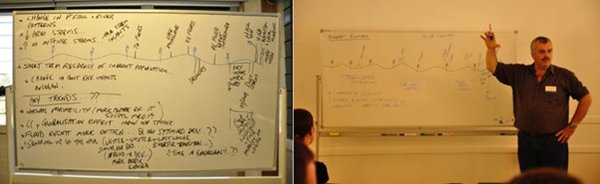
A simple approach is to develop and present your own narrative (story) about past events, or to construct a timeline of past events together with stakeholders.
This knowledge can be used to develop a case for action for your area of interest. To do this it is important to understand and be able to articulate some of the complexity of climate and climate change, and its implications.
Figure 5: A simple approach is to develop and present your own narrative (story) about past events, or to construct a timeline of past events together with stakeholders. This can be done as a fairly simple whiteboard exercise.
Figure 5: A simple approach is to develop and present your own narrative (story) about past events, or to construct a timeline of past events together with stakeholders. This can be done as a fairly simple whiteboard exercise.
Figure 5: A simple approach is to develop and present your own narrative (story) about past events, or to construct a timeline of past events together with stakeholders. This can be done as a fairly simple whiteboard exercise.
case studies that show how to help envision the future:
This is a similar approach to Witness King Tides, where citizen scientists 'snap' the future to better understand coastal climate change..
Douglas Shire used an historical approach, by mapping the past to learn from past events where the community was resilience during major upheaval.
This approach also highlights that both climate and climate change are inherently variable.
Climate change does is not linear and incremental, but can involve gradual shifts, sudden step change, concurrent and successive events.
This complexity complicates assessing impacts and risks. To respond effectively, you’ll need to identify and plan for a range of possible scenarios, including unexpected or compounding events.
Talking with stakeholders about past events can help identify how things are connected and what effects those events had – both directly and indirectly. Knowing this helps create a better adaptation plan.
The Douglas Shire where a storyline was constructed with the community to reflect on major events in the past, to help them better consider the future.
Refresh your understanding of climate change science and impacts
Information about climate change and its implications can be found here:
What do current and future climate change mean for my area of interest, my organisation and me?
Now that you have a solid understanding of past and present climate patterns – as well as the complexities of climate change – it’s time to consider what these changes mean for your specific situation.
To do this effectively, you’ll need access to reliable climate change information, ideally tailored to your region or area of responsibility. This data will help you assess potential impacts and inform appropriate adaptation responses.
Accessing data or descriptions of how climate will change is essential to support your understanding of how climate change may affect you. In doing this you need to know how to interpret this information.
At this early stage – known as a first pass risk assessment or screening – you don't need to source extensive data or detailed visualisations. Sufficient is a broad understanding of potential climate risks.
More detailed data, mapping, and analysis can be introduced later – particularly if your area of interest is identified as having a high risk of climate change impacts.
You can get more information about emission scenarios and climate change:
Envision the future and set the boundaries of your risk assessment
At this stage it is important to select the climate change scenarios and time frames that you will use for your risk assessment.
Select at least two climate change scenarios.
We recommend to choose one at the lower emission level (perhaps aligned to policies such as the Paris Agreement), and a higher-level scenario based on current day emission trends. This range allows you to explore both optimistic and more challenging futures (see Box below).
Select relevant time frames for your organisation
Timeframes should align with your organisation’s planning horizon. You should also select the timeframes of interest to your organisation. Some users like to select 20-year timeframes, while other will choose longer intervals. These are often unique to the decision frameworks of organisations.
Develop future scenarios.
The envisioning component enables you to set up scenarios of change that can be used to help determine the impacts of climate change when you assess the consequences. Envisioning isn’t limited to climate variable – your scenarios can include other elements and assumptions related to the future such as future demography, technologies, land use change.
Communicate these effectively
Scenarios can be presented in various formats. They can be written narratives, diagrams or other ways that are useful to communicate these concepts effectively to stakeholders to determine change. They may include qualitative and quantitative elements to present a richer picture of potential futures.
First pass risk screening
The first-pass risk screening helps you identify your potential exposure to coastal climate hazards, including when and where risks may emerge.
This assessment is deliberately designed to be a high-level cost-effective process. It can guide early understanding of potential impacts, how these may evolve over time. It can support decision-making, including investment due diligence. It can also highlight opportunities arising from risk management.
This screening can be completed using readily available national or regional data, supported by expert judgement where needed. Lack of detailed local information should not prevent you from undertaking this step.
This exercise should enable you to initiate a discussion in your organisation around climate risks.
The process should not be complicated and can be undertaken as part of an overarching visioning exercise for short, medium and long-term planning in your organisation.
CoastAdapt provides guidance on basics of risk assessment and a simple tool in Sea-Level Rise and You to assist you to assess your local scale risk.
For this first-pass risk screening, we recommend that you use a high emission scenario (SSP5-8.5). This will enable you to consider the 'worst case of your exposure.
However, we also recommend that you consider the risks associated with multiple climate futures and also consider at least one other emission scenario.
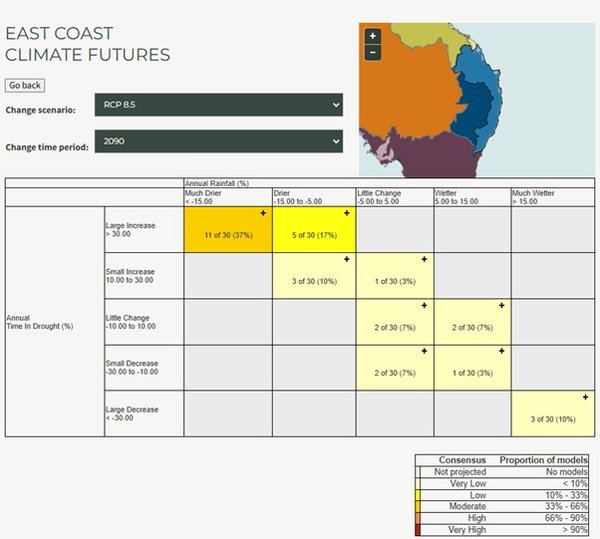
This will help you to understand the range of uncertainty regarding certain climate attributes such as rainfall (see Figure 5).
Considering a range of climate futures may also require you to consider what adaptation responses are required for drought, for floods, and importantly, for a rapid switch from one to the other.
Figure 6: Model projections for the East Coast of Australia in 2090 for a high emission (RCP 8.5) scenario.
Note that 11 of the 30 models project a much drier future, but three of the 30 models project a much wetter future. These suggest the need to understand risks at drier and wetter extremes, which will then need to underpin selection of adaptation options.
Figure 6: Model projections for the East Coast of Australia in 2090 for a high emission (RCP 8.5) scenario.
Note that 11 of the 30 models project a much drier future, but three of the 30 models project a much wetter future. These suggest the need to understand risks at drier and wetter extremes, which will then need to underpin selection of adaptation options.
Figure 6: Model projections for the East Coast of Australia in 2090 for a high emission (RCP 8.5) scenario.
Note that 11 of the 30 models project a much drier future, but three of the 30 models project a much wetter future. These suggest the need to understand risks at drier and wetter extremes, which will then need to underpin selection of adaptation options.
After conducting the first-pass risk screening process you should be able to determine whether adapt is needed and which areas or risks to prioritise.
This provides a basis for more detailed analysis on the areas or risks of most concern through a second-pass risk screening and, if necessary, a detailed assessment which will use progressively more detailed data, information and modelling. These more detailed risk assessments will often require hiring specialist consultants.
At this stage, it is important to consider stakeholder engagement to both inform the assessment but also to raise awareness of climate impacts.
A useful outcome at this early stage is for climate risks to be included in organisational risk registers and reporting mechanisms.
Embedding climate risk in these highly strategic documents will support engagement with decision-makers within the organisation, and help to ensure that risks associated with climate change are integrated into standard organisation processes.
Resources needed for a first pass assessment
A first-pass risk assessment or screening requires few resources; they are not expensive to undertake and can be based on best readily available information (at a fairly coarse level), and on expert opinion.
It is important to document the methods used and any expert input, and to store this information properly. This record will act as a baseline, and can be revisited and assessed over time as more information becomes available or if finances allow for additional data to be collected, or apparent risk and associated appetite for risk makes action necessary.
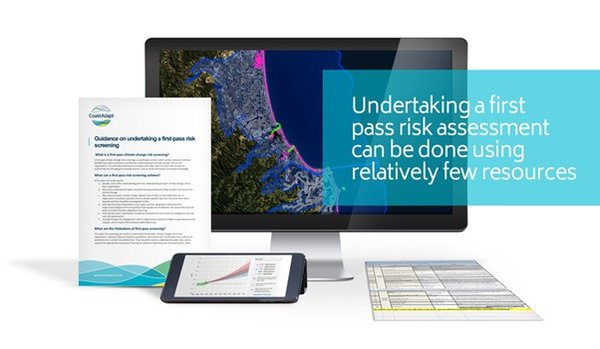
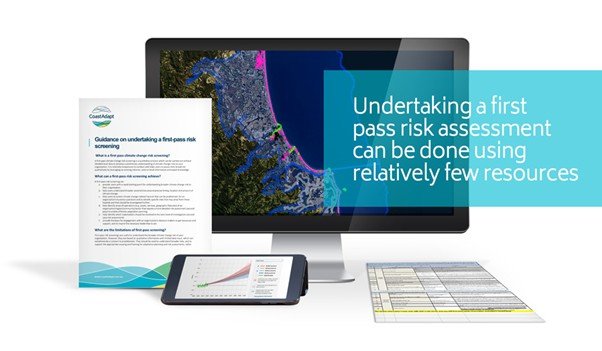
Figure 7: Undertaking a first pass risk assessment can be done using relatively few resources.
Without an initial assessment of your organisation’s or project’s exposure to climate change, it may be difficult to build a strong case for action with decision-makers within your organisation.
It also limits your ability to have informed, evidence-based discussions with stakeholders and the community. This can result in missed opportunities for early action, leading to greater challenges over time if resources are not secured, planning is inadequate, and community engagement is insufficient.
Why adapt
After completing a first-pass risk assessment, you have an understanding of the broad impacts of climate change on your area of interest. These impacts present both challenges and opportunities that can be addressed through adaptation planning.
Developing an effective plan requires further analysis and engagement with internal and external stakeholders. A key early step is clearly communicating the implications of climate change identified in your assessment and why adaptation is necessary.
It is important to consider how climate change affects communities, ecosystems, organisations, and infrastructure
Adaptation can help people live with a changing climate, maintain or enhance community wellbeing, and protect key coastal values. Importantly, following an adaptation process can also help to uncover opportunities: Harnessing opportunities can help to maintain economies and lifestyles.
These are important messages: highlighting these opportunities can be a powerful way to engage stakeholders and communities.
Figure 8: Some impacts of climate change on coastal areas
- NCCARF
None
Figure 8: Some impacts of climate change on coastal areas
NCCARF
None
Figure 8: Some impacts of climate change on coastal areas
NCCARF
There are legal, financial, ecological, economic, and social reasons to adapt to climate change. All of these should be considered when deciding whether to implement adaptation measures.
While early stages of adaptation planning may not require significant investment, it is essential to understand the risks, consider potential costs, and begin engaging stakeholders.
This forms part of developing an adaptation pathway. Early engagement is critical—without it, resistance from disengaged or disaffected communities may undermine future efforts by resisting everything about the process.
READ: more about adaptation
CoastAdapt includes a range of resources on legal, financial, and planning aspects of adaption:
planning
legal
nature-based strategies
Understanding the legislative context
Getting organisational buy-in (developing a case for action)
Buy-in from senior management, boards, elected officials or your community
Stakeholder engagement
Adaptation roles, responsibilities and governance
1.5 First pass risk screening
The first-pass risk screening:
Is a valuable tool for initiating internal discussions about climate risks.
Is intentionally broad – it is designed to be a coarse, cost-effective process. This enables you to determine your potential future exposure to coastal climate change hazards and broadly consider:
what temporal and spatial scales are the associated risks likely to be apparent
what types of impact are likely to affect your area, and how these impacts may change over time as the climate changes
what are potential opportunities that may arise from addressing risks.
It does not require a lot of resources. It can usually be done using ready available information and national or regional scale data, and even expert opinion. A lack of detailed local information should not prevent you from undertaking this step. The process should not be complicated and can be undertaken as part of an overarching visioning exercise for short, medium and long-term planning of your organisation.
1.6 Organisational and stakeholder buy-in and support to act
1.7 Establish governance for project
Checklist for Step 1 of C-CADS
Key considerations in identifying challenges
1.1
Have you scoped out/framed your adaptation needs and challenges, including the area/asset of interest?
Once you have selected the appropriate scope and identified and considered barriers, the next step is to articulate clearly what you aim to achieve through climate change planning adaptation.
This clarity of purpose will guide your early efforts and help you to communicate your intent when you engage with internal and external stakeholders.
Your vision should provide a broad aspirational picture of what you hope to achieve
Your goals should outline the specifics that are needed to achieve your vision. These may reflect the stakeholder and community values that you have identified at this stage.
You vision and goals are not fixed – they can and should evolve as you progress through your journey and gather more input.
They are likely to change once you engage iteratively with stakeholders, and as you work through the adaptation planning process.
You should check existing plans and monitor other planning processes underway in your organisation. Do any of these need to be reconsidered? Are they aligned with or assimilated into your plan?
1.3
Have you established a vision and goals for your adaptation journey?
Once you have selected the appropriate scope and identified and considered barriers, the next step is to articulate clearly what you aim to achieve through climate change planning adaptation.
This clarity of purpose will guide your early efforts and help you to communicate your intent when you engage with internal and external stakeholders.
Your vision should provide a broad aspirational picture of what you hope to achieve
Your goals should outline the specifics that are needed to achieve your vision. These may reflect the stakeholder and community values that you have identified at this stage.
You vision and goals are not fixed – they can and should evolve as you progress through your journey and gather more input.
They are likely to change once you engage iteratively with stakeholders, and as you work through the adaptation planning process.
You should check existing plans and monitor other planning processes underway in your organisation. Do any of these need to be reconsidered? Are they aligned with or assimilated into your plan?
1.4
Have you considered the past and current challenges that have occurred in your area of interest?
Have yu looked at how your coastline will change in CoastAdapt's Shoreline Explorer?
Are there datasets or maps provided by the State Government, or in the Coastal Risk Australia tool (www.coastalrisk.com.au) that show coastal hazards in your region?
Has your local area been affected by catchment flooding, sea inundation, erosion, heatwaves or bushfires in the past? See DEA Water Observations in Shoreline Explorer?
Have you accessed any additional local data and knowledge on climate change that may be available in your local area (local government, universities, NRM groups)?
Have you considered accessing local knowledge on climate change impacts from long-term residents and Traditional Owners?
1.6
Have you used the information you have generated to seek buy-in from your organisation, and from external stakeholders?