Adapting to climate change requires exploring a broad spectrum of strategies that stakeholders can evaluate and implement. Some approaches are designed to address current climate extremes, while others are more suitable as the impacts of climate change intensify over time. A practical path forward involves developing a phased pla - an evolving set of options that can be activated progressively as climate conditions change.
Using decision support - C-CADS
July 13, 2025
At a glance
This step helps to identify adaptation strategies to address the climate change impacts on your previously identified interests, assets, and stakeholders.
Working closely with both experts, stakeholders and community enables you to identify a diverse set of potential options – or combinations of options – that can be considered and included in your adaptation plan.
Some options may already exist in other plans for different purposes and will also help to address climate change impacts. Others options may offer immediate benefits under current climate conditions (e.g. extreme weather events), while some will become critical as climate change impacts intensify.
By collating a set of potential options at this step, along with additional details for each option, you'll be well-prepared for the next step of evaluating and prioritizing these options.
Purpose
This step will help you to:
identify adaptation options that address physical and transition climate change risks as well as other pressures
reassess options and strategies from existing plans to help to determine whether they are still relevant under a changing climate
consider suites and sequences of options, support you to take a pathways approach and avoid unnecessary expenditure and adverse side-affects from your actions.
Introduction to Step 3
In the previous step, you assessed both physical and transition risks, as well as opportunities arising from climate change. You prioritised the systems – such as assets, geographic areas, or communities – that require adaptation planning. Using the results of a first pass risk assessment, you engaged internal and external stakeholders, and obtained their support for action. You also undertook a more detailed risk assessment for your area of interest, and have sufficient detail about the risks that are faced to enable you to take action.
From this step onwards, you will work on developing your adaptation plan. To do this you need to explore a suite of management options that can be used to address some of your identified climate change risks. Start by reviewing your organisation’s current practices for managing climate-related risks and other pressures. Consider whether these approaches remain effective or if new strategies are needed to address future challenges.
At this stage, it is not necessary to evaluate the sequencing, costs, or benefits of each option. Instead, focus on compiling a broad list of potential management actions that could be useful, or could be acceptable to stakeholders. Identifying a wide range of management options enables you to consider their interactions (i.e., how best to achieve multiple benefits and to consider sequencing of actions) which then can be linked to trigger levels (i.e. when to activate a given management option).
Stakeholder engagement is critical during this phase. ntegrating the views of stakeholders into your formal decision-making process will help them to understand and engage in the option selection process and, if this is done transparently, will help to reduce issues with many stakeholders down the track
Stakeholders often bring valuable local knowledge and innovative ideas that may not have been previously considered. Even suggestions that seem impractical should be respectfully evaluated before being set aside.
In this step of the C-CADS framework, we offer guidance on identifying options to address the climate impacts affecting your area of interest. We outline several broad categories of adaptation strategies and provide links to other CoastAdapt resources for further exploration:
Planning options – including local and regional land use, infrastructure, and development planning.
Engineering options – such as structural measures and technological solutions.
Environmental options – focusing on nature-based strategies and natural resource management.
Social, community, and education measures – aimed at building awareness, resilience, and capacity within communities.
In most cases, we recommend implementing a series of smaller, incremental actions that align with existing community goals and expectations while addressing climate impacts. These adjustments can be more easily integrated into current systems and are often more acceptable to stakeholders.
However, if these smaller incremental adaptation options cannot meet long-term adaptation needs, more significant or drastic and transformative changes may be necessary.
We explore the concept of transitions and transformative adaptation later in Step 3.
Using risk registers to identify options
The risk register developed during Step 2 of your risk assessment process serves as a valuable starting point for selecting adaptation options. As part of that assessment, you would have identified any existing risk management strategies or actions already in place.
If a current strategy or action exists, your first step should be to evaluate whether it remains adequate to address future climate risks. You may find that it needs to be strengthened, modified, or expanded to remain effective under changing conditions.
If no existing strategy is in place, you should begin exploring a range of potential management options. These options – discussed in more detail in a later section – should be evaluated based on factors such as available resources, implementation timeframes, and your organisation’s risk appetite.
This approach ensures that adaptation planning builds on existing efforts where possible, while also identifying new opportunities to manage emerging risks effectively.
Non-climate related synergies and trade-offs
When identifying management options, it is important to also consider actions your organisation is already taking to address non-climate-related issues. These existing initiatives may intersect with climate adaptation strategies, potentially offering valuable co-benefits or, conversely, leading to unintended negative consequences. Recognising these overlaps early can help align efforts, avoid conflicts, and enhance overall effectiveness.
Drawing on experience and lessons of others
In recent years, a wide range of stakeholders – including private organisations, local councils, regional bodies, community groups, and individuals – have actively developed climate adaptation plans and responses. This growing body of work presents valuable opportunities to learn from others, leverage existing knowledge, and build on proven approaches.
EXPLORE:
the many case studies in CoastAdapt that show real-world experiences in adaptation planning and implementation.
These examples can help guide decision-making and inspire locally relevant solutions.
Additional resources and guidance are available through State and Commonwealth agencies, including:
Within these responses are a variety of potential options. A typical adaptation plan will include a range of different options. These may include planning options, soft and hard engineering solutions, ecological options, economic options and options relating to adaptive capacity.
These are broadly categorised as the following list.
Planning options
Engineering options
Nature-based strategies
Social, community and education options.
In selecting the approach or approaches to use, consider the objectives of the exercise, the time and budget available and the expertise available to you to assist with the engagement exercise.
Importantly, engaging with experts and a range of stakeholders can help to identify both novel options and options that are align best with stakeholders' values and aspirations.
Table 1. A non-exhaustive list of adaptation strategies, the climate stressors they address, and the associated benefits and risks of each option.
Adaptation options
Climate stressor addressed
Benefits
Risks
Planning
Avoidance
Prevent development in high-risk areas: Ensure that new public and private infrastructure developments are not approved in areas vulnerable to climate change impacts unless robust planning controls and risk mitigation measures are in place.
Coastal and estuarine flooding and erosion. Bushfire
Reduces exposure to future risk. If new developments are permitted, and developments are affected by climate impacts, there are potential legal implications for local and state governments.
Potential for developers and property owners to be negatively affected financially in the short-term. Futherrmore, there is a risk of decisions being challenged in court by developers and property owners. However, with better planning the impact of these risks will be reduced in the future.
Promote heat-resilient coastal design: Require that new developments in coastal areas incorporate heat-resilient design features, including cool roofs, natural shading, passive ventilation, green infrastructure, and adequate tree canopy coverage, to reduce the effects of extreme heat and support community health and well-being.
Extreme heat and heatwaves.
Reduces urban heat island effects; Improves thermal comfort for residents; lowers energy consumption; strengthens community resilience to extreme heat events.
If not properly planned and managed, tree planting can interfere with grey infrastructure, obstruct drainage systems, or increase maintenance costs, potentially reducing its effectiveness as a heat mitigation strategy.
Hold the line
Incorporate sea-level rise and storm tide and, where appropriate cyclone criteria (including soft barriers such as mangroves), in design standards to retrofit existing development (when owners apply for a development approval to renovate), and for new climate smart precincts.
Increase longevity of existing housing and infrastructure costs. Increase resilience to current extreme events.
If developments and precincts are more resilient, but surrounding infrastructure is not, it could leave residents isolated during extreme events, which exacerbate the risks.
Engineering
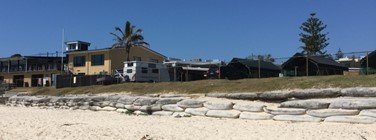
Design and construct a seawall to prevent beachfront infrastructure from being undermined and lost through excessive beach erosion.
Sea-level rise, storm surge and associated beach erosion.
Well designed seawalls can provide hard substrate as potential habitat; they can also help to ensure beach access.
Loss of beach and associated amenity; potential effects on local economy from loss of tourism.
Construct levees to reduce flooding along estuaries and coastal streams.
Changes in rainfall, sea level rise.
Reduced flooding of built up areas.
Transfer risks to other areas. Changing hydrology can change erosion risk. Cause a disconnect between estuary and surrounding wetlands.
Environment
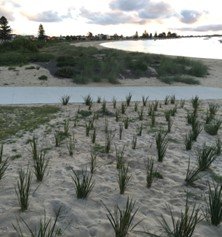
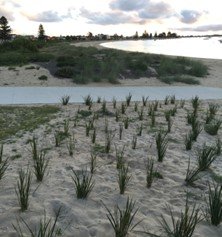
Revegetation of coastal dunes.
Sea level rise, storm surge and associated erosion.
Increased stability of dunes. Habitat for fauna and flora. Shade for beach users. Wildlife corridors.
Bushfire risk (minor).
Rehabilitate degraded ecosystems.
All.
Increased habitat. Increased biodiversity. Potential for carbon sequestration.
There are limits to the extent of climate impacts that these measures will address.
Social, community and education measures
Engage communities of place and interest on climate change risk, vulnerabilities and adaptation pathways. Work through existing community networks to discuss the need and process for adaptation planning, to get interest and involvement from beyond those directly affected.
Social, community and education measures essentially build the capacity to effectively implement adaptation options and thus apply to most climate stressors. The effort required to implement options will depend on the particular stressors and impacts being addressed and the scale and geographical extent of these.
People who are meaningfully included in the development and selection of adaptation options may be more likely to support the decision outcomes and also help facilitate implementation.
Poorly designed and/or implemented engagement approaches may alienate communities. Lack of good examples and case studies to inspire and inform on this.
Incorporate traditional knowledge into vulnerability assessments and adaptation planning.
All.
Including a range of knowledge sources may improve decision outcomes and also lead to enhanced engagement of those groups whose knowledge is included.
If done poorly, Indigenous protocols may not be recognised and respected. Insufficient expertise and resources to adequately engage with bearers of traditional knowledge.
Work with stakeholders to identify options
Stakeholders, both internal or external to your organisation, bring a diverse range of experiences, skills, knowledge, and values, often shaped by their direct connection to the local area. Their familiarity with local risks, combined with insights into adaptation strategies trialed elsewhere, makes them valuable contributors in identifying potential adaptation options and strategies, which will also support later implementation.
To ensure meaningful engagement, it’s important that stakeholders understand the process and rationale behind how options will be selected. Clear communication is essential to manage expectations: i.e., stakeholder suggestions will be considered, but not all will be adopted as there are a lot of factors to consider.
As highlighted in Step 2, it is also important to incorporate Traditional Knowledge and culturally informed responses where relevant.
Selection of adaptation options is based on a number of factors such as extent of the risk, available resources, time and leadership, practicality of implementation, community acceptance just to name a few.
You should explore the suite of adaptation options (discussed later) and identify the ones that match your context. You can shortlist a number of options at this step and then, in the next step (Step 4: Assess options and risks), there is further guidance to evaluate them (e.g., comparison of cost, benefit, risk, etc.).
As well as identifying possible options, you should also gather additional information about each option that can help you later in the process.
Such information could include:
an estimate of the time required to fully implement the action, from initiation to completion
an account of the lead up time required to plan, seek planning approvals, and obtain regulatory or organisational approvals
a preliminary cost estimate of the action (which helps to develop an indication of the time that may be required to obtain the funding)
an outline of the the form and length of engagement required with the community and other stakeholders about some of the actions (this is important because some actions may be highly controversial, and may require lengthy periods of consultation in order to get a social licence to act)
an indication of other benefits that may result from implementing the option, such as improved biodiversity, public health or economic opportunities.
an outline of potential risks, including technical, financial, social, or environmental challenges, that may affect the selection of the option.
Determining this type of information when identifying options will be beneficial for when you begin to do detailed analysis and prioritisation of options
Keep in mind that not all options will be new, and many useful actions may be already identified and described in other management plans, strategic planning documents or elsewhere in your organisation, or with other organisations relevant to your adaptation challenge.
It is important that these actions are identified and captured in a single plan. This enables interactions between actions to be considered and for sequencing of actions to be effective. The adaptation plan will outline what sort of engagement is required to ensure that reprioritisation is implemented.
A useful exercise is to undertake and analysis of the various actions that have been identified across all management and planning purposes by your organisation, or the partner organisations involved in the plan.
By assessing these actions in the context of a climate-affected future, you can determine whether each one: remains relevant, should be modified, re-prioritised or dropped.
We recommend developing a spreadsheet that lists all existing options identified in other plans and strategies of your and/or partner organisations that are relevant to addressing climate risk.
Develop a spreadsheet of climate-relevant options in organisation
We recommend developing a spreadsheet that lists all existing options identified in other plans and strategies of your and/or partner organisations that are relevant to addressing climate risk.
The spreadsheet should contain relevant information to support consideration of existing actions. Such information could include the following list:
Name/description of action
What plan/strategy is the action listed in?
Is any funding attached to the action?
Expected outcomes of the action?
Who/which department is responsible for implementing the action?
Is there any monitoring/evaluation plan in place to assess effectiveness of the action?
Additional columns could consider the relevance and appropriateness of each action for supporting your organisation to address climate risk:
Is the action still appropriate in a climate affected future?
What risk(s) will it address (including what level of climate change)?
Is the current priority level of the action still appropriate?
Are there any potentially maladaptive (unintended and negative) outcomes if this action is implemented?
What actions are needed in other management plans and strategies are needed to support this action?
Who is responsible for making these changes?
For example:
A local council may propose developing a coastal boardwalk and picnic area near a low-lying shoreline. However, climate risk assessments may reveal that the site is highly vulnerable to coastal flooding and storm surges.
To reduce long-term maintenance costs and ensure continued public access, the council could consider relocating the facilities to higher ground or incorporating flood-resilient design features, such as elevated structures and durable, water-resistant materials.
Taking a proactive approach not only minimizes disruptions from frequent flooding but also helps maintain public confidence in the sustainability and resilience of coastal infrastructure investments.
Categories of adaptation options
Loss acceptance or ‘do-nothing’ option
In some situations, choosing to accept the impacts of climate change without intervention may be a valid and practical adaptation option. This approach is most appropriate where:
human safety is not at risk
infrastructure impacts are minimal
communities or stakeholders are willing to tolerate the associated risks.
If this option is selected, it is essential to provide stakeholders with clear information about:
expected changes and potential losses
likely timing of those impacts
complementary actions. such as minor infrastructure relocation, may be needed to support this approach
This strategy may be particularly relevant for adaptation planners facing budget constraints, as many adaptation measures can be costly.
No regrets options
No regrets options are adaptation measures that provide benefits under current climate conditions while also addressing long-term climate change impacts. These actions are considered valuable regardless of uncertainties in future climate projections.
Often, such options are already included in existing management or strategic plans—such as floodplain or coastal zone management plans—and may already be funded.
These types of actions offer immediate benefits, are cost-effective, and help build long-term resilience, making them a practical starting point for adaptation planning.
For example:
reducing sediment and nutrient runoff onto coral reefs, which supports reef health under current conditions and enhances resilience to rising sea temperatures
restricting housing development on floodplains, which lowers the risk of flooding both now and in the future.
Win-win options
Win-win adaptation options are strategies that not only reduce climate-related risks or leverage emerging opportunities, but also deliver additional benefits aligned with an organisation’s broader policy or management goals. These benefits may span social, economic, environmental, and even climate mitigation outcomes.
Such options offer multiple layers of value, making them particularly attractive for integrated planning and long-term resilience.
For example, restricting new developments near estuarine foreshores can:
reduce flood risk in vulnerable coastal areas
allow saltmarshes and other estuarine habitats to migrate inland as sea levels rise
support biodiversity by maintaining fish nursery grounds, bird roosting sites, and other ecological functions.
Existing actions
Most organisations involved in adaptation planning already have a range of existing plans and strategies that guide their operations. These documents typically include actions aimed at addressing specific issues, many of which may also be relevant to a climate-affected future.
It is important that these actions are identified and captured in a single plan. This enables interactions between actions to be considered and for sequencing of actions to be effective. By assessing these actions in the context of a climate-affected future, you can determine whether each one: remains relevant, should be modified, repriorities or dropped. Then, the adaptation plan will outline what sort of engagement is required to ensure that reprioritisation is implemented.
The process of developing a spreadsheet discussed above- that lists all existing options identified in other plans and strategies of your and/or partner organisations - can be useful to have with internal and external stakeholders
Ensure adaptation actions are fit-for-purpose
Adaptation options must be fit-for-purpose and tailored to the specific context and designed to address the scale and nature of climate impacts expected in your selected area.
While it may be helpful to refer to lists of potential options, each must be evaluated in relation to the local challenges being addressed. Initial selection does not require detailed design; however, each proposed option should be accompanied by supporting information to assist with evaluation in later stages.
It is also important to consider the additional opportunities and co-benefits that may arise from implementing adaptation measures. Identifying options that deliver multiple benefits can also help build stronger cases for investment and community support.
For example:
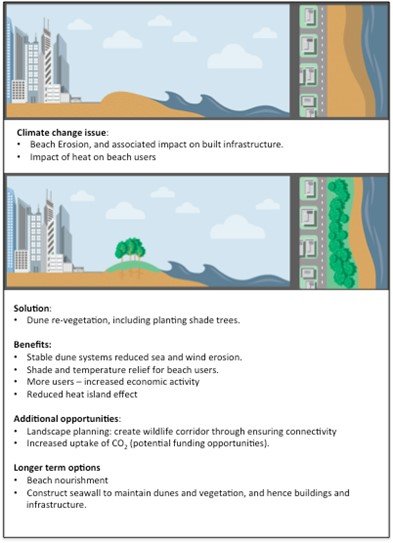
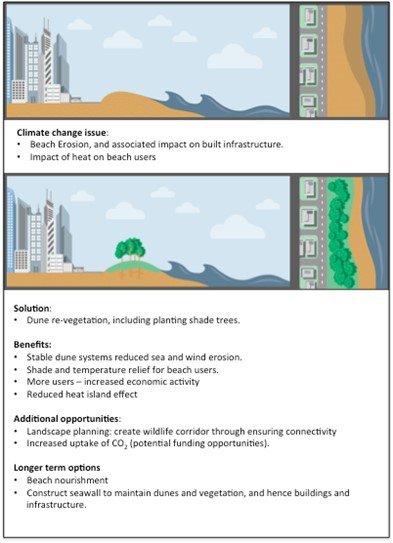
Planting trees above dunes can stabilise the landscape and reduce wind and water erosion.
These trees can provide shade for beach goers, enhancing their experience by keeping them cool and attracting more visitors, which provides economic benefits for the local area.
If integrated into a broader landscape or regional plan, tree planting can contribute to wildlife corridors, supporting biodiversity.
At sufficient scale, tree planting may also contribute to carbon sequestration and qualify for funding under carbon mitigation schemes (see Figure).
Figure 3: Indicative adaptation options to reduce beach erosion and achieve multiple benefits for stakeholders.
Most adaptation options can be implemented in a staged or incremental manner, evolving over time as climate impacts become more pronounced. This approach allows for flexibility and adjustment, aligning actions with the severity of emerging risks.
However, there may come a point when incremental changes are no longer sufficient. This may require transformational change.
Transformational adaptation refers to adaptation actions that lead to significant, systemic changes, potentially disrupting ecosystems, industries and communities - and their values, or ways of life - but also unlocking new opportunities and broader co-benefits for communities.
Most adaptation plans focus on incremental changes, or small adjustments to current policies, behaviours, or practices. However, there may come a point where these gradual measures are no longer sufficient to address the scale or urgency of climate change impacts. At that stage, radical or transformative change may become the most effective, or even the only, viable option.
At this stage it is possible that a radical or transformative change will be a better option or perhaps the only option. It is important that such options are considered (but not necessarily implemented), and in considering them it is important to have a holistic appreciation of the whole system and the way it may respond.
In thinking about transformational options - and to ensure it is effective adaptation, it will be important to
consider them early in the planning process
take a holistic view of the system and how it may respond to large-scale change
assess the capacity of the organisation and its stakeholders to support a well thought out learning process
ensure the presence of strong leadership, community engagement, and a structured learning process to guide the transition.
Because transformational adaptation often involves whole-of-system change, it is typically considered at state, national, or international levels. However, local governments, businesses, and industries can also play a critical role by identifying and testing options which are transformative in nature, and can be important test sites for innovation and learning in climate change adaptation activities and policy development. See Transformational adaptation for more information.
Climate change is one of many pressures affecting the coastal zone. It can have direct impacts, such as sea-level rise, and also amplify other pressures, like increased sediment runoff during intense rainfall events. When identifying adaptation responses, it’s essential to understand how climate change interacts with other environmental and human pressures.
Therefore, adaptation options should be evaluated not only for their ability to address climate risks but also for their potential to deliver integrated benefits across multiple areas. For example, planting or protecting mangroves on estuarine banks can:
stabilise shorelines and reduce erosion
mitigate storm surge impacts
provide habitat for fish and crabs
support carbon sequestration.
This kind of integrated solution addresses both climate and non-climate pressures, enhancing overall resilience and ecological health.
It is also important to recognise that climate risks cannot be considered in isolation. Decision-makers, whether senior managers or stakeholders, will base their choices on a broader understanding of social, economic, and environmental benefits, not climate climate alone. Therefore, integrated solutions are more likely to gain support and deliver lasting value - especially in a resource-constrained decision-making context.
Often a suite of actions is possible,and so it is important to understand the interactions between the various options are understood and considered when evaluating options (Step 4). This can help ensure that future actions are not maladaptive.
Climate change is not static, and given the uncertainty surrounding the scale, timing, and nature of climate change, decision-makers may hesitate to invest in costly measures until impacts are more certain. This challenge can be addressed through the adaptation pathways approach, which involves:
starting with no regrets options
sequencing actions over time (which also spreads reourcing over time)
activating more intensive measures as thresholds are reached
This flexible, staged approach supports informed decision-making and helps build long-term resilience in the face of evolving climate risks.
Iteration with C-CADS Step 2 (Assess risks and vulnerability)
At this stage of the process, you will be in a position to revisit your assessment of risks and vulnerability before jumping straight to the next step.
Iterating between vulnerability and risk assessments in identifying options will help reduce wasted effort.
3.1
3.2
3.3
3.4
3.5
3.6
3.7
3.8
3.9
Checklist for Step 3 of C-CADS
Key considerations in the XXXXX step
3.1
Have you identified adaptation options using risk registers, existing knowledge, and stakeholder input?
Have you reviewed information in CoastAdapt to understand the benefits and risks of planning, engineering, environmental, and social adaptation options?
Have you assessed whether existing measures from other management plans or strategies remain relevant, need reprioritisation due to climate change, or should be integrated into your adaptation plan?
Have you engaged effectively with stakeholders to ensure their input has informed the identification of options? If not, have you identified the resources needed to support meaningful stakeholder engagement?