Assessing risks and vulnerabilities to climate change will help to create a risk register to support identifying and planning adaptation options.
Using decision support - C-CADS
June 05, 2025
At a glance
You are now in a position to assess your vulnerability to climate change and identify the associated risks that may require action.
This section outlines how to carry out this assessment, taking into account the capacity of your organisation, stakeholders, and community to respond to potential climate impacts.
At this stage, it i important to consider which risks are most likely to occur and to identify thresholds or indicators that signal when a particular risk needs to be actively managed.
Developing or updating a risk register can support this process and help identify potential adaptation strategies.
Purpose
In this step you will:
select an appropriate risk assessment and reporting approach that aligns with your organisation’s specific needs, challenges, and available resources, and apply it to gain a deeper understanding of climate-related risks
assess the adaptive capacity of your organisation and key stakeholders to respond to these risks
develop a clear understanding of when and whether to take action, based on the nature and urgency of the risks identified
establish a strong evidence base to support both internal decision-making and external engagement efforts.
Introduction to Step 2. Assess risk and vulnerability
At this stage, you have secured support from senior management and elected officials (such as your board or council) to develop an adaptation plan. You’have begin to engage with internal colleagues and relevant external organisations, and have either established advisory groups or begun gathering input from existing community groups to support both planning and implementation.
With this foundation in place, you are now ready to begin developing a detailed climate adaptation strategy or plan.
Your initial risk screening has helped outline key vulnerabilities – highlighting decision areas, systems, and assets within your organisation that are most at risk. This process has also clarified the appropriate scale for your planning efforts and identified the internal and external stakeholders you need to involve in risk communication and adaptation planning.
Now, to develop a robust adaptation plan, you need more detailed knowledge of the vulnerabilities and risks affecting the shortlisted decision areas, systems, or assets of your organisation. This involves conducting a risk workshop with relevant stakeholders to explore potential impacts (both direct and indirect) in greater detail, and to assess your organisation’s capacity to respond.
Depending on your decision-making context, you may choose to apply a second-pass or third-pass risk assessment screening. These approaches help refine your understanding of risks and inform the selection of appropriate management actions for adaptation.
Before proceeding with further risk assessment, it’s important to identify any existing or planned climate risk actions within your organisation or among stakeholders. This knowledge will shape your planning activities and guide discussions with stakeholders about their appetite for climate-related risk – that is, how much risk they are willing to tolerate – and the corresponding level of adaptation required.
Establish the appropriate risk assessment methodology for your situation
There are a variety of approaches that can be used for risk and vulnerability assessment. The choice of approach should reflect your organisation’s current stage in its climate adaptation journey, as well as the complexity of the risks you face and the resources available.
If resources are limited and it is not feasible to secure funding for a detailed risk assessment (such as a second or third pass), you can use the results of your first-pass risk screening to support high-level adaptation planning.
Alternatively, if more detailed information becomes available, you may choose to redo the first-pass screening with greater specificity for your shortlisted decision areas, systems, or assets.
However, if you decide not to pursue a more detailed risk assessment, it is important to acknowledge that this increases the likelihood that your assessment may not be accurate, and you may not have right amount of information necessary to develop an appropriate plan.
This may result in an incomplete understanding of the risks, potentially leading to inappropriate recommendations or decisions that could have adverse consequences when implemented.
You will need to clearly document the reasons why you have not taken this step, including any scientific, social or economic rationale. This may be required in the future if any adaptation/management decisions are questioned by the community, stakeholders, Boards or in the courts.
poor planning or implementing of adaptation that leads to Maladaptation.
Your first-pass risk screening may reveal that there are no major climate risks to your organisation’s interests at this stage. This outcome is not necessarily problematic, provided you establish a set of climate change indicators and associated impact metrics that can be monitored over time.
These indicators should be assessed at predetermined intervals to help track changes and reassess your organisation’s exposure to climate risks as conditions evolve. This approach ensures that your adaptation planning remains responsive and forward-looking, even in the absence of immediate threats.
EXPLORE:
further guidance in CoastAdapt about a flexible and staged way to plan:
On the other hand, if your first-pass risk screening indicates that climate change impacts are likely to be significant and span multiple sectors of your organisation,you should consider undertaking a second-pass risk assessment.
As your adaptation journey progresses, you may eventually need to undertake a third-pass risk assessment, particularly if your organisation is considering a major project to protect a high-risk but critical system or asset essential to your operations.
Both second- and third-pass assessments require more detailed information about the nature of the risks, including the extent and rate of change, to support sound decision-making. This level of detail is crucial for determining when to invest, and for informing the design and implementation of adaptation options, such as engineering solutions.
Both second and third pass assessments often involve detailed modelling, hazard studies, or technical analyses to understand the relevant risk (extent and rate of change) for you to make sound decisions (i.e., when to invest, engineering design of options). This means that they will be resource-intensive in terms of time, expertise, and funding.
In many cases, you may need to use expert consultants to undertake this process. Spending money wisely at this stage may reduce spending at a later stage, and enable options to be identified that are fit-for-purpose.
Use your organisation's existing risk assessment approaches
Most organisations already have established risk assessment and reporting frameworks embedded within their management processes. When undertaking climate risk assessments, it is useful to review and align with these existing practices, and amend them where necessary.
Leveraging current systems can streamline the process, making it easier to report climate risks, gain internal support, and integrate adaptation planning into broader organisational decision-making.
Understand your risk
Note physical or transition risks
There are two key categories of climate-related risks identified by the Task Force on Climate-related Financial Disclosures (TCFD) and it is important to consider both.
Physical risks that arise from the direct physical impacts of climate change, such as extreme weather events, sea-level rise, and long-term shifts in climate patterns.
Transition risks that are associated with the shift toward a low-carbon economy, including changes in policy, technology, market preferences, and legal frameworks.
While transition risks may pose challenges, they can also present significant opportunities for organisations.
Figure 1: Example of physical and transitional climate risks and opportunities
Physical and transition risks
Figure 1: Example of physical and transitional climate risks and opportunities
Refine your prority area of interest
Having defined the initial scope of adaptation planning in the previous C-CADS step – including the appropriate scale of action – you should now deepen your understanding of the system and its components. This involves building on the information used to frame the challenge and identifying key dynamics, relationships, and vulnerabilities within the system.
Much of the required information may already exist in existing documents, plans, or datasets, and can often be sourced from relevant agencies, stakeholders, or previous studies.
Where is critical infrastructure placed in your area of interest?
What are the present and future demographics of your community?
What are important features and characteristics of the area?
Have any risk assessments of the area already been undertaken?
Do you know how your estuary(ies) function (e.g., Figure 1)?
What ecosystems services are provided by elements in your area?
Figure 1: Example of hydrodynamic forces in an estuary.
- Understanding Estuaries
None
Figure 1: Example of hydrodynamic forces in an estuary.
Understanding Estuaries
You may decide to hire a consultant to undertake a data review and develop an understanding about your area, or you could decide do an in-house desk top study in house.
Once you have a good overview of your area of interest, you are well placed to begin your risk assessments.
EXPLORE:
Dataset resources (in prep)
Prepare a risk statement
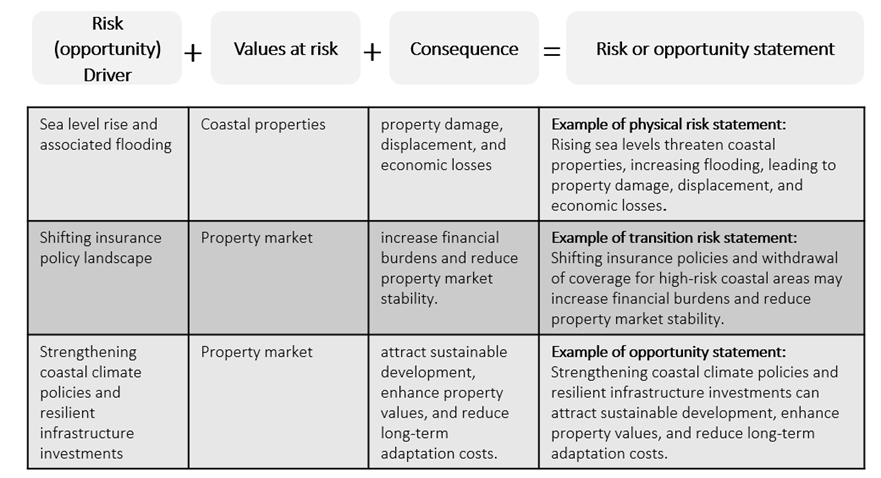
After identifying key risks during the initial risk screening (Step 1: Identify Challenges), the next step is to develop risk statements as part of the second-pass risk assessment. These statements provide a concise summary of how a system may be exposed to a specific climate hazard, highlight underlying vulnerabilities, and describe the potential future consequences of these impacts.
Figure 2 illustrates sample formats for drafting risk statements.
You are encouraged to develop both physical and transition risk statements that are tailored to your organisation’s specific context and priorities.
LEARN:
more in CoastAdapt about crafting effective risk statements, including examples in:
Figure 2 below also illustrates sample formats for drafting risk statements.
Figure 2: How to develop a risk statement.
Risk statment with examples
Figure 2: How to develop a risk statement.
Understand climate change risk and vulnerability
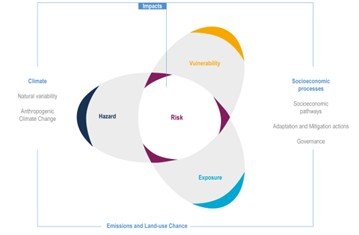
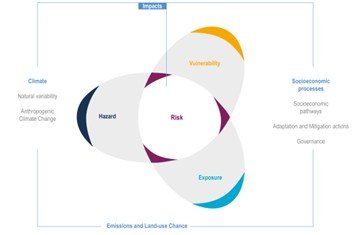
Understanding climate change risk also requires a clear understanding of vulnerability (see Figure 3).
Climate change vulnerability is defined as the propensity of a system to be adversely affected by climate change (IPCC 2022). It includes factors such as sensitivity or susceptibility to harm, as well as limitations in the capacity to cope with and adapt to climate impacts (IPCC 2022).
In contrast, risk is defined as the potential for adverse consequences where something of value is at stake and the outcome is uncertain, recognising that values can vary widely.
Risk is commonly represented as the probability of a hazardous event (likelihood) occurring, multiplied by the impact (consequences) if it does.
According to the IPCC (2014), climate change risk arises from the interaction of three key elements:
hazard – the climate-related physical event or trend,
exposure – the presence of people, assets, or ecosystems in harm’s way,
vulnerability – the degree to which those exposed are susceptible to harm and able to adapt.
Figure 3: Illustration of the fundamental concept of risk and vulnerability to climate change.
- Source: IPCC 2022 (Sixth Assessment Report, Working Group 2, Chapter 1, Figure 1.5).
risk
Figure 3: Illustration of the fundamental concept of risk and vulnerability to climate change.
Source: IPCC 2022 (Sixth Assessment Report, Working Group 2, Chapter 1, Figure 1.5).
Understanding the vulnerability of your business, organisation, or system of concern – such as assets or communities – can help you analyse the possible consequences of a potential hazard, which will lead you to understand your risks.
When evaluating these risks, it’s important to distinguish between climate change risk and that is it different to disaster risk:
Climate change risks refer to long-term threats driven by gradual shifts in climate patterns, such as rising temperatures, sea level rise, and changes in precipitation. These risks unfold over time and can affect ecosystems, infrastructure, and human health in complex ways.
Disaster risks, in contrast, are linked to sudden, extreme events like cyclones, floods, and wildfires. While some disasters are naturally occurring, climate change can amplify their frequency and intensity.
In summary, climate change risks develop progressively and influence broader environmental conditions, whereas disaster risks are immediate and event-driven – often intensified by climate change.
Complex risks
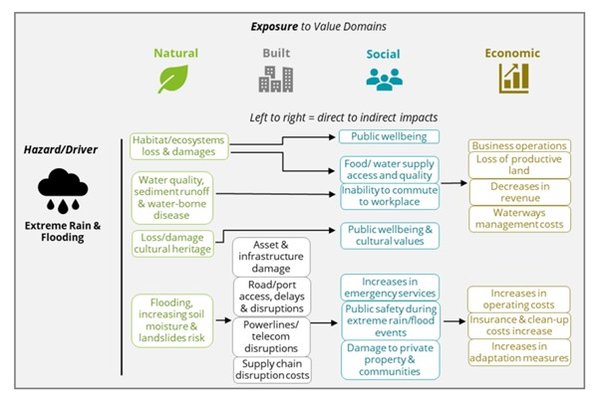
Effective climate change risk assessment also involves identifying and understanding complex risks, which arise from the interplay of multiple hazards, vulnerabilities, and systemic interdependencies.
Unlike single-event risks, complex risks are characterized by cascading and compounding effects, where climate hazards such as extreme heat, sea level rise, or flooding interact with social, economic, and environmental factors. These interactions can disrupt critical infrastructure, overwhelm emergency response systems, and exacerbate existing inequalities within communities.
Addressing complex risks requires a holistic approach – one that considers cross-sector interdependencies, long-term uncertainties, and potential feedback loops. This ensures that climate adaptation strategies remain robust, flexible, and responsive to evolving challenges.
As part of your assessment, it is important to consider these cross-cutting risks and determine which are material to your organisation’s operations, assets, and stakeholders.
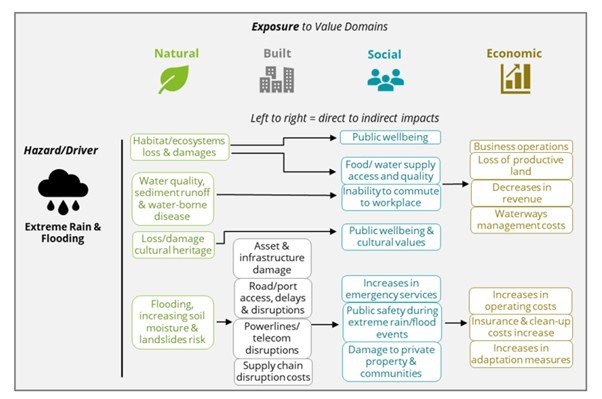
Figures 4: Example of cascading risks across different value domain. Source: Technical Report on Tasmania’s Risk Assessment for Climate Change 2024.
- Technical Report on Source: Tasmania’s Risk Assessment for Climate Change 2024.
cascading risks
Figures 4: Example of cascading risks across different value domain. Source: Technical Report on Tasmania’s Risk Assessment for Climate Change 2024.
Technical Report on Source: Tasmania’s Risk Assessment for Climate Change 2024.
Understanding risk and vulnerability of your business to climate change
Before you start conducting a second pass risk assessment you should specify your scope or the objective of this process. Answering some of the following questions may help you to clearly define your scope.
You may have tackled some of these questions in your first pass risk screening in Step 1. It is worth revisiting them at this stage, now you are engaging with other stakeholders.
What level of risk are you (and your stakeholders) willing to bear?
What is your area of interest?
Which climate change scenarios should you use (consider the advice on envisioning presented in Step 1)?
What is the time span you are interested in (consider the advice on envisioning presented in Step 1)?
Has the area of interest been affected by present or past climate driven events such as floods, heatwaves, bushfires, beach erosion?
The vulnerability of your business, organisation, or system to climate change can be assessed by examining its exposure to climate-related changes, its sensitivity to those changes, and its capacity to adapt. These three elements – exposure, sensitivity, and adaptive capacity – collectively determine the degree of vulnerability.
For example:
Consider a house located on low-lying land, making it highly exposed to rising sea levels over time. If the building materials are not resistant to saltwater, the house is also highly sensitive to this hazard. Furthermore, if the house is built on a concrete slab that limits the possibility of elevation or retrofitting, reducing its capacity to higher sea levels in future.
In this scenario, the combination of high exposure and sensitivity, along with limited ability to adapt, results in a high level of vulnerability to climate change impacts.
Assessing exposure to climate risk
At this stage, you should gather climate change projection data relevant to your area of interest. It is important to avoid relying on a single projection or benchmark value (e.g., a fixed sea-level rise estimate). Instead, consider a range of future climate possibilities –projections – rather than treating them as a single prediction or best guess.
A widely used approach in climate planning is to develop three scenarios – worst-case, best-case, and mid-range – to explore the spectrum of potential future outcomes. The selection of scenarios should also be informed by the design life of your system and the criticality of the services it provides.
However, for critical systems or long-term investments, it is essential to consider longer time horizons and high-emission scenarios to fully understand the breadth of potential risks. This enables more informed prioritisation of risks based on your organisation’s decision-making timeframes.
For example:
If your system has a short design life (10–20 years), it may be appropriate to use a high-end projection. This is because, over shorter timeframes, the differences between projections are minimal, and current observations suggest that climate change is tracking toward the upper end of projected ranges.
Begin by identifying the components of your business or organisation that may be at risk from climate change. A useful starting point is to consult existing hazard studies or maps developed for your area of interest. Areas currently exposed to climate hazards are likely to face increased risks under future climate conditions.
Tools such as the CoastAdapt visualisation (Sea-Level Rise and You) can provide preliminary insights into coastal inundation risks. However, this data is coarse and should be used cautiously, i.e. primarily for first or second-pass assessments.
For a more precise analysis, especially when informing investment decisions or engineering design for complex projects, it may be necessary to engage specialist consultants to develop tailored hazard maps suitable for third-pass assessments.
It’s important to note that conducting detailed risk assessments prematurely – without first-pass groundwork – can be inefficient. Early-stage assessments help identify where deeper analysis is needed and which stakeholders should be engaged to support adaptation planning. Jumping into technical detail too quickly can hinder progress both technically and socially.
Also, remember that coastal areas may be exposed to multiple climate hazards, including extreme heat, bushfires, and catchment flooding. A comprehensive assessment should investigate all relevant hazards that could materially impact your organisation.
Sensitivity to climate risk
In general, systems that are highly sensitive to climate change are more likely to experience adverse impacts and should be considered more vulnerable. Assessing sensitivity involves understanding how projected climate changes may affect your organisation’s assets, operations, or interests.
A practical approach is to take the components you've identified as exposed and evaluate each one individually to determine how it might be impacted by future climate conditions. To support this process, refer to the summary of Impacts on coastal sectors and industries, which outlines climate change effects across various industries and systems.
If you determine that projected climate changes are likely to affect your system’s components, then those components should be considered sensitive to climate change impacts – and therefore more vulnerable.
For example:
If you are assessing risk to the storm water system of an area close to the coast and you find that a future projection suggests increased intensity of rainfall, then the current capacity of the storm water system may not handle the runoff.
This would then cause some localised flooding during rain storms which could restrict access to community assets and impact private property. Therefore your storm water system should be considered as sensitive to climate change.
Understanding the coastal system dynamics around your area of interest – such as sediment movement, beach erosion, or accretion – can help assess the sensitivity of shorelines to future climate-related changes. This knowledge is also valuable when exploring potential adaptation options later in the planning process.
It is important to consider interdependencies between systems and how disruptions in one can affect others. These indirect impacts can significantly influence overall vulnerability. For example, when assessing risks to a water supply network, consider how the performance of nearby or connected infrastructure – such as electricity grids or transport networks – might affect the operation and maintenance of your system, and vice versa.
For example:
When assessing risks to a water supply network, consider how the performance of nearby or connected infrastructure – such as electricity grids or transport networks – might affect the operation and maintenance of your system, and vice versa.
Adaptive capacity
Once you understand the potential impacts of climate change on your asset or area of interest, the next step is to assess the capacity of your organisation (its assets, or members of the community) to respond to these impacts.
This is known as adaptive capacity. It includes evaluating the ability of your organisation, its assets, and the broader community to adjust to changing conditions, manage risks, and seize opportunities.
Adaptive capacity is shaped by the ability to modify behaviours, reallocate resources, and adopt new technologies. Factors that limit flexibility, reduce resources, or hinder innovation will lower adaptive capacity. Conversely, organisations that embrace change and foster innovation tend to have higher adaptive capacity.
Understanding adaptive capacity is crucial, as it determines how well organisations and communities can cope with the pressures of climate change. There is a growing research base on determining adaptive capacity, and getting detailed understanding of the adaptive capacity of a community or organisation often requires dedicated research and analysis.
While detailed assessments often require dedicated research and analysis, a general estimate can be derived using indicators available through sources like the Australian Bureau of Statistics. Census data provides useful variables – such as income levels, mortgage sizes, education attainment, housing types, age distribution, and workforce skills – all of which can offer insights into a community’s adaptive capacity.
A 'capitals' approach
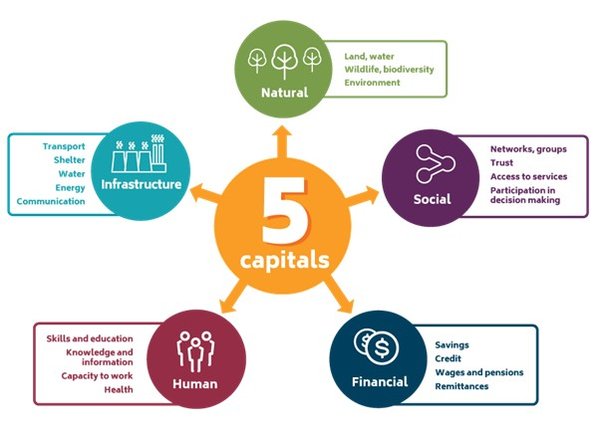
Successful assessments of adaptive capacity often use a ‘capitals’ framework, such as the Five Capitals model (Ellis, 2000) or the Four Capitals approach (Tinch et al., 2015).
These frameworks focus on identifying key types of capital – such as natural capital, social capital, financial capital – and gathering data to evaluate their condition and contribution to resilience. By examining the strengths and weaknesses in each capital, it is possible to assess and monitor changes in adaptive capacity over time.
Data can be sourced through top-down approaches, using national or state-level datasets, or through bottom-up methods, such as community workshops and local knowledge gathering.
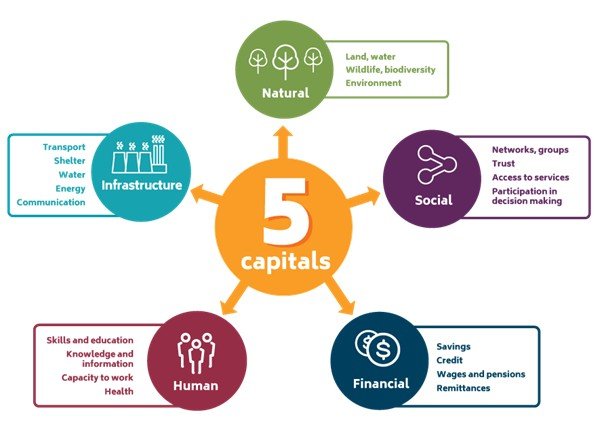
Figure 5: Five capitals often used to determine adaptive capacity of individuals
Adaptive capacity is not only related to individuals or communities –organisations also play a critical role in climate resilience. An organisation’s adaptive capacity reflects its ability to anticipate, respond to, and recover from climate-related impacts.
Key factors that influence this capacity include:
economic resources available to the organisation
technology that is accessible and effectively used
information and skills within the organisation or readily accessible
infrastructure that supports operations and resilience
organisational culture and processes, particularly those that encourage flexibility and innovation or problem solving
decision-making context, including regulatory and policy environments that can either support or constrain adaptation efforts
As you progress through the adaptation process, you’ll need to identify and implement strategies that reduce vulnerability and risk, while enabling your organisation or community to thrive in a changing climate. At this stage (Step 2), it’s valuable to begin considering options that build adaptive capacity.
By assessing your organisation’s strengths and weaknesses across these factors, you can identify relevant adaptation options and establish criteria to monitor over time. This will help evaluate the effectiveness of your strategies and track whether adaptive capacity is improving or declining.
Analysing risk and establishing or updating a risk register
Risk registers are essential tools for the strategic management of an organisation. Developing or updating a risk register allows you to assess the likelihood and consequences of various risks that could affect your operations and strategic objectives.
This process aligns with standard risk management frameworks commonly used by organisations to evaluate and manage risks.
As you build your risk register, a key step involves conducting a risk workshop with relevant stakeholders to qualitatively assess the consequences of specific climate-related risks and the likelihood of specific risk/s occuring. Your understanding of the vulnerability of your system will now help inform the likely consequences of these risks.
By qualitatively rating these risk, you can effectively prioritise future actions. It is also important to document all sources of uncertainty that may influence your assessment: these include the climate change scenarios selected.
Once you have a broad understanding of your key climate risks, it is important to explore whether any of these risks could cascade across systems, potentially amplifying their impact on your organisation. Climate change may also introduce entirely new risks. Shifts in social-economic and demographic factors combined with more frequent and intense physical hazards may create complex risks.
At this stage, you should identify any relevant compound or complex risks, discuss them during your risk workshop, and incorporate them into your risk register. This will help ensure a more comprehensive understanding of your organisation’s exposure and vulnerability.
You can then begin to identify management actions to reduce these risks and assign responsibility for addressing them. Risk registers are often reviewed at senior management levels and serve as a key tool for engaging elected officials and Boards –helping to secure the resources are available to address these risks, which can change over time.
It is useful to maintain a climate risk register for your organisation and update it regularly. Initial insights can be drawn from your first-pass risk assessment, which helps identify how risks may manifest within your organisation.
At this stage, management options can remain high-level and be refined later as your adaptation planning progresses.
Your risk register should be informed by your vulnerability assessment, which may already be completed or will be further developed as part of this step (see box below).
Risk register
Your risk register should include at a minimum, the following information:
categories of assets important to your interests
a description of the risk that a changing climate poses to the asset
the consequences of the risk on your asset and likelihood
the controls (existing activities) which are in place to address each risk
an indication of the level of risk for different climate scenarios or different time frames.
Priorities for developing responses
Priority areas for action – known as climate risk hotspots – can be identified by examining the overlap between vulnerability, adaptive capacity, and climate or biophysical changes. A hotspot exists where vulnerability is high, adaptive capacity is low, and projected climate or environmental changes are significant. Without targeted adaptation measures, these areas are likely to experience severe and potentially costly impacts – financially, socially, and environmentally.
Identifying hotspots within your area of interest is important as these are likely to be the areas where planning and action are of highest priority. Mapping these areas allows for targeted engagement with affected stakeholders (in or around, or with a link to the hotspot areas), where there is likely to be tension or conflict.
Identifying hotspots also supports informed decision-making around focussing resources at these areas, identification of options, and engagement around priority areas and options for funding action
The nature of each hotspot – and the appropriate response – may vary depending on local conditions. Therefore, it is essential to document the rationale used to identify hotspots and clearly communicate this during community engagement activities.
Presenting vulnerability assessments
You can choose to assess your risks at multiple time frames (i.e., short-term, mid-term and long-term). Using the outcomes, you can create a simple graph showing time and risk ratings, and plot the various issues you have identified. This type of graph will give you a visual representation of your risks over time and can help you to decide when action is required, and assist with communicating risks to decision makers (Figure 7).
Given my vulnerability do I need to update my objective? Do I need to adapt? Do I need a plan? And when should I act?
The outcomes of your vulnerability and risk assessments provide the information needed to extend initial engagement with internal and external stakeholders.
These insights will help clarify the scope and scale of adaptation efforts required and guide the development of a fit-for-purpose adaptation plan, building on your initial framing.
At this stage, it’s important to revisit your vision and objectives developed in Step 1 (Identify Challenges) to ensure they still align with what you aim to achieve through an adaptation plan. If new challenges have emerged during risk workshops or assessments, your original objectives should be refined or expanded to reflect these insights.
You should also establish clear mechanisms for securing buy-in across your organisation and from key external partners. This is critical to ensure your adaptation plan is not only developed but also can be implemented effectively. Without this organisational alignment, there is a risk that the plan may remain unused – leaving your organisation vulnerable to future climate impacts.
It can be challenged to secure a decision to invest in climate action, particularly for long-term impacts like sea-level rise. Climate-related issues are often complex, the data may carry uncertainty, and the consequences may seem too far into the future. Social and political biases can further complicate decision-making, and proposed actions may require your organisation to change established practices, which such shifts can often encountering resistance.
When faced with these challenges, many default to familiar strategies: raise awareness, improve information, and educate stakeholders. They hope that these strategies will be enough to convince their decision makers to back their ideas. Experience has shown that they are rarely sufficient on their own: much more that needs be done to get buy-in and deliver meaningful change.
READ:
in CoastAdapt about Generating organisational momentum to help you act effectively on climate-related risks and build the internal momentum needed to implement adaptation strategies.
Determine thresholds, lead times and decision points for current practices.
This step is important in shaping a practical and effective adaptation plan. It recognises that your organisation may already have existing actions, strategies, or plans that are relevant to your plans to address climate change impacts. Your organisation may also have several approaches in place for dealing with current climate risk and vulnerabilities.
Reviewing these existing measures helps determine whether they remain relevant in a climate-affected future, whether their priority should be adjusted, or whether they should be discontinued altogether. It is important to consider the sequencing of actions and the lead times that may be required for actions, as well as the type of engagement that is required to implement actions
We recommend creating a simple spreadsheet that lists all current actions, including:
the purpose and intended outcomes of each action
the timeframe for implementation
and how each action aligns with the climate change scenarios underpinning your adaptation plan.
This will help you assess whether priorities of each action needs to change, and whether any actions in your plan may lead to maladaptive or unintended consequences under future climate conditions.
Additionally, this step allows you to identify any opportunities to enhance or build upon existing actions as once the climate impacts become greater.
Understanding vulnerabilities and limitations of current practices also helps determine internal and external stakeholders who should be involved in your planning process. Their involvement will help them understand why current practices might have a ‘use-by-date’.
It is essential to understand what and when current practices may become ineffective. For example, consider how many times a city’s main street can flood in a year before it becomes unviable for small businesses to operate in that area.
Not undertaking this step risks misalignment between new adaptation actions and existing strategies. You may end up with bad sequencing or with adaptation actions that may undo current efforts already supported by your organisation; or with . You may also end up spending more money than is necessary. Importantly, completing this step can unlock additional benefits through better alignment across organisational plans and priorities.
Engaging with stakeholders about vulnerability and risk assessment results (move to beginning??)
By this stage in the C-CADS process (Steps 1 and 2), you will have gathered substantial information about how climate change has affected, is affecting, and may affect your area of interest and business. From this information you have likely identified key internal stakeholders and shared findings during your risk workshop.
While it may feel premature to engage the broader community, this is actually an ideal time to begin expanding your engagement efforts.
The Information Manual: Community Engagement recommends starting with a range of existing community groups and using existing community events. This approach helps engage with a broad range of coastal stakeholders – not just those directly affected – build early understanding of the issues and the complexity involved in addressing them. It is essential to present information in ways that are accessible and meaningful to stakeholders.
Clear communication builds trust. The community should be able to understand the methods used and any uncertainties and outcomes and feel able to question methods used and results found. If they do not feel they understand the issues, risks and vulnerabilities, there is a risk they will disengage or feel that they are being treated with disdain. If the community feels excluded or confused, there’s a risk of disengagement or mistrust, which will make it harder to gain the support needed to achieve your adaptation goals.
This process may also reveal capacity gaps within your organisation, prompting the need for external advice or support in designing effective engagement strategies.
Remember, community engagement is not a one-time activity. You will need to connect with the community multiple times throughout the adaptation process.
Climate change is disproportionately impacting First Nations peoples (Trewin, 2021). Their deep connection to Country, along with traditional knowledge, land management practices, and conservation understandings, are vital for recognising complex risks –particularly in coastal areas – and for developing effective adaptation strategies.
It is therefore essential that Traditional Owners are actively engaged throughout the entire risk assessment and adaptation planning process. Meaningful engagement ensures that strategies are culturally appropriate, locally informed, and more likely to succeed.
In addition to planning, Traditional Owners can play a key role in project implementation, monitoring, and evaluation. The integration of traditional practices, such as cultural fire management, should be considered as part of adaptation responses.
Key considerations in Step 2: Determine Risks and Vulnerabilities
2.1
Have you reviewed the guidance in CoastAdapt and determined whether a first-pass, second-pass, or third-pass assessment is appropriate for your context?
Have you explored national data providers (e.g., Geoscience Australia, Climate Change in Australia, Australian Research Data Commons, TERN, IMOS) and your State agency for relevant datasets that could support your assessment?
Have you checked for previous studies on local hazards and verified whether the data collected is accessible? Have you scanned local media to understand community perceptions of these hazards?
Are you making decisions about assets or communities located within 100 m of an erodible coastline or in low-lying coastal or estuarine areas? If so, have you considered whether a second- or third-pass assessment is needed?
Have you sought advice from coastal or engineering experts regarding the significance of local risks and the adequacy of available data for detailed assessments?
Where further data collection is required, have you considered data management and ease of use to maximise data usefulness? Have you accessed CoastAdapt guidance on commissioning consultants?