


At a glance
- Insurance is not only a financial tool but also a form of climate governance. Coordinated decision‑making across federal, state, and local governments is essential to balance insurance affordability with long‑term risk reduction and climate adaptation.
- Government policies related to insurance can influence household behaviour in ways that can reduce or increase long term exposure and vulnerability to climate-related risks
- State governments and local councils are not directly involved in insurance but undertake urban planning, hazard mapping, data provision, community awareness, education, mitigation activities, and emergency management.

The role of the national government
At a national level, the Australian Government’s primary role in insurance is to regulate and oversee the insurance market. This oversight aims to ensure stability, fairness, and accessibility, particularly as climate-related risks place increasing pressure on insurance affordability and availability.
In addition to market regulation, the Federal Government plays an important role in understanding and communicating national-level risks, supporting industry stability, and learning from past disaster events.
These functions involve different policy choices, including regulating market conduct, intervening to stabilise markets, and, in some circumstances, absorbing or redistributing risk that would otherwise be borne by households or insurers.
Reinsurance pools
One mechanism used by governments to support a stable insurance market is the establishment of reinsurance pools.
A reinsurance pool is a cooperative arrangement in which insurance companies share large and unpredictable risks. By spreading risk across multiple insurers, reinsurance pools enable coverage for hazards that would otherwise be too costly or risky for individual insurers to manage alone.
This approach contributes to the overall stability and resilience of the insurance industry and can improve affordability for policyholders. However, while reinsurance pools can support affordability and market participation, if not carefully designed, they can affect incentives for risk reduction and adaptation.
Cyclone reinsurance pool
In 2022, the Australian Government established the Cyclone Reinsurance Pool (the cyclone pool), to reduce the costs of reinsurance for cyclone-related risks. By lowering reinsurance costs, the cyclone pool aims to make property insurance more affordable for households and small businesses in high‑ and medium‑risk cyclone-prone areas.
The cyclone pool covers losses caused by cyclonic winds, cyclone-related flooding, and storm surge across Northern Australia. It is estimated to cover 3.3 million households, 220,000 small businesses, and 140,000 residential strata and small commercial strata properties.
There is ongoing discussion about whether this model should be extended to hazards other than cyclones, particularly floods. Such discussions highlight trade‑offs between improving affordability and avoiding the long‑term locking‑in of development in high‑risk areas.
how the northern Australia cyclone pool works.
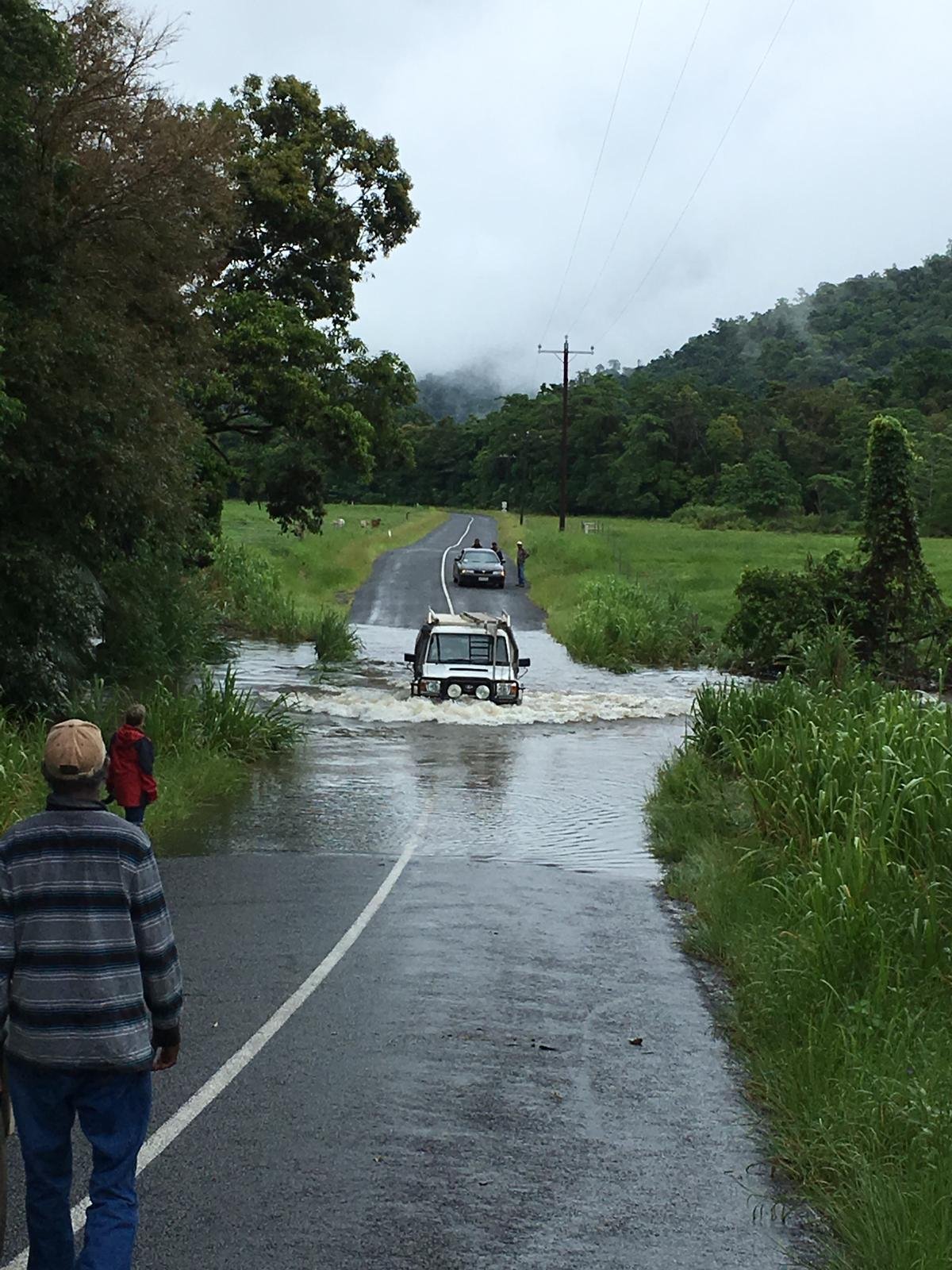
flooded road
© NCCARF
Other insurance pools
Other countries are also addressing insurance challenges linked to natural hazards through various forms of insurance pools. These arrangements often arise where private insurers are withdrawing cover or setting premiums that are unaffordable for many households.
International case studies from a 2025 report by FloodRE that highlights several common features of pools:
- participation is typically mandatory or automatically attached to property insurance, limiting the ability to opt out
- penetration rates are high, often exceeding 80%.
- most schemes include an element of solidarity, allowing risks to be distributed relatively evenly across insured parties.
- the level and form of government involvement in risk‑taking varies widely between countries.
The examples studied in the report (from France, New Zealand, Norway, Switzerland, and the United States) also illustrate different ways governments can intervene to maintain access to insurance while managing escalating climate risks.
These approaches also demonstrate that insurance pools involve distributional choices: this raises questions about equity: for instance, who pays for risk; who benefits from cross‑subsidisation?
how other countries are considering insurance and increasing climate-related extreme events.
- a CoastAdapt case study on the FloodRe UK
- an OECD blog about the role for insurance written in response to 2024 wildfires in Southern California.
Flood RE front page
Comparison table
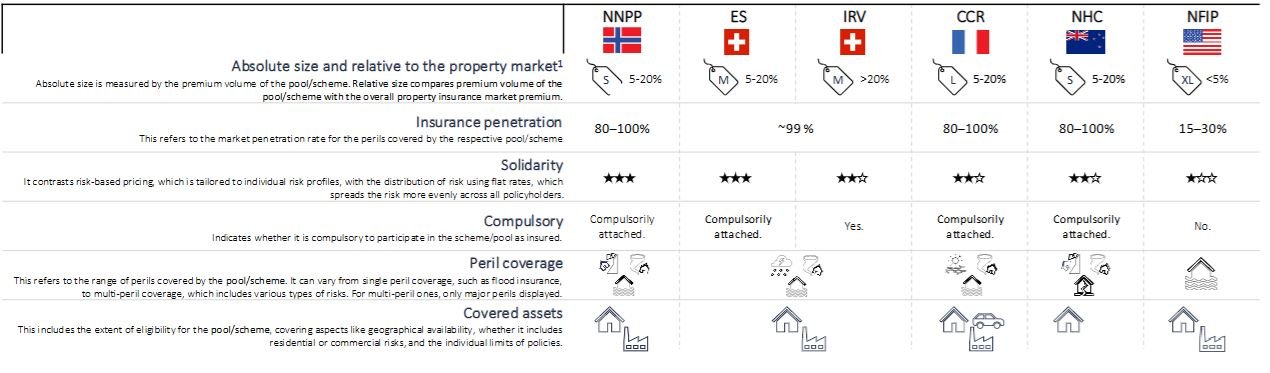
A comparative overview of six insurance pools
@ Swiss RE 2025
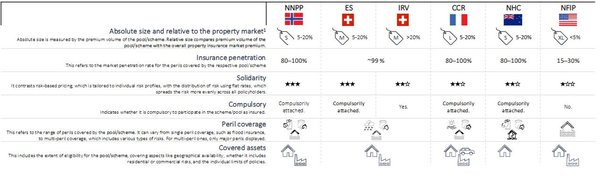
A comparative overview of six insurance pools
- @ Swiss RE 2025Comparison table
A comparative overview of six insurance pools
@ Swiss RE 2025
Understanding and communicating risk
Beyond market regulation, the Federal Government plays a key role in identifying and communicating climate-related risks, which has relevance for insurance.
In 2024, it released the first National Climate Risk Assessment, which was developed by the Australian Climate Service. This assessment provides a national evidence base for understanding climate risks and underpins the National Adaptation Plan released in September 2025.
Clear and accessible risk information is critical for adaptation, as insurance pricing and availability act as signals that influence decisions about building, rebuilding, retrofitting, or relocating.
more about National and state risk assessments
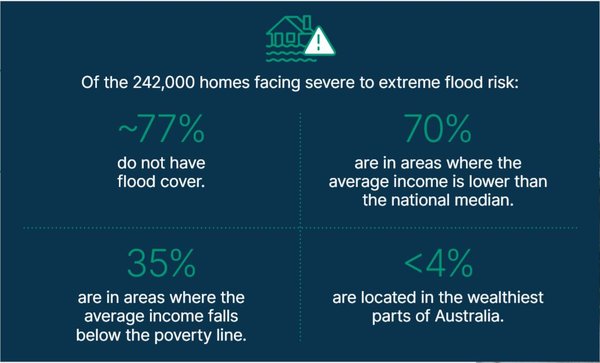
ICA analysis combined the Socio-Economic Indexes for Areas (SEIFA) deciles from their Index of Relative Socio-Economic Disadvantage, cross referenced against the National Flood Information Database.
- © Insurance Council of Australia 2025food risk infographic
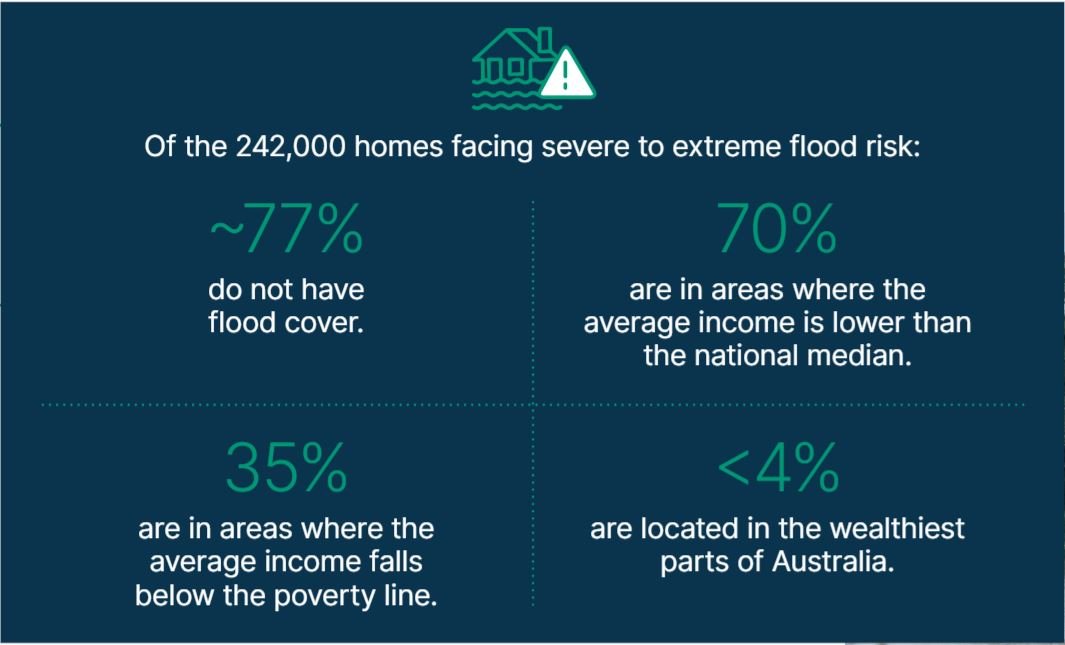
ICA analysis combined the Socio-Economic Indexes for Areas (SEIFA) deciles from their Index of Relative Socio-Economic Disadvantage, cross referenced against the National Flood Information Database.
© Insurance Council of Australia 2025
Learning from past and recent events
Public inquiries into major disaster events are another important way governments influence insurance outcomes. These inquiries help identify systemic issues and drive reform across the insurance sector.
The 2024 Flood Inquiry report Flood Failure to Future Fairness examined insurers' responses to the 2022 flood events in eastern Australia.
The inquiry identified issues such as inconsistent decision-making, prolonged claim delays, and inadequate settlements, all of which caused significant distress and financial hardship for affected policy holders.
It also highlighted a lack of standardisation across insurers, with neighbouring properties received very different insurance rulings despite being affected by the same flood impacts.
The report presented 86 recommendations that would improve practices of the insurance sector. The Insurance Council of Australia responded by endorsing 78 of the 187 combined recommendations from this inquiry and a concurrent code review.
These findings highlight the role of governments in addressing maladaptation risks, such as moral hazard and unequal outcomes, through oversight and reform.
two blog posts about insurance written by experienced coastal scientist, Bruce Thom:
- December 2023: Coastal hazards, insurance and federal powers.
- November 2024: Flood Insurance Inquiry: lessons for the coast?
The role of state and local governments
State and local governments do not have a direct role in insurance policies and premiums, but can play an important role in reducing risks and supporting householders and communities to plan for climate hazards.
Key responsibilities for state and local governments include hazard mapping and data provision, community education and awareness‑raising, mitigation activities such as building preparedness, and support for emergency services and volunteers (COAG 2011). Many of these responsibilities already sit with local councils, often with support from state governments.
These activities are especially important given the limited availability of insurance for certain hazards, such as damage caused by 'Actions of the Sea. In the absence of insurance cover, planning and risk reduction become even more critical.
- High‑quality and accessible hazard mapping helps identify the scale and timing of risks to individual properties, enabling owners to make informed decisions about risk management. Making this information readily accessible is essential, as property owners cannot respond to risks they do not understand.
- Sound land‑use planning and development controls also play a central role in reducing damage from coastal inundation, wave action, and erosion. Future losses can be reduced by measures such as development setbacks based on hazard mapping and building design requirements: for example, raised floor levels and deep pile foundations.
a report by the Insurance Council of Australia report on Actions of the Sea.
This acknowledges climate change is exacerbating coastal hazards and significant investment and government-industry collaboration is required to mitigate these risks.