


At a glance
- Effective coastal planning requires good data. High-quality, well-managed data is essential for credible, fair, and effective coastal adaptation decisions in Australia.
- Data is used across many coastal sectors. Decision-makers rely on diverse data types for hazard mapping, climate adaptation, emergency planning, environmental protection, fisheries, and community development.
- There are clear steps for responsible data use. Key practices include identifying the right data, assessing quality, using ethical and legal guidelines, cleaning and storing data securely, and crediting sources.
- Ethical and participatory approaches improve outcomes. Involving communities and respecting data ethics builds trust, supports inclusion, and leads to more durable and locally supported coastal planning decisions.

Effective coastal planning needs good data used properly
Effective coastal planning in Australia depends on using high-quality, responsibly managed datasets. By understanding what to look for, where to find it, how to evaluate and use it fairly and ethically, you improve the credibility and impact of your work, while also avoiding duplication and misuse.
about Ethical use of data for coastal adaptation

Data can be used in creative ways. The warming data for the UK were projected onto the White Cliffs of Dover in June 2023 to mark Show Your Stripes day.
- #Showyourstripes @UniofReadingShow your stripes Dover

Data can be used in creative ways. The warming data for the UK were projected onto the White Cliffs of Dover in June 2023 to mark Show Your Stripes day.
#Showyourstripes @UniofReading
Understanding data quality
a video from Canada that sets out their nation's six dimensions of data quality.
This explains the fundamentals of data quality and how these can be used to evaluate the quality of data.
Data quality is defined by the Australian Bureau of Statistics (ABS) through seven key dimensions in its Data Quality Framework. These are:
- institutional environment – trust in the organisation producing the data
- relevance – how well data meets user needs
- timeliness – speed of data availability; or the moment the data covers and the moment users can use it
- accuracy – freedom from error; how well it describes the real world it intends to represent
- coherence – over time and across sources; follows standard structures and classifications
- interpretability – clarity and ease of understanding
- accessibility – ease to discover, obtaining, and process data and related information.
These dimensions are fundamental for assessing, communicating, and improving data quality across public and private sector applications.
about Citizen science projects: data quality is often cited as a concern, however this can be managed.
Get started with data
1. Determine what kind of data you need
When defining your data needs, be clear about your planning objective and ask:
- Are you planning for erosion, sea-level rise, or infrastructure resilience?
- Do you need biophysical, social, or economic datasets, or a combination?
- What spatial and temporal scales are relevant (e.g., shoreline segments, decadal trends)?
- Are you assessing vulnerability, risk, or adaptive capacity?
2. Seek to use existing data
Reusing existing, high-quality datasets provides many benefits for coastal planning:
- It can avoid duplication of effort: Using existing datasets avoids reinventing the wheel, especially for commonly studied coastal indicators like sea-level rise or coastal land use.
- It can reduce over-surveying of vulnerable populations (people and ecosystems: by reusing datasets rather than conducting additional (perhaps redundant) surveys, you help avoid overburdening vulnerable populations or sensitive ecosystems.
- There is the opportunity to enhance your data with demographic, temporal or geospatial layers, which can create richer and more multidimensional insights. For example, overlaying city heat maps with demographic data can highlight vulnerable populations for specific interventions.
- It is useful to establish a benchmark for monitoring. Historical datasets provide a baseline to compare your own data collection results for detecting change, for example, in shoreline retreat or wetland loss over time.
- It can facilitate interdisciplinary research: for example, combining ecological, hydrological, and social datasets supports a systems approach to coastal issues.
- It can enable innovative use. Datasets can be recombined in useful ways,
- It can provide access to rare data. For example, data that is possible to collect only once, such as temporal or event data in astronomy, climatology, or geology.
3. Evaluate data for suitability and reliability
Evaluate existing data to determine if it is reliable, relevant and fit for purpose. Read accompanying information and manuals to consider the following.
- Who produced it? Is the data source trusted (created by government, research organisation etc.). Avoid datasets with unknown or non-transparent origins.
- Does the dataset have clear documentation that is detailed enough for you to assess its quality and limitations. Good datasets include metadata describing collection methods, scale, resolution, units, quality assurance, and limitations.
- Are the methods sound? Confirm if the collection methods (e.g. remote sensing, field surveys, modelling) are appropriate and acceptable.
- Is the resolution and timeframe appropriate? A dataset might be accurate but unsuitable due to the characteristics, timeframes and models used.
- Are they appropriate and relevant for your use, or do they have mismatched temporal or spatial scales?
- Are limitations explained? Any missing data, data coding or modification should be documented sufficiently. Appropriate metadata should be available and explain the 'who, what, when and why' the dataset was created.
- Can you integrate it? Consider format and structure of the data is suitable for use, including software and integration with other data. Is it compatible with your tools (e.g. GIS, statistical software). Look for machine-readable formats like CSV, GeoTIFF, NetCDF.
- Are there restrictions on using the data: are there legal or ethical constraints? Usage rights and access restrictions must be reviewed before you undertake any analysis.
4. Use data responsibly and ethically
about Ethical use of data for coastal adaptation
Practical steps to use data ethically include:
- Understand usage licences and read terms of use carefully to ensure you follow them. Most Australian government data uses Creative Commons attribution (CC BY) licenses)
- Acknowledge through correct attribution: credit datasets in all outputs – reports, maps, models – with source name, year, and a persistent link.
- Only collect and share data that is necessary for the intended purpose.
- Store securely: use institution-approved cloud platforms or servers that comply with data privacy and retention standards.
- Avoid re-identification: de-identified datasets (especially social data) must not be re-identified so it can be traced back to a specific individual or identity. Assess the context in which it might be shared or used to determine the risk of re-identification.
- Apply for restricted access: some datasets require approval before access – such as aerial photography from Geoscience Australia, or culturally sensitive Indigenous data.
about CARE principles for Indigenous data, which requires cultural sensitivity.
5. Prepare or 'clean' the data
Raw datasets often require preparation before they can be used for analysis.
This involves:
- cleaning: remove duplicates, standardise units, handle missing values, check for outliers
- transformation: convert data formats, project spatial data, aggregate by time or location.
Follow data cleaning best practices to maintain traceability and ensure robust analysis.
Ensure that you keep a log of your steps in cleaning and transformation steps as this supports reproducibility and audit trails.
There are a number of tools you can use including:
- R/Python (Pandas) for cleaning and statistical transformation.
- QGIS/ ArcGIS for spatial data manipulation and visualisation.
about confidentiality of data in the Australian Bureau of Statistics Data confidentiality guide
6. Manage and store the data
Keep a master copy of datasets created or acquired in a separate folder. Do this also for any data with major changes such as cleaned data, processed or analysed data. This will ensure data at any stage is available to return to in case of loss, corruption or the need to verify processes undertaken.
Store data in secure, shared storage within your organisation's secure cloud or network environment to enable back-up, access by collaborators and to minimise data loss or corruption. If this isn't possible, create a regular back up of the data and save it in another secure location or device.
Note that Dropbox and Google Drive are not necessarily secure and often the data is stored overseas. These services may not meet the requirements of some data owners that share data with organisations.
7. Cite and credit data sources
Data creators need to be acknowledged, and crediting them builds transparency and trust.
Government and research data is protected by copyright law and requires permission to reuse and credit to be provided.
To encourage reuse, most open government data in Australia is made available under Creative Commons licenses, providing clear reuse and credit guidance. See Geoscience Australia's copyright notice and Climate Change in Australia's terms and conditions for examples.
It is common to provide credit and a link to the data used in works, such as advice, reports, fact sheets and publications. This enables the reader to verify the source and increases transparency and trust in the work. Credit can be as simple as including the name of the data source, year and a URL link e.g. Geoscience Australia, 2024. https://www.ga.gov.au.
Or for publications, a full reference is required such as this example from a Geoscience Australia dataset (and note the date you accessed it as the content may change over time).
- For eample: Peljo, M., Tan, K., Symington, N., DeGraaf, R., Ross Spulak (2024). EFTF Upper Darling Floodplain Downhole and surface geophysics data release. Geoscience Australia, Canberra. https://dx.doi.org/10.26186/149480 accessed dd/mm/year.
FAIR principles for managing data
The FAIR principles – Findable, Accessible, Interoperable, and Reusable – for data management aims to provide a framework for sharing data in a way that maximises its use and reuse.
- Findable: Data should be easily located by both humans and machines. This involves assigning persistent identifiers and rich metadata to datasets, ensuring they are indexed in searchable resources.
- Accessible: Once found, data must be retrievable using standardized protocols. This includes clear usage licenses and, where necessary, authentication and authorization procedures to access the data.
- Interoperable: Data should be compatible with other datasets and tools. This requires the use of standardized vocabularies and formats, facilitating integration and analysis across different systems and disciplines.
- Reusable: Data must be well-described and documented to allow replication and combination in future research. Clear licensing and provenance information are essential to ensure data can be reused appropriately.
FAIR data
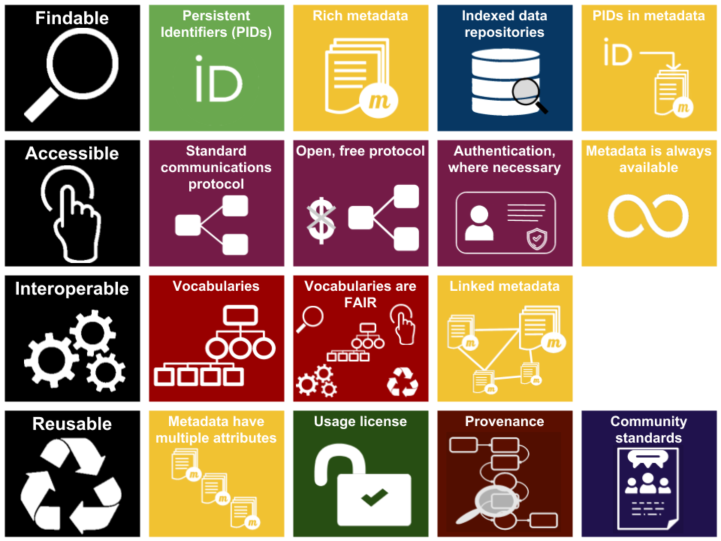
FAIR principles for data management
CC-BY except F.A.I.R logos, CC-BY-SA by Sangya Pundir
FAIR principles for data management
- CC-BY except F.A.I.R logos, CC-BY-SA by Sangya PundirFAIR data
FAIR principles for data management
CC-BY except F.A.I.R logos, CC-BY-SA by Sangya Pundir
Australian Research Data Commons offers support
Australian Research Data Commons (ARDC) is Australia's research data infrastructure facility and offers several tools and resources, including the ones below and many more.
- FAIR data training: Offers free online courses and materials to educate researchers and data managers on FAIR data practices.
- FAIR data self-assessment tool: Allows users to evaluate the FAIRness of their datasets and provides recommendations for improvement.
- Guide on good data practices: Outlines effective strategies for managing research data throughout its lifecycle.
Using data to collaborate (and build better datasets and connection)
Collection, deliberation and use of data can be a powerful community participation tool in coastal planning, enabling more inclusive, transparent, and locally relevant decision-making: community-engaged data collection and sharing enhances trust, strengthens planning outcomes, and fosters long-term stewardship of coastal environments.
Community‑engaged data collection and use can be a powerful participation tool in coastal planning, supporting more inclusive, transparent, and locally relevant decision‑making.
There are now several Australian studies that demonstrate approaches such as participatory GIS, social mapping, and citizen science enable communities to articulate place‑based values, priorities, and local knowledge that are often overlooked in technical assessments. When communities are involved in collecting and deliberating over data, trust in planning processes increases, information asymmetries are reduced, and planning outcomes are better aligned with community aspirations and environmental realities.
Research also demonstrates that participatory data practices strengthen long‑term stewardship of coastal environments. By contributing to monitoring, mapping, and shared datasets, communities develop a sense of ownership over outcomes and are more likely to remain engaged beyond formal planning processes.
a case study about participatory GIS that shows how different types of knowledge can be drawn together to better reflect local values, aspirations and priorities (in prep).