


At a glance
- Local governments are central to climate adaptation, with councils leading diverse initiatives, from infrastructure upgrades to community education, to address climate risks and build resilience.
- Economic modelling shows strong returns on adaptation investment: adaptation actions are found – in the report Adapting Together 2025 – to deliver between $0.80 and $3.10 in community benefits for every $1 spent, highlighting the value of sustained funding.
- Local councils have an important role to play in reducing emissions, building resilience, and advocating for stronger climate policy. These tasks are outlined in ALGA's Climate Review 2024 provides an overview of climate action by local governments across Australia.

Peak body: the Australian Local Government Association
The Australian Local Government Association (ALGA) is the national voice for Australia’s 537 councils, working through a federated network of state and territory associations.
Established in 1947, ALGA represents local governments to influence national policy and priorities, and drive outcomes across the country. It's broad aim is to ensure that 'the role of local councils is recognised, respected and sustainably resourced'.
IMG_3615
ALGA's recent reports on climate and local government
ALGA covers the many issues that are relevant for local governments across Australia. Below are the most recent ones.
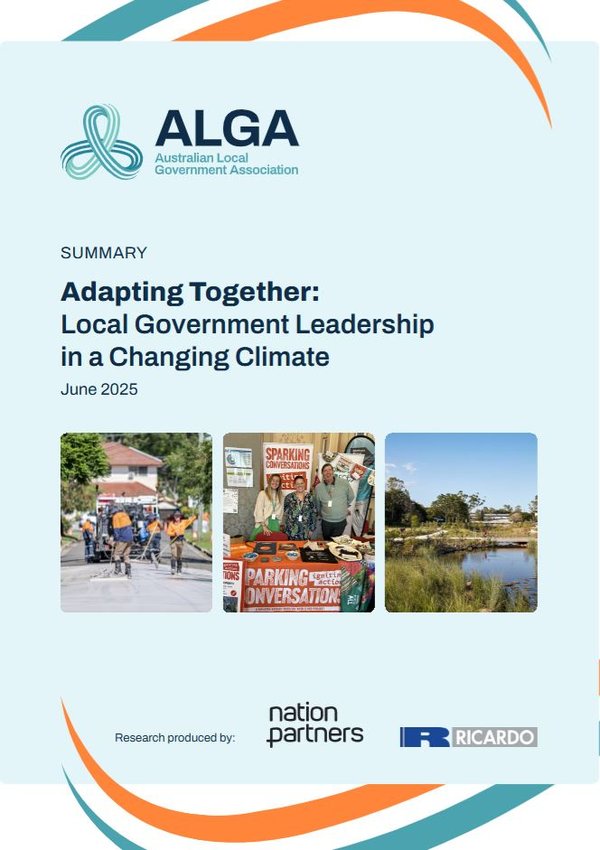
2025 Report: Adapting Together: Local Government Leadership in a Changing Climate
Australia’s local governments are on the frontline of climate change. Councils already experience more frequent disasters, rising heat, and sea level rise. While challenges differ across the country, councils share a commitment to keeping communities safe, healthy, and resilient.
This report, Adapting Together: Local Government Leadership in a Changing Climate (2025), outlines how councils lead on climate adaptation, the value of their work, and the benefits of supporting it for the nation. More than 200 examples of local government action were reviewed along with economic modelling of five case studies.
Climate change has impacts across all aspects of local government operations. Councils manage local infrastructure, deliver community services, plan land use, and play a central role in emergency management.
As the level of government closest to the community, councils understand local risks and opportunities. Their local knowledge means councils are vital for achieving national adaptation goals and protecting systems of national importance, including health, infrastructure, the natural environment, and even national security.
Adaptation is about rethinking and evolving how decisions are made, so that council operations and investments are resilient to climate impacts.
Councils already integrate climate considerations into planning, service delivery, and community programs. If climate change is not factored into council work, the financial risks and community costs will only grow.
Key findings reported
- Local governments are indispensable in adapting to a changing climate. They play a critical role in supporting the systems we value nationally, such as our infrastructure, health, natural environment, and emergency management.
- Climate change adaptation is the ongoing process of evolving how we make decisions so that we can cope with the expected impacts of climate change. This research takes a snapshot of actions to show how local governments are doing this to benefit their communities.
- Economic modelling of five case studies provided conservative estimates of local government adaptation actions delivered benefits of between at least $0.8 and $3.1 per $1 of investment. Cost-benefit analysis in respect to climate adaptation refers to avoided costs and benefits gained, not financial return.
- When modelled at the national scale, continued local government spending on adaptation at these levels would equate to at least $400 million per year, or $2 billion invested in the five years to 2030. This $2 billion investment is estimated to benefit local communities by between $2.2 and $4.7 billion in that period.
- These benefits are on top of those derived from councils factoring climate considerations into core council decision making – which are difficult to quantify.
- There is critical need for ongoing funding for local governments to incorporate climate considerations across all council work with their communities.
- Secure, ongoing funding for councils will generate the best national return on investment for adaptation expenditure. Larger projects currently rely on short-term funding which is inefficient and undermines capacity building.
ALGA, 2025
Types of adaptation actions taken by councils
The report found that a range of strategies were used by councils to address climate change impacts on their communities and operations.
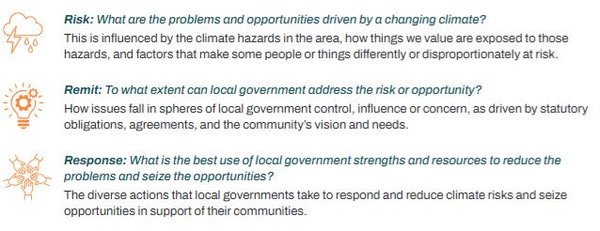
ALGA 2025_risk remit

Local government approaches relate to considerations of the risk, their remit, and the most effective response.
© ALGA 2025
Local government approaches relate to considerations of the risk, their remit, and the most effective response.
- © ALGA 2025ALGA 2025_risk remit
Local government approaches relate to considerations of the risk, their remit, and the most effective response.
© ALGA 2025
Councils are taking diverse approaches, which fall into several categories:
- Governance and planning (44%): e.g., City of Onkaparinga (SA) - Climate change risk assessment and climate response plan that guides decision-making across all council functions.
- Physical and technological measures (29%): e.g., City of Cockburn (WA) - C.Y. O’Connor Artificial Reef was installed to reduce coastal erosion has reduced wave force and wave height while providing new habitat for ocean life.
- Knowledge, behavioural and cultural change (24%): e.g., Northern Rivers councils (NSW) - Tackling Mosquitos Together, which involved a coalition of councils developed a behavioural change program aimed at reducing residents’ risk from mosquito-borne illnesses exacerbated by a warming climate.
- Regulatory, economic and financial measures (5%): e.g. City of Darebin (VIC) - Solar Savers, which helps low-income households access solar energy through an innovative financing model.
more adaptation actions in the Australian Adaptation Database developed by the NESP Climate Services Hub
Economic value of local government adaptation
'The most important value that councils deliver for national adaptation is their knowledge of communities, uniquely positioning them to broker collaboration and support those most susceptible to impacts.
© ALGA 2025: Adapting Together. Summary report, p.6
Economic modelling of five case studies showed that local government adaptation delivers between $0.8 and $3.1 of community benefit for every $1 invested. These benefits include avoided property damage, reduced healthcare costs, improved wellbeing, and enhanced environmental outcomes.
At the national scale, councils are estimated to be spending at least $400 million annually on adaptation – totalling $2 billion by 2030. This investment is projected to deliver between $2.2 and $4.7 billion in benefits. The largest share of benefits (up to 85%) comes from reduced fatalities and health costs during extreme heat.
However, much of this work is dependent on short-term and uncertain funding. ALGA is calling for a dedicated $400 million per year national Adaptation Fund to provide councils with the certainty to plan long-term, deliver larger projects, and build capacity. Secure and ongoing funding would more than double the benefits of local government adaptation by enabling:
- more effective planning and targeted actions
- greater efficiency and reduced delivery costs
- increased skills and capacity in councils
- reduced risks to project success and stronger benefit-cost outcomes.
ALGA - economic benefits table

The ALGA 2025 report revels the costs of adaptation revealed through the five case studies in this report.
© ALGA 2025, p.6

The ALGA 2025 report revels the costs of adaptation revealed through the five case studies in this report.
- © ALGA 2025, p.6ALGA - economic benefits table
The ALGA 2025 report revels the costs of adaptation revealed through the five case studies in this report.
© ALGA 2025, p.6
the report Adapting Together: Local Government Leadership in a Changing Climate 2025.
- Summary
- Full report
- the webinar about the report in June 2025
ALGA report summary2025

© ALGA 2025: Adapting Together. Summary report.
ALGA report summary2025
© ALGA 2025: Adapting Together. Summary report.
Report: Australian Local Government Climate Review 2024
ALGA's Climate Review 2024 provides an overview of climate action by local governments across Australia. Primarily it highlights the role of councils in reducing emissions, but also covers building resilience, and advocating for stronger climate policy.
Community groups are vital partners, driving advocacy and local initiatives. Councils are encouraged to support these groups through funding, collaboration, and inclusive engagement, especially with First Nations communities.
The report recommends stronger collaboration between local, state, and federal governments, including recognition of council contributions to national climate targets. It advocates for strategic alignment, long-term funding, and shared governance to accelerate climate action.
the report Australian Local Government Climate Review 2024.
Review_cover 2024
© ALGA 2024: Climate Review

Review_cover 2024
© ALGA 2024: Climate Review
This review – based on survey responses from 120 councils and 64 community groups – aligns with national sectoral plans and outlines council actions across energy, transport, waste, agriculture, and industry. Councils are leading in areas such as renewable energy procurement, electric vehicle infrastructure, and waste diversion. However, many lack resources to monitor and evaluate progress effectively.
Local governments are responsible for 1.5% of national emissions but influence up to 29% of Australia’s emissions through community-wide initiatives.
© ALGA 2024: Climate Review.
Local governments have a critical role to play in Australia's transition to net zero. Most councils have set corporate and community emissions reduction targets, with many aiming for net zero by 2030. Key barriers include funding, staff capacity, and access to data and expertise.
Councils are central in preparing for, responding to and recovering from extreme events as local communities are increasingly affected by bushfires, floods and storms. Yet most report feeling ill-prepared. The review calls for improved multilevel governance, consistent climate risk frameworks, and dedicated funding to support adaptation and resilience.
Community groups are vital partners, driving advocacy and local initiatives. Councils can play an important role in supporting these groups through funding, collaboration, and inclusive engagement, especially with First Nations communities.
The report also includes infographics developed by the Climate Ready Institute that present key legislative and policy frameworks for climate adaptation in Australia. Note that these were developed in late 2023 and there are likely to be changes in legislation since then.