


At a glance
- ICOLLs are coastal estuaries that alternate between open and closed states, separated from the ocean by a sand berm; this dynamic makes them highly sensitive to environmental changes and challenging to manage.
- They are most common in NSW and Victoria, but are also found in Queensland and Western Australia
- Each ICOLL is unique in morphology, salinity, and ecology, supporting diverse species adapted to fluctuations in water levels, salinity, dissolved oxygen (DO), and a variety of other physical and chemical parameters.
- ICOLLs spend most of their time closed (around 70%), leading to long water residence times, nutrient build-up, potential algal blooms, and the possibility of becoming stratified with low levels of DO in sections of the ICOLL.
- Management is complex, requiring a balance between flood risk reduction, ecological health, and community expectations.
- They are highly vulnerable to climate change impacts.

Coastal lagoons that are mostly closed but sometimes open
Intermittently closed or open lakes and lagoons (ICOLLs) are a type of coastal estuary that alternates between being connected (open) or disconnected (closed) to the ocean. This intermittent opening distinguishes them from other types of estuaries, making them more complex to manage and more vulnerable to impacts of climate change.
Every ICOLL is unique in morphology, varying in the size of the catchment, the lagoon, the sandy barrier or berm.
The entrance of an ICOLL may shift, become narrow and close completely. This occurs due to sediment dynamics: waves deposit sand while streams and tides redistribute it.
Every ICOLL is also unique in terms of the salinity of water, which can vary from being fresh to brackish to hypersaline, depending upon the amount freshwater, the climate and how long and frequently it is open.
The ecology of ICOLLs is similar to estuaries but is also influenced by the shifts between being open and closed. They may support diverse communities of fish, invertebrates, aquatic plants, and birds, and provide critical nursery habitats for species that move between marine and estuarine environments. Fluctuations that accompany being open and closed may also shape unique adaptations among resident species, allowing survival under swings in salinity and DO that typically shape ICOLLS.
Where to find an ICOLL
ICOLLs are found along wave-dominated coastlines that have low estuary flow and small tidal range. In Australia, ICOLLS are found from southern Queensland, New South Wales, to Victoria.
In NSW, there are about 135 estuaries that drain to the sea: about half (70) are ICOLLs and most of these are located in southern NSW where estuaries tend to be smaller.
more details about NSW ICOLLs, including their how they are classified into different types.
In Victoria, ICOLLs are located in the south east of the state. ICOLLs are also found in southern Queensland, south-west Western Australia, and some parts of Tasmania, but are much fewer than in NSW.
how Victorian ICOLLs are classified into different three types, which influences management strategies (Sweeney et al. 2017).
ICOLLs are also found in southern Queensland, south-west Western Australia, and some parts of Tasmania, but are much fewer that NSW.
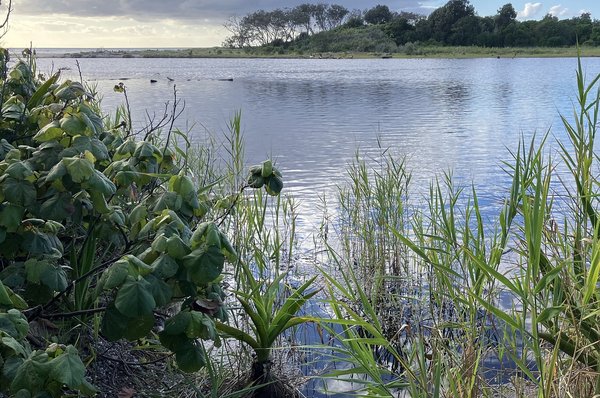
A closed Tallow Creek- one of three ICOLLs in the Byron Shire
- © NCCARFtallow ck sml
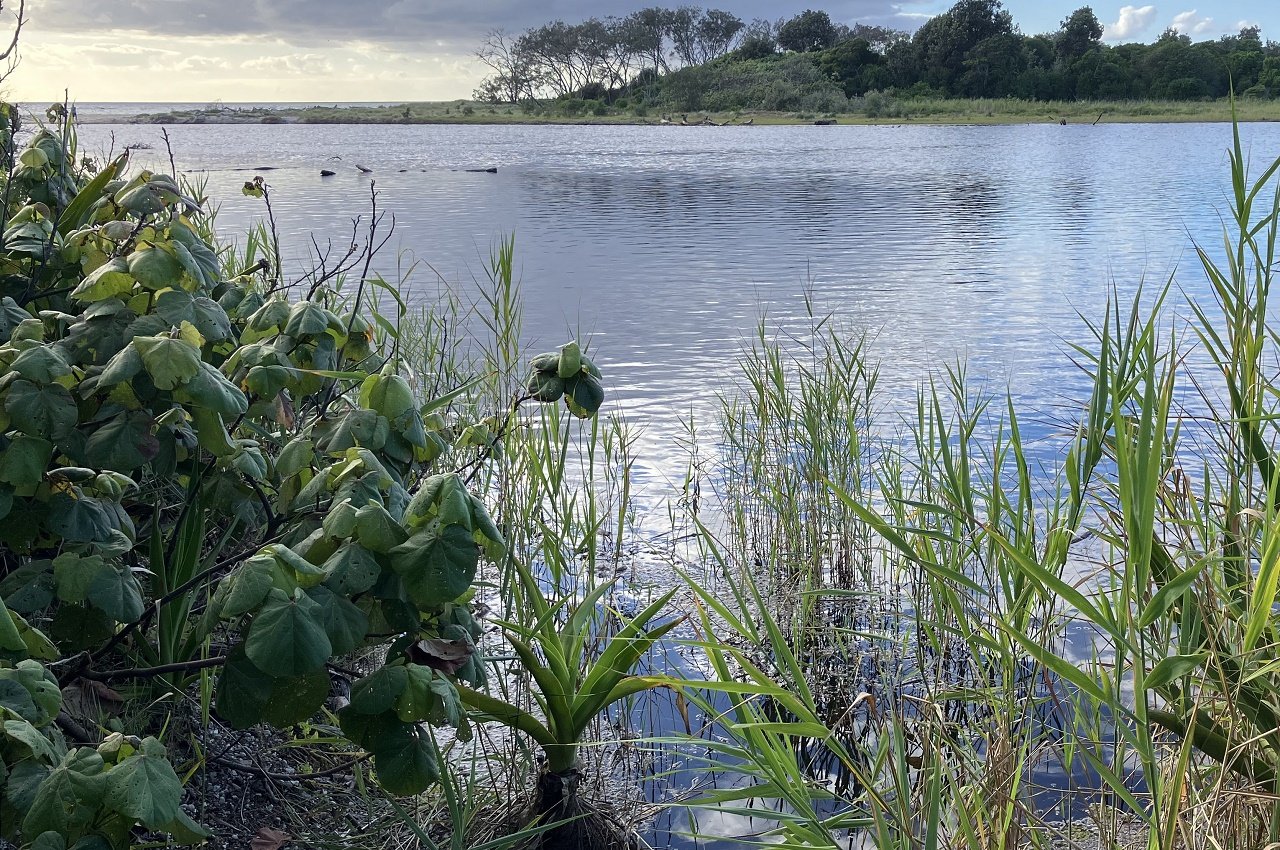
A closed Tallow Creek- one of three ICOLLs in the Byron Shire
© NCCARF
Challenging to manage
Management of ICOLLs require careful consideration of environmental health, community expectations, and financial and safety implications.
Setting triggers for the artificial opening of an ICOLL involves balancing multiple factors. Managers must weigh the need to reduce flooding risks to homes, roads, parks, sewage systems, and aquaculture infrastructure against potential ecological and environmental impacts such as the loss of wetland habitat and potential fish kills.
Other concerns include long-term changes from sand entering the system, community complaints about water quality or odours, and the high costs of mechanical interventions like dredging. There is also a risk that people become complacent, assuming entrance management will always protect property during floods, which may not happen.
ICOLLS - opening and closing is key
When closed, ICOLLs are separated from the ocean by a sandy barrier or berm. The berm is constantly being reshaped by natural forces such as waves, tides, flood flows, and wind, which redistribute sand and sediments.
When rainfall in the catchment leads to high water levels in a closed ICOLL, it can lead to localised flooding around the ICOLL itself or upstream in the lower catchment – which is part of the build-up of water being sufficient to force an opening. When the berm at the mouth of an ICOLL builds up, the closed ICOLL may become susceptible to flooding and may affect public assets such as parks, roads and other built structures, and potentially private properties such as houses or business premises or farmland, as well as.
Sudden openings (either natural or artificial, but more likely from artificial) can cause rapid changes in salinity, turbidity, and water levels. These can trigger ecological shocks stressing fish, invertebrates, and plants. At their worst, a sudden opening can lead to fish kills (which are named for the dramatic images of dying fish, but are not just limited to death of fish but also other more cryptic critters.
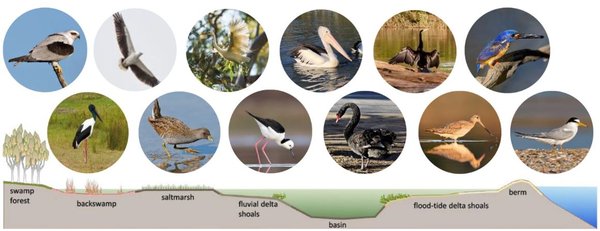
Birds of ICOLLS typically found in NSW.
Little is known about the effects on birds of opening ICOLLs. Some species, like waders, may benefit from more frequent openings, while others that need flooded wetlands may lose out. Over time, changes of habitat changes, such as the loss of saltmarsh, could impact birds.
Birds of ICOLLS DPIE

Birds of ICOLLS typically found in NSW.
Little is known about the effects on birds of opening ICOLLs. Some species, like waders, may benefit from more frequent openings, while others that need flooded wetlands may lose out. Over time, changes of habitat changes, such as the loss of saltmarsh, could impact birds.
© DPIE 2021. CC BY 4.0.
More time closed than open
ICOLLs tend to spend more time closed than open. Estimates in NSW are they are closed for approximately 70% of the time.
When closed, they often have long water residence times, strong stratification of temperature, DO and shallow depths, making them sensitive to environmental changes. Being closed for long periods can affect the water quality: with limited input of new water, the isolation can lead to nutrient build-up which may lead to algal blooms and low DOlevels.
When opening occurs naturally
Opening of an ICOLL may occur naturally after heavy rain. With heavy rainfall from the catchment, water levels rise and if high enough, forces the water to spill over the sand berm. This force rapidly scours open the mouth to reopen the ICOLL. Once open, sea water comes and goes in the estuary with the tides.
Closure of the ICOLL occurs once ocean waves and tides gradually push sand into the opening to seal the channel, recreating the berm and closing off the estuary mouth until next time.
When rainfall in the catchment leads to high water levels in a closed ICOLL, it can lead to localised flooding around the ICOLL itself or upstream in the lower catchment – which is part of the build-up of water being sufficient to force the opening. Often flooded are private properties such as houses or business premises or farmland, as well as public assets such as parks, roads and other built structures.
When opening is forced
ICOLLs may be opened artificially, which can occur in a managed or unmanaged way. Artificial openings can prevent extreme water quality issues and fish kills but also may disturb natural flooding and drainage patterns, disrupt fish and invertebrate life cycles, and affect shorebird habitats.
Frustration about this flooding amongst local property owners can lead them to artificially open the mouth – often by digging a trench – to allow the backed-up water to drain out to sea. This is an unmanaged opening, and it is illegal.
“residents living near the ICOLLs can often be found complaining in local social media groups of flooded yards and infrastructure after prolonged or heavy rain when the creeks are slow to open to the sea."
The Echo newspaper 29 January 2024
In most jurisdictions, Councils have the authority to open an ICOLL in their local government area if there is a risk or to public health or safety due to flooding or to poor water quality. Councils require approvals from the State and need to notify various authorities before they undertake the associated works.
Heavy equipment such as excavators are used to open ICOLLs by digging a predominately central channel through the entrance barrier to the ocean. This is an expensive process.
Artificial opening needs to be managed carefully, taking into consideration tides, swell and rainfall conditions. Not getting this right can result in fish kills.
about how some NSW councils describe their ICOLL management
- Coffs Council's management of ICOLLs including triggers for artificial opening
- Byron Shire Council's management also describes what does not trigger an opening.
a case study from Cape Byron Marine Park that provides practical tips for coastal managers on artificial openings of ICOLLs.
Impacts of climate change
ICOLLs are considered highly vulnerable to climate change, impacts, especially sea level rise and storm surge, changes in rainfall patterns and sedimentation, increased in water temperature and acidification as well as increased polluting effects from bushfires. They are also likely to experience effects due to urban settlements and changing settlement patterns.
These changes, individual and compounding, highlight the need for careful management and more research on how sea-level rise and climate extremes will impact ICOLLs.
Sea-level rise
Sea-level rise will change how ICOLLs function. As ocean levels rise, the sand berm at the entrance will also rise and move landward, causing higher water levels inside ICOLLs and more flooding of low-lying areas and wetlands. These wetlands may drown, build up sediment to keep pace with rising seas, or shift upslope. While sea-level rise will affect flooding from catchment runoff, studies show the increase in flood levels is small compared to the rise in sea level and mostly affects the entrance area, not the main basin.
The sand delta at the entrance may also rise with sea level if enough sand is available, but this will happen slowly. Until then, tidal range and water exchange may increase when the entrance is open.
Rainfall and sedimentation
Climate change will also bring more intense rainfall events, even though overall annual rainfall may decrease. This means ICOLL entrances could stay closed longer during droughts but open suddenly during heavy rain.
Changes in storm patterns, like East Coast Lows, may also affect entrance dynamics, with fewer moderate storms but possibly more extreme summer events.
Fluctuations in rainfall will also affect the sediment patterns through sediment flow from the catchment.
Warming and acidification of waters
As climate change leads to increased water temperature, this will increase stratification or lack of mixing of surface and bottom layers. This reduces levels of DO in deeper water, which can lead to fish kills and poor water quality, especially when the entrance is artificially opened and there is a rapid draw down of the oxygenated surface waters. Higher temperatures also speed up nutrient cycling and encourage algal blooms, which can harm ecosystems.
Acidification, caused by more carbon dioxide in the water, lowers pH and reduces carbonate needed by shell-building animals like molluscs and crustaceans. These species are common in ICOLLs and are important for the food web.
Acidification can also change sediment chemistry, releasing nutrients and metals into the water. This can make water quality worse and increase toxicity risks for aquatic life.
Impacts on and from human settlements
Urban development already reduces buffer zones like wetlands and riparian vegetation that help to filter pollutants and absorb flood waters. Responses to flooding often result in further hardening of surfaces, such as stormwater systems and levees or seawalls, which alter natural flows and so reduce sediment supply or increase pollutant and nutrient inputs.
Further reduction in natural buffers – through increasing encroachment of urban areas – will reduce water quality and limit resilience to flooding and sea-level rise.