


At a glance
- Groundwater is essential for Indigenous communities, agriculture, industry, and drinking water, especially in dry regions.
- Its flow and quality are influenced by tides, waves, geology, salinity, and human extraction, making it difficult to measure and manage.
- Over‑extraction, climate change, and contamination threaten groundwater availability and can cause issues such as saltwater intrusion in coastal areas.
the full report Coastal groundwater and climate change

What is groundwater
Groundwater is water that flows through the sediment and rocks under the ground. It comes from rain that seeps into the ground to be stored below the water table in the pores and fractures of rocks. It is stored there, but eventually it filters into a river, lake or sea: a process that can take millennia. The type of rock it passes through affects its chemical makeup and how easy it is to access.
Groundwater is hard to see, expensive to measure and, due to complexity and spatial variability in geology, difficult to understand and challenging to simulate.
Groundwater is a valuable resource
Over millennia, Australian Indigenous peoples have adapted and survived through a deep knowledge of how to find and manage water across various landscapes under complex cultural lore. Groundwater, particularly in arid areas, remains central to their physical, spiritual and cultural wellbeing.
In contemporary Australia, especially in drier inland regions, groundwater is used for irrigation by agriculture, cooling and processing by industry, and as drinking water for rural communities. Both water quality and how much can be extracted (its yield) determine whether groundwater is suitable for uses like drinking, farming, or industry. Much of Australia has experienced increasing pressure on groundwater resources due to a drier climate and increased scarcity of surface water.
Broadly, groundwater is heavily regulated by state and national frameworks that aim to control extraction, ensure sustainable use and protect ecosystems. However, limited investment in monitoring and management has led to excessive licensing and, in some cases, over-extraction, worsened by unmetered use, low or no-cost access, and management plans that ignored groundwater–surface water connectivity.
Poor management, particularly during droughts, can lower water tables and have environmental impacts through reduced river flows and stressed ecosystems.
of the Ten New Insights in climate science prepared by Future Earth
#5; Declining groundwater levels: Climate change is accelerating groundwater depletion, increasing risks to agriculture and urban settlements.
Ospina et al. 2025
Groundwater at the coast
The flow of groundwater
Fresh groundwater tends to discharge at the coast via several mechanisms. These include evapotranspiration, mixing with saline groundwater to form a subsurface region of brackish water; and direct seepage through wetlands, springs, tidal rivers and the ocean floor.
However, at the local scale, the flow of groundwater near a waterbody may vary. Groundwater levels and resulting groundwater flow vary in response to natural factors such as rainfall and the rise and fall of the tides, waves, and human factors such as groundwater pumping and irrigation.
Where groundwater interacts with brackish waters, such as within a wetland, the density difference between fresh and saline waters will also help to drive groundwater flow, with fresher water tending to move over the top of more saline waters.
The influence of tides and wavves
A groundwater system and its connected water bodies can be affected by ocean tides and waves, much like an estuary or tidal creek. These tidal and wave actions create both cyclic and irregular water flows within the groundwater system and any linked inland water bodies. Additionally, tides and waves function like a pump, raising the groundwater table above the average water level of the ocean or estuary.
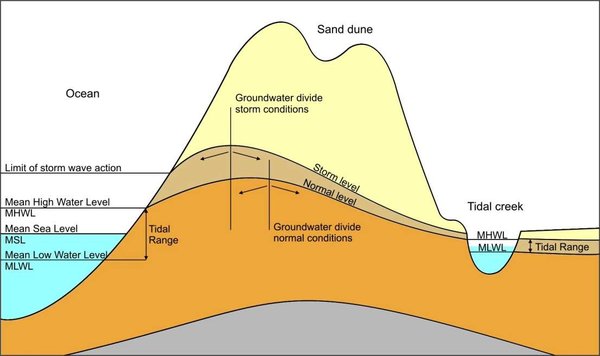
Elevation of coastal groundwater by tide and wave action
- © Water Research Laboratory, UNSW.coastal groudwater
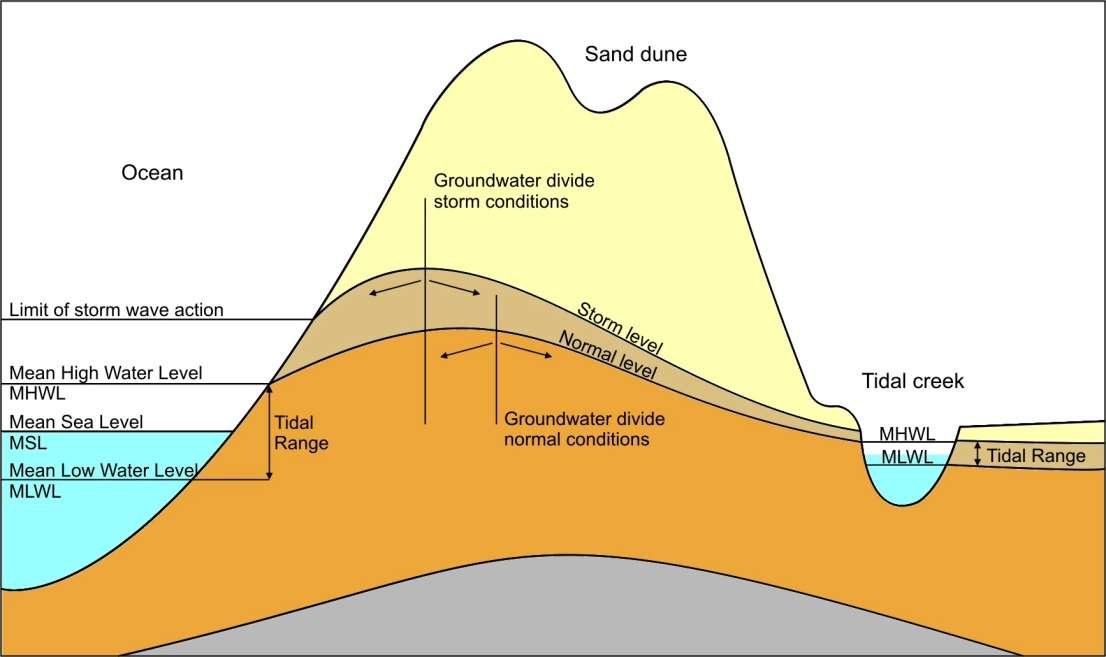
Elevation of coastal groundwater by tide and wave action
© Water Research Laboratory, UNSW.
During low tide, the groundwater level around a tidal water body can be higher than the water level within it, causing groundwater to flow out through the banks and base into the water body. Conversely, at high tide, the water level in the tidal body may rise above the surrounding groundwater, pushing water back into the groundwater system. Because of this dynamic, groundwater levels near tidal waters often fluctuate in sync with the tides or react to coastal storms. However, since groundwater moves slowly through soil and rock, these tidal fluctuations diminish quickly as you move further from the water’s edge.
Additionally, further from the bank, changes in groundwater levels tend to lag behind the tide by several hours. To accurately assess the average groundwater level around a tidal water body, monitoring should be conducted at multiple tide stages and ideally during both neap and spring tide cycles.
The influence of saltwater
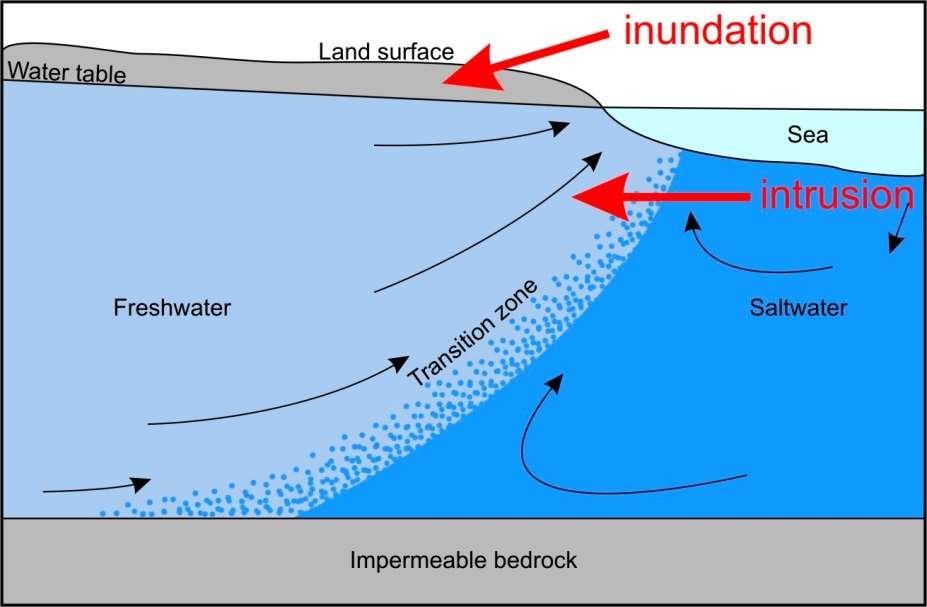
The regular rise and fall of water levels in bodies like oceans, estuaries, or saltwater wetlands plays a crucial role in the surrounding groundwater system. This tidal movement influences how nutrients and contaminants exchange between surface water and groundwater. Tides help mix fresher groundwater flowing toward the coast with the saltier or brackish water moving into the groundwater from the water body. Without tides, the lighter fresh groundwater would simply flow over the denser saline groundwater, which would remain much deeper underground.
For example, if the water table next to a coastal water body were 1m above its base, and there were no tides, the boundary between fresh and saline groundwater would settle about 40m below the surface. However, tides and waves cause significant mixing along this interface, allowing brackish groundwater to be found at much shallower depths. This tidal mixing can increase groundwater salinity near the water body but also creates pathways for contaminants to move into or out of the groundwater system.
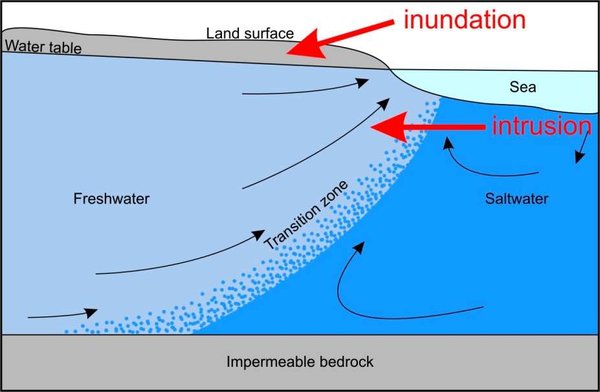
Idealised theoretical position of the salt water interface.
- © Water Research Lab, UNSW: Timms et al., 2008.saltwater interface
Idealised theoretical position of the salt water interface.
© Water Research Lab, UNSW: Timms et al., 2008.
Under natural conditions, the flow of fresh groundwater toward the ocean helps prevent seawater from moving inland. However, when groundwater is extracted from an aquifer connected to a saltwater source - such as a saltwater wetland - this can alter the flow patterns and cause seawater to move into the freshwater aquifer. This process, where saltwater advances into freshwater zones, is called saltwater intrusion.
Saltwater intrusion is a growing concern along many Australian coasts, where over-extraction of groundwater and rising sea levels are pushing seawater into freshwater aquifers. This threatens vital freshwater supplies, especially in vulnerable coastal communities and agricultural areas, highlighting the need for careful water management and sustainable practices.
Contamination of groundwater
Groundwater can become contaminated by various pollutants entering the surrounding aquifer from surface waters or land activities above. This can happen when liquid wastes from stormwater, agriculture, mining, or industry flow into a water body, or when fertilizers, pesticides, and chemicals like firefighting foams seep directly into the soil. Shallow, unconfined aquifers with high permeability are especially vulnerable to pollution.
Contamination of coastal groundwater
Contaminant pathways in coastal systems are highly sensitive to changes in climate, land use, and water use. This sensitivity arises from the intricate interplay between shifting land and water activities, rainfall and runoff patterns, tidal and wave forces, and the mixing of fresh and saltwater with coastal geology. In these delicate environments, even a minor change in one factor can dramatically alter how contaminants move and impact the environment.
a CoastAdapt case study on contamination in the coastal zone due to historical landfills.