


At a glance
- Planning beyond 2100 is essential: Climate change impacts such as sea-level rise and ocean warming will continue for centuries, making short-term horizons inadequate for coastal adaptation.
- A multi-century lens helps to build resilience: While it isn't possible to have precise forecasts for 2200 or 2500 it is useful to consider the general trajectories of risks to enable more flexible, durable, and equitable strategies to reduce locking in future vulnerabilities.
- Today’s decisions shape centuries of risk: Infrastructure and land-use choices made now will influence coastal habitability far beyond this century, underscoring the need for foresight in adaptation planning.

Why we need to look beyond 2100
Climate change planning has traditionally used the year 2100 as the nominal outer boundary for projections and decision-making. This made sense when 2100 was more than a century away. It now looms as less than a human lifespan and less than the design life of major infrastructure.
For coastal decision makers, this creates a challenge: climate change is not confined to the 21st century but will extend far beyond. Sea-level rise, ocean warming and associated impacts will continue for centuries, shaping coastlines, ecosystems and communities.
For instance, a major asset built today such as a port, seawall, transport link and water infrastructure, designed to operate for a century will have their performance, costs and risks extending well beyond 2100. Without projections that look past 2100, future hazards like sea-level rise, storm surge, and salinity intrusion will be underestimated.
Projections for sea level rise already extends to 2150–3000, but projections for temperature and precipitation lag behind.
In coastal areas, adopting a multi-century lens supports more durable, flexible and equitable adaptation pathways that better align with the realities of future coastal change.
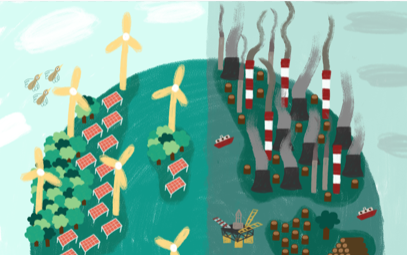
Creative activities can help us to imagine the future.
- CC-BY-NC-SA Joana Campinas for ArtistsForClimate.orgJoana campinas
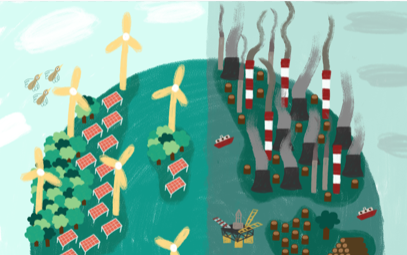
Creative activities can help us to imagine the future.
CC-BY-NC-SA Joana Campinas for ArtistsForClimate.org
Multi century projections
Why projections beyond 2100 are limited
Projections for sea level rise already extend to 2150–3000: projections for temperature and precipitation lag behind.
While emissions and concentration scenarios (RCPs and SSPs) extend to 2300–2500, most complex climate models (CMIP5 and CMIP6) stop at 2100, with only a handful reaching 2300.
Running models further is computationally expensive, so studies often rely on simpler models for long-term projections. This means detailed insights – such as like regional temperature extremes, ecosystem services, crop viability, and freshwater availability –are scarce beyond 2100.
Lyon et al (2021).
Modelling that extends beyond 2100 provides important insights for adaptation planning. Lyon et al. (2021) examined global climate conditions, heat stress and agricultural suitability to the year 2500. They used emissions scenarios representing strong, moderate, and weak global climate policy (RCP2.6, RCP4.5, and RCP6.0).
This study highlights the following.
- Warming continues. Under a moderate-high emissions pathway (RCP6.0), global mean temperatures keep rising after 2100: they reach approximately 3.6°C in 2200 and 4.6°C (above pre-industrial levels by 2500), with greater warming over land and polar regions.
- Sea levels keep rising: Sea levels continue to rise for centuries due to deep-ocean heat uptake. Under the moderate-high emissions pathway sea-levels rise to 0.86cm by 86 cm by 2500.
- Heat stress climbs: By 2500, large areas of already warm places could experience extreme heat stress for much of the year, challenging human health, productivity and liveability. These areas include northern Australia and much of Africa, the Amazon, the Arabian Peninsula, Southeast Asia, and the Maritime Continent (located between the Indian and Pacific Oceans).
- Food systems generally struggle: Under a moderate-high emissions pathway, suitable land for staple crops declines substantially after 2100, increasing long-term risks to food security and driving population movement. (However, under the lower emissions pathway RCP2.6, temperate crops have a much smaller decline and tropical crops experience a slight increase.)
The Conversation article in 2021 based on this work, Our climate projections for 2500 show an Earth that is alien to humans.
Implications for current planning for coastal adaptation
A multi-century perspective does not require precise forecasts of conditions in 2200 or 2500: those kinds of forecasts are inherently uncertain and will always carry a wide margin of error. Instead, the value lies in anticipating the direction and scale of change and using that insight to make decisions today that remain viable under a range of plausible futures.
For coastal practitioners considering major decisions:
- Design for long asset lives. Stress test decisions against multiple futures rather than a single 'end of century' approach, especially for decisions about settlement patterns or major infrastructure to avoid locking communities into escalating risk or costly retrofits.
- Use adaptive pathways: Adopt adaptive pathways that can be revised as new data emerges. Rolling baselines and nested timeframes (short-, medium-, and long-term) help integrate immediate actions with multi-century foresight.
- Priorise nature-based strategies
Ecosystem-based approaches and managed retreat may offer greater long-term resilience than hard protection, but only if future shoreline change and habitat migration are anticipated early. - Consider equity: Coastal adaptation must be embedded in global cooperation frameworks to manage equity, mobility and resource allocation.
- Anticipate mobility: Longer-term projections highlight the likelihood of population displacement driven by heat stress, inundation and resource pressures, with implications for housing, health and regional planning.