


At a glance
- Disasters are increasingly complex, unfolding as cascading, compounding, aggregated, and protracted events rather than isolated hazards.
- These events interact across social, economic, ecological, and institutional systems, amplifying impacts and slowing recovery.
- Repeated and overlapping disasters place sustained pressure on communities, services, and decision‑makers, leading to disaster fatigue and reduced capacity.
- Understanding different types of complex events helps planners and decision‑makers anticipate risks, manage ongoing stress, and strengthen resilience.

Disasters are getting more complex
Climate change is reshaping the nature of disaster risk, increasing the frequency, intensity, and interaction of hazards. Instead of occurring as single and discrete events, climate-related risks increasingly play out as complex disasters, impacting across social, cultural, ecological, economic systems and affecting the ability of these systems to adapt.
The impacts of complex disasters are diverse: they can increase damage, slow recovery and inflate recovery costs, weaken support systems, increase vulnerability to future disasters.
Complex disasters tend to be categorised in various ways, but here we consider important types such as aggregated, compounding, cascading and protracted. The differences between them can be confusing: they lie in the hazards, connections between components, timing and spatial scales.
Understanding these differences helps planning
The differences between these types of complex disasters do matter: it isn't just semantics, even though the terminology can be confusing.
Each type describes a different way in which hazards interact: some hazards trigger new ones, others coincide and amplify each other’s impacts, and some unfold over months or years, stretching a system’s capacity to cope. Hazards can be weather related, but they can also be technical or social.
Understanding these distinctions helps decision‑makers think through for their situation and anticipate interacting risks, manage ongoing stresses, and strengthen the resilience of systems that must withstand repeated or overlapping shocks.
The summer of 2019–2020 in Australia unfolded with bushfires widespread even before the official fire season had begun. After a prolonged period of hot and dry weather, Black Summer bushfires burned across vast swathes of the east coast.
Biodiversity suffered as natural landscapes burned – even rainforest and mangroves were not spared in some areas. An estimated three billion animals perished. In urban areas – some blanketed by smoke for weeks – lives and homes were lost and towns emptied under evacuation orders.
Communities tend to recover best when they pull together. But before communities could get back on their feet, in early 2020, the nation faced a new threat in the form of a global pandemic. Fire‑affected regions faced lockdowns, disrupted services, and a recovery process made slower and more isolating.
In 2021, La Niña brought widespread high rainfall events to the east coast and in some areas flooding disrupted the pandemic response. Some flood evacuation centres reopened before fire season signs had come down.
Again in 2022, intense rainfall events across the sodden east coast led to flooding and landslips. Rivers overtopped in some places where rebuilding had only just begun. Widespread infrastructure failures made communication difficult and rural and remote travel hazardous.
Subsequent stressors in some communities - insufficient and crowded housing, poor responses by insurance companies - contributed to further declines in mental health and increases in domestic violence.
These overlapping crises occurred widely across a huge geographical area, overwhelming all levels of emergency response agencies. These crises revealed how traditional 'one‑event‑at‑a‑time' frameworks fail in real-world conditions where hazards accumulate and interact.
In one study – but the experience is likely repeated across many disaster affected regions – the Blue Mountains City Council leaders reported significant disaster fatigue, describing exhaustion, limited resources, and diminishing time to plan or recover between events. The research identified that the pressures of repeated and continued response reduced decision‑making capacity and created new social, economic, and operational challenges for the council and the wider community.
SCU lismore floods
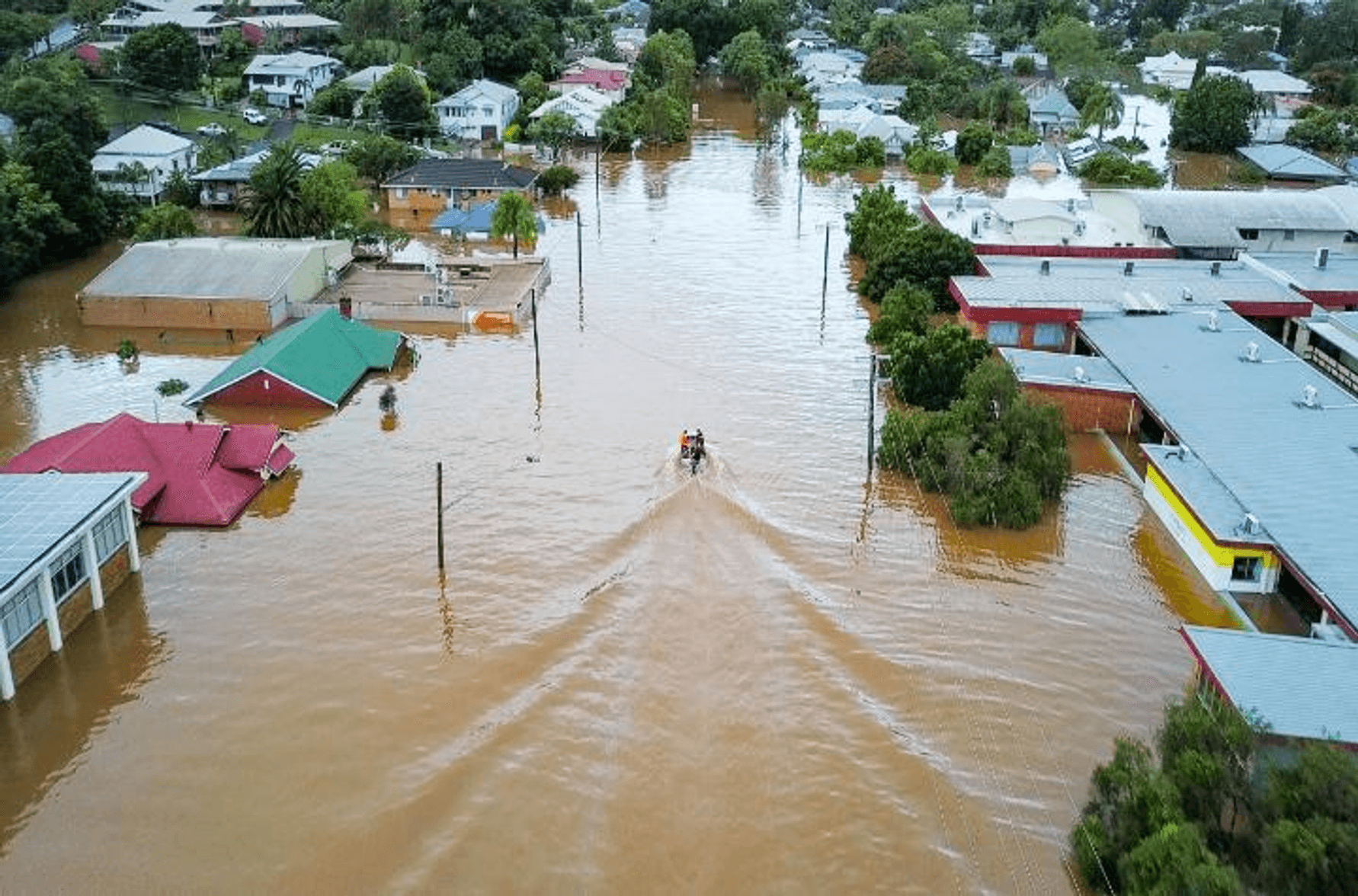
Major flooding in the Northern Rivers in 2022 is a good example of a compounding event.
© Southern Cross University, 2022
Major flooding in the Northern Rivers in 2022 is a good example of a compounding event.
- © Southern Cross University, 2022SCU lismore floods
Major flooding in the Northern Rivers in 2022 is a good example of a compounding event.
© Southern Cross University, 2022
Defining types of complex risk: compounding, cascading, aggregated, protracted
Complex disasters can unfold in several different ways, and each type highlights a different form of risk.
- Cascading disasters arise when one event triggers another, like heavy rainfall leading to landslips and infrastructure failures.
- Compounding disasters occur when hazards coincide or happen in quick sequence (such as extreme rain falling on saturated soils) amplifying their overall impact.
- Aggregating disasters involve smaller events that build up over time, creating significant cumulative stress on communities and infrastructure.
- Protracted disasters extend over long periods, often overlapping with other events and intensifying social and economic pressures.
- Cascading = one hazard directly contributes to or worsens another.
- Compounding = multiple hazards occurring together or close succession and amplifying harm.
- Aggregated = accumulated stress from repetition or scale
- Protracted = persistent conditions extending impacts over time
Cascading event
Cascading events occur when one hazard or disruption triggers another, creating a chain of escalating impacts across interconnected systems. In a cascading sequence, the effects of an initial event weaken systems, expose new vulnerabilities, or generate conditions that make subsequent problems more likely.
These follow‑on events may be physical, social, economic, or institutional, and each step in the chain intensifies the consequences of the previous one. Cascading events often unfold across sectors, particularly infrastructure, health, and community wellbeing: so disruptions spread rapidly and compound overall harm.
This interconnected process shows how disasters rarely occur in isolation but evolve through linked cause‑and‑effect pathways.
In the above snapshot, cascading events are illustrated by:
- losing a home followed by delayed or disputed insurance claims that heightened household stress, conflict, and mental health strain
- bushfires quickly followed by the pandemic, where isolation intensified trauma, then flooding during COVID‑19 forced evacuations that required infection‑safe shelter
- prolonged dry weather that destabilised slopes, contributing to landslips during heavy rain.
These cascades show how hazards can pile on: where one event amplifies the consequences of the next.
Compounding event
Compounding events occur when multiple hazards or drivers coincide or occur in close temporal sequence, interacting to amplify overall impacts even if the hazards are not directly linked. The defining feature of compounding events is interaction: combined conditions produce greater harm than the sum of individual events.
Compounding can arise from simultaneous hazards, pre‑existing conditions that intensify impacts, or successive events that disrupt recovery from earlier shocks. Research shows that such interactions significantly increase stress on social, ecological, and economic systems, reducing coping capacity and organisational resilience.
In the above snapshot, compounding events are illustrated by:
- the impacts of fires, heavy rainfall events, floods, landslips and COVID‑19 overlapped so closely that:
- recovery from one event was interrupted by another
- community trauma accumulated
- resources and personnel were continuously stretched
- decision‑making capacity and organisational resilience declined
Most of the focus to date has been on compounding events, but it is still a relatively new area of research. A typology of these is presented in the box below: currently there are four types.
Types of compounding events.
- Preconditioned events:
- When existing weather‑ or climate‑driven conditions aggravate the impacts of a hazard.
- Example: drought and heat primed the landscape for extreme fire.
- Multivariate events:
- When multiple climate drivers and/or hazards combine to create an impact.
- Example: heat and wind amplified bushfires
- heat and smoke had health impacts, particularly for vulnerable people
- fires followed by extreme rainfall impacted on biodiversity
- Temporally compounding events
- When a succession of hazards leads to an impact
- Example: fires followed by the pandemic and then floods in succession, with each disrupting recovery from the previous event.
- Spatially compounding events
- When hazards occurring in multiple connected locations cause an aggregated impact.
- Example: hazards have impacts across many regions at the same time. This can overwhelm emergency services across many jurisdictions and so they can't be deployed from other areas. It can also overwhelm the capacity for repairing and rebuilding.
about a multivariate event - where bushfires in NSW were followed by floods with impacts on biodiversity - in a CoastAdapt case study about eDNA monitoring of platypus.
CoastAdapt resources on insurance
Aggregated events
Aggregated events occur when many smaller or repeated events build up over time or across places, creating major strain on communities and systems. Each event alone might be manageable, but together they add cumulative stress that makes recovery harder and weakens resilience.
From the snapshot above, aggregated events are exemplified by:
- repeated bushfires, floods, and landslips over several years gradually exhausting community and emergency response capacity
- simultaneous disasters across multiple regions limiting the ability to share resources for response and recovery.
But this sounds like compounding?
With an aggregated event there are many events occurring together, which sounds just like compounding events.
However the difference is nuanced.
What makes it aggregated is that there is not an interaction or triggering. If you removed any single event, the others would still have happened — but together they wore systems down. Damage accumulates simply because events keep happening. Repeated hits gradually exhaust councils, communities and services.
Protracted events
Protracted events are disasters or crises that last a long time and don’t have a clear end. Their impacts continue for months or years, placing ongoing pressure on people, services, and institutions and turning recovery into a long‑term challenge rather than a short phase.
From the snapshot above, protracted events are exemplified by:
- long‑term housing shortages and delayed rebuilding caused by slow insurance processes and repeated disruptions
- ongoing mental‑health stress and social impacts continuing years after the initial bushfires, floods, and pandemic.
But this sounds like compounding too
With a protracted event there are ongoing impacts that overlap with new events, which sounds just like compounding events.
However the difference is nuanced.
What makes it protracted is that the same disaster has impacts long after the hazard has passed. The recovery is long-lasting (or never finishing?).
For example, the flooding event passes but housing shortages, insurance disputes, mental health impacts last for years. These prolong and slow recovery turning recover into a long-term condition.