



At a glance
- Anthropogenic climate change is caused by human activities, and is also known as global warming or the enhanced greenhouse effect.
- Global warming is caused by the release of greenhouse gases such as carbon dioxide (CO2) into the atmosphere.
- Greenhouse gases warm the atmosphere and can cause other effects such as sea-level rise and changes in patterns of rainfall and storms.
- Current levels of greenhouse gases in the atmosphere are unprecedentedly high.

What is climate change or global warming?
Anthropogenic climate change is also known as global warming, or the enhanced greenhouse effect.
It is caused by human activities through the release of greenhouse gases such as carbon dioxide (CO2) into the atmosphere.
What's in a name? Different terms for climate change
There are a number of terms used to describe a changing climate due to anthropogenic sources and they are generally accepted to mean the same thing.
- Climate change is the most widely accepted scientific term. It refers to long-term shifts in temperature, precipitation, and weather patterns caused by human activities (mainly greenhouse gas emissions).
- Anthropogenic climate change is the same as above but specifically points to the human causes of warming.
- Global warming focuses more specifically on the increase in Earth’s average surface temperature. Critics argue it is misleading because warming is uneven – some regions warm faster, others slower, and a few areas are even cooling (like parts of the North Atlantic).
- The 'greenhouse effect' is a narrower term that describes the science of the warming mechanism.
More colloquial terms for climate change.
- Global 'boiling' is a dramatic phrase coined by UN Secretary-General António Guterres, who declared we have entered the "era of global boiling" in response to unprecedented heat records in July 2023.
- Global weirding is a term that captures how people around the world are noticing weather is getting "weirder" (e.g. fires in winter) and more extreme.
- Does hyperbolic language help or hinder climate action?
an article in The Conversation about whether hyperbolic language helps or hinders climate action?
What are the greenhouse gases?
In the atmosphere, the principal greenhouse gases include water vapour, carbon dioxide (CO₂), methane (CH₄), nitrous oxide (N₂O), and ozone (O₃).
Greenhouse gases are vital for life on Earth. Without them, the planet would be about 33 °C colder, that means temperatures would be around −19 °C instead of +14 °C.
They work by letting most sunlight (shortwave radiation) pass through the atmosphere but absorbing and re-emitting heat (longwave radiation) from Earth’s surface. This process traps heat and keeps Earth warm enough for life.
The science of the greenhouse effect
Put simply, hot objects give off energy at shorter wavelengths, and cooler objects give off energy at longer wavelengths. The Sun is very hot, so it emits mostly shortwave radiation. Earth is much cooler, so it emits longwave infrared radiation.
The greenhouse effect occurs when greenhouse gases let most of the Sun’s shortwave energy pass through the atmosphere and warm the Earth's surface. But they absorb much of the longwave heat that Earth sends back out. Some of this heat is then sent back toward Earth by the atmosphere, which makes the surface warmer (see Figure 1).
videos about
- carbon and climate change by the Smithsonian, the world's largest museum, education and research complex
- the Greenhouse effect by NASA.
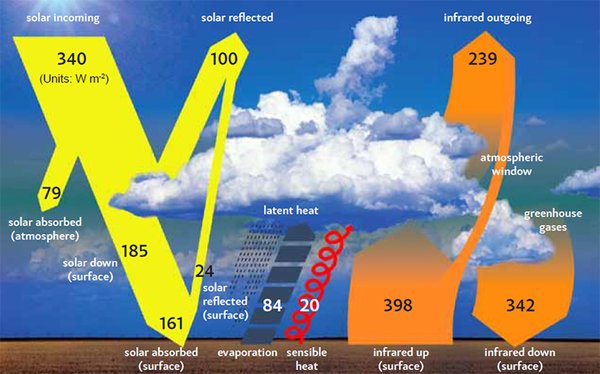
Figure 1: Present-day global average energy budget. The rates at which energy enters and leaves the Earth system approximately balance on average globally. With more greenhouse gases in the atmosphere (but no other changes), the system must reach a higher temperature to maintain balance.
- IPCC 2013 (Fifth Assessment Report, Working Group 1, Figure 2.11), adapted by Australian Academy of Sciences, 2015.Greenhouse effect
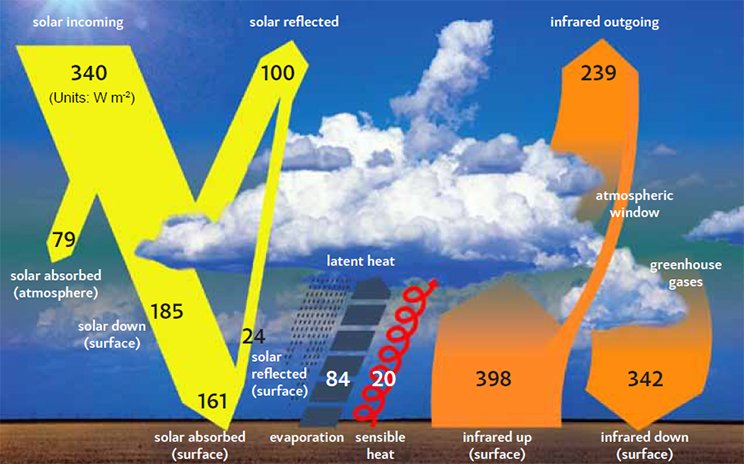
Figure 1: Present-day global average energy budget. The rates at which energy enters and leaves the Earth system approximately balance on average globally. With more greenhouse gases in the atmosphere (but no other changes), the system must reach a higher temperature to maintain balance.
IPCC 2013 (Fifth Assessment Report, Working Group 1, Figure 2.11), adapted by Australian Academy of Sciences, 2015.
Effects of human activities on greenhouse gas concentrations
Since the industrial revolution began around the 1780s, human activities have added large amounts of greenhouse gases, especially carbon dioxide, to the atmosphere.
The main sources of these emissions are the burning of fossil fuels such as coal, oil, and natural gas; industrial processes; and land-use changes, including deforestation, agricultural expansion, and soil degradation.
Some greenhouse gases are more effective than others at trapping heat. For example, methane warms the atmosphere much more strongly than carbon dioxide, but because there is far less methane in the air, its total effect is smaller than that of carbon dioxide.
To compare their impacts, scientists use a measure called carbon dioxide equivalent (CO₂e). This expresses the warming effect of each gas as the amount of CO₂ that would cause the same level of warming.
Concentrations of greenhouse gases have varied naturally over very long timescales (millions of years). However, since about 1850 human activities have increased these gases so quickly and on such a large scale that current concentrations are unprecedented.
Global climate is projected to continue warming over this century and beyond - even if we reduce greenhouse gas concentrations in the atmosphere.
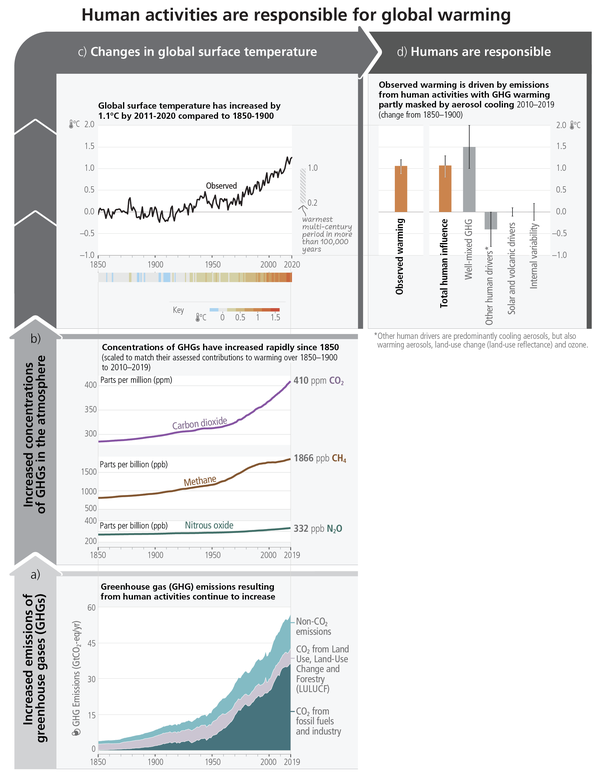
Figure: The causal chain from emissions to resulting warming of the climate system.
Panel a: Greenhouse gas emissions have risen quickly in recent decades.
Panel b: Human-caused emissions include carbon dioxide from burning fossil fuels and industry (dark green), carbon dioxide from land-use changes like deforestation (green), methane, nitrous oxide, and fluorinated gases (light blue). These emissions have increased the levels of major greenhouse gases – CO₂, CH₄, and N₂O – in the atmosphere.
Panel c: The size of each section shows how much each gas has contributed to warming since 1850–1900. Methane’s effect includes its indirect impact on ozone. Global surface temperature has risen by about 1.1°C since 1850–1900.
Panel d: The bar on the right compares today’s temperature with past warm periods over the last 100,000 years. The recent decade is as warm as or warmer than the warmest periods caused by slow natural changes. Studies show that almost all the warming since 1850 is due to human activities, mainly greenhouse gases, with smaller effects from aerosols, land-use changes, and natural factors like solar and volcanic activity.
- IPCC 2023. AR6 Synthesis reportSRL-image-0
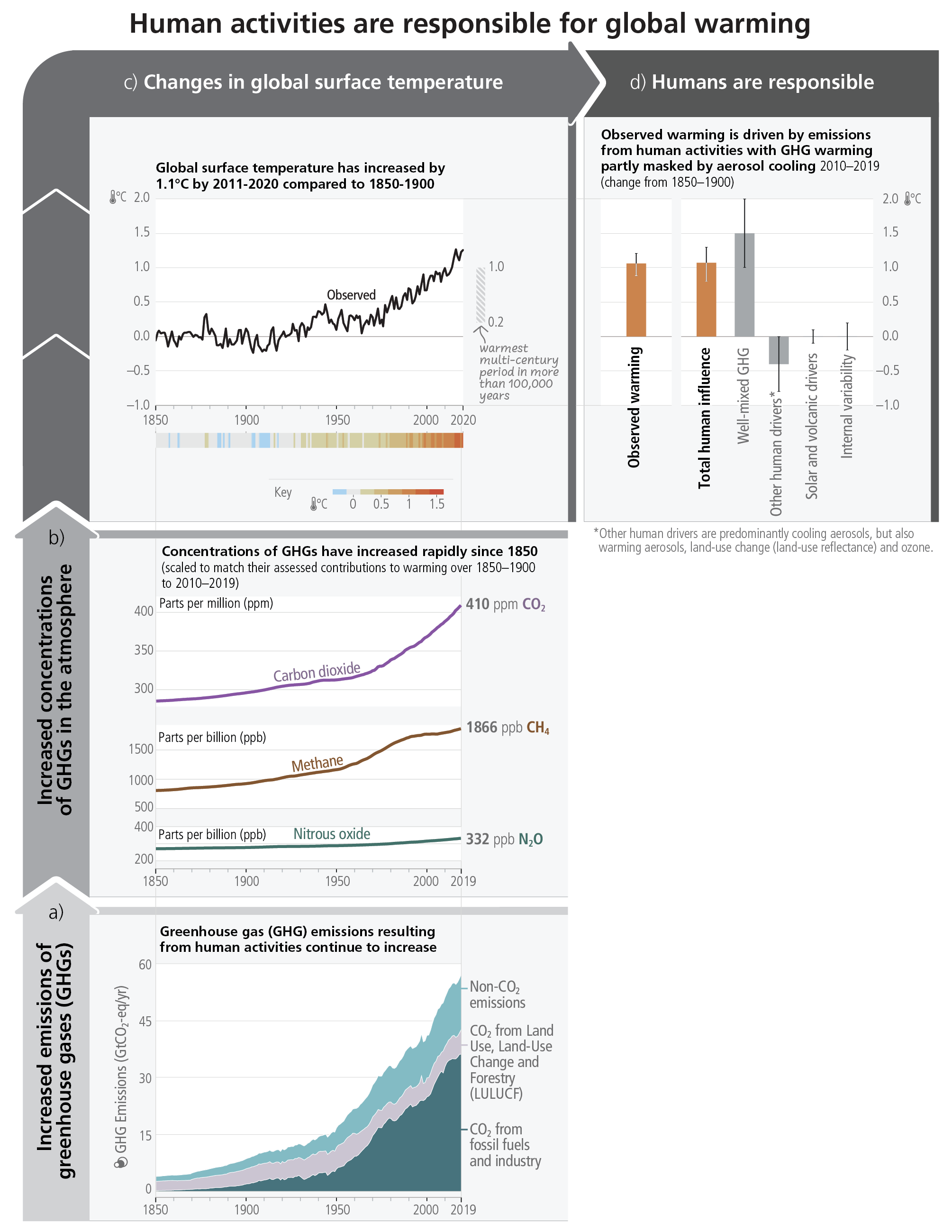
Figure: The causal chain from emissions to resulting warming of the climate system.
Panel a: Greenhouse gas emissions have risen quickly in recent decades.
Panel b: Human-caused emissions include carbon dioxide from burning fossil fuels and industry (dark green), carbon dioxide from land-use changes like deforestation (green), methane, nitrous oxide, and fluorinated gases (light blue). These emissions have increased the levels of major greenhouse gases – CO₂, CH₄, and N₂O – in the atmosphere.
Panel c: The size of each section shows how much each gas has contributed to warming since 1850–1900. Methane’s effect includes its indirect impact on ozone. Global surface temperature has risen by about 1.1°C since 1850–1900.
Panel d: The bar on the right compares today’s temperature with past warm periods over the last 100,000 years. The recent decade is as warm as or warmer than the warmest periods caused by slow natural changes. Studies show that almost all the warming since 1850 is due to human activities, mainly greenhouse gases, with smaller effects from aerosols, land-use changes, and natural factors like solar and volcanic activity.
IPCC 2023. AR6 Synthesis report
"Since systematic scientific assessments began in the 1970s, the influence of human activity on the warming of the climate system has evolved from theory to established fact."
Intergovernmental Panel on Climate Change - https://www.ipcc.ch/report/ar6/wg1/
Effects of greenhouse gases on climate
Increasing greenhouse gases does not significantly change incoming sunlight, but it increases the absorption of Earth’s outgoing heat (longwave radiation) in the atmosphere. This strengthens the greenhouse effect and causes global warming.
Human-driven warming affects rainfall patterns, increases extreme weather events, and contributes to other changes such as rising sea levels and melting ice.
current (2024) state of the climate, which is produced biannually by Bureau of Meteorology and CSIRO.
It draws on the most recent monitoring, science and projection information to describe variability and change in Australia's climate
Effects of greenhouse gases on oceans
Increasing greenhouse gases in the atmosphere are warming the oceans, which have absorbed about 93% of the extra heat from global warming so far.
As water warms, it expands. This thermal expansion has been the main cause of sea-level rise in the 20th century, with smaller contributions from melting glaciers and ice sheets.
Global sea level rose about 20 cm between 1901 and 2018, and in the future, melting ice is expected to become the largest contributor to rising seas
more on sea-level rise in CoastAdapt
Effects of greenhouse gases are widespread
Increasing carbon dioxide in the atmosphere has wide implications for a range of natural and human-made processes and activities.
These changes ripple through ecosystems, affecting fisheries, food security, and coastal protection; and through urban areas, affecting infrastructure.
Combined with warming and compounding with other stressors, they create compounding impacts on both land and marine systems.