



At a glance
The Bruun Rule.
- Provides a quick, first‑order estimate of shoreline retreat on sandy, unconsolidated coasts with minimal data.
- Assumes a simple, two‑dimensional beach profile with no major geological features, sediment gradients, or human interventions.
- Useful as an initial screening or strategic comparison tool to identify potentially vulnerable coastlines.
- Not suitable on its own for site‑specific predictions, development setbacks, or regulatory decision‑making.
A rapid assessment of shoreline retreat
Coastal erosion results in the landward retreat of shorelines and the destabilisation of dune systems. On sandy shores, the Bruun Rule is to provide a general indication of the magnitude of shoreline recession associated with a given rise in sea level. It should not be used for detailed planning of regularly decision-making.
What is the Bruun Rule
The Bruun Rule is a simple model commonly used to make a quick estimate of how far a sandy shoreline may retreat landward in response to sea‑level rise.
Its simplicity is both a strength and weakness: it is simple and easy to apply, yet its assumptions are not always met, which limits its usefulness.
Essentially, the rule assumes:
- that a sandy beach profile maintains an equilibrium profile, a characteristic cross‑shore shape controlled by waves and sediment size.
- as sea level rises, this equilibrium profile is assumed to shift upward and landward, with sand eroded from the upper beach and dunes being deposited offshore between the shoreline and the depth of closure (which is the seaward limit of the active beach profile)
Therefore, under this assumption, the volume of sand eroded from the beach is conserved within the nearshore system.
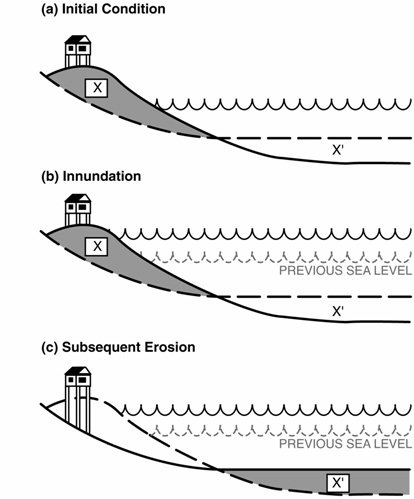
Figure 1. How the Brunn Rule works. A one-metre rise in sea level implies that the offshore bottom must also rise one metre in order to maintain the cross-shore beach profile. The material to raise the offshore bottom may come from shoreline erosion in the absence of beach nourishment
- ©Titus et al. 1986, reprinted by permission Taylor & Francis LLC,Bruun rule 2
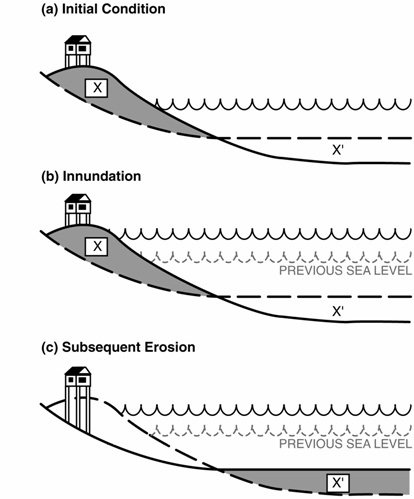
Figure 1. How the Brunn Rule works. A one-metre rise in sea level implies that the offshore bottom must also rise one metre in order to maintain the cross-shore beach profile. The material to raise the offshore bottom may come from shoreline erosion in the absence of beach nourishment
©Titus et al. 1986, reprinted by permission Taylor & Francis LLC,
Use of the Bruun Rule
The Bruun Rule is a has been popular 'rule of thumb' in coastal management because it:
- is simple and quick to apply
- requires relatively little data
- provides a first‑order estimate of potential shoreline retreat
- can be applied consistently across long stretches of sandy coast
Key assumptions of the Bruun Rule
The Bruun Rule relies on several strong assumptions, including the:
- coast is sandy and unconsolidated
- shoreline is straight and two‑dimensional
- coast has no significant headlands, reefs, or inlets
- longshore sediment transport gradients are negligible
- human-derived interventions (such as seawalls, groynes, nourishment) do not affect sediment movement
- wave climate remains unchanged apart from sea‑level rise.
However, many real‑world coastlines, including most Australian coasts, do not meet these conditions.
A check of the Bruun Rule for modelling shoreline change?
Puerto Rico
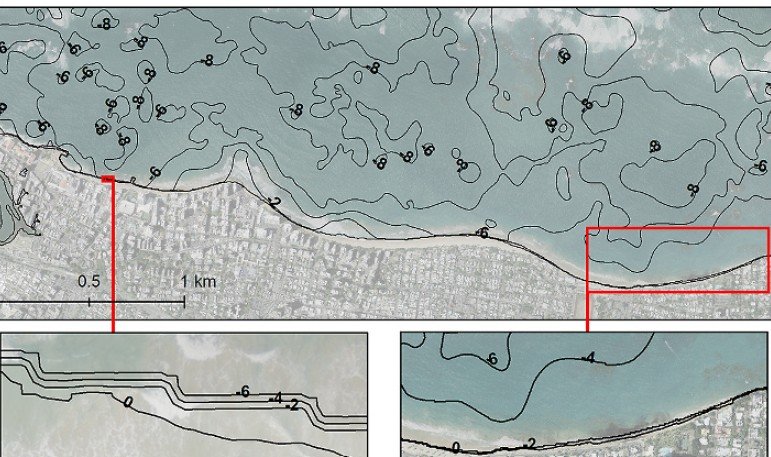
Nearshore platform morpholophy of the Puerto Rico site: other study sites were located in New York and California.
Reproduced under CC BY license.
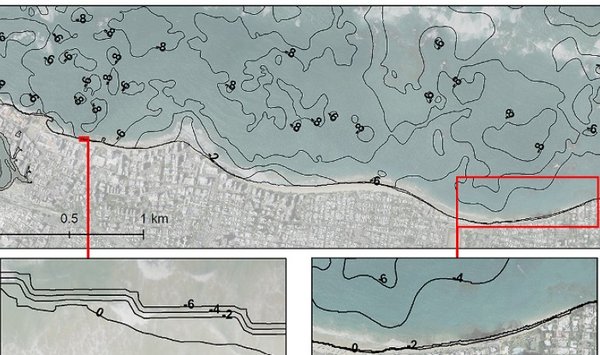
Nearshore platform morpholophy of the Puerto Rico site: other study sites were located in New York and California.
- Reproduced under CC BY license.Puerto Rico
Nearshore platform morpholophy of the Puerto Rico site: other study sites were located in New York and California.
Reproduced under CC BY license.
The Bruun Rule is still commonly used to estimate sandy shoreline retreat under sea-level rise because it is simple and data‑light. This study tested whether it produces reliable results for real coastlines and planning-relevant timescales.
The researchers applied the Bruun Rule to three morphologically different sandy beaches, assessing shoreline change over annual to decadal timescales. Results were evaluated against observed shoreline changes, historical shoreline records, and projections from a more sophisticated hybrid shoreline model.
The study found
The study showed that the Bruun Rule did not accurately reproduce past shoreline change and generated unrealistic future projections for all beaches tested. Errors were substantial even over decadal timescales, which are periods typically used for planning horizons.
The shortcomings stem from fundamental assumptions in the model:
- a linear relationship between sea-level rise and shoreline retreat is assumed, which does not reflect real coastal behaviour
- the model does not account for nearshore circulation, sediment transport pathways, or site-specific morphology, all of which strongly influence shoreline evolution.
The study concluded
Using the Bruun Rule as a stand‑alone tool can mislead erosion hazard assessments and adaptation decisions, particularly for sandy beaches. Apparent simplicity may mask large uncertainties.
Seenath and Dale, 2024
Strengths of the Bruun Rule
When used appropriately, the Brunn Rule can help coastal managers do a rapid screening and thendecide where more detailed analysis is justified.
It's key strengths are that is:
- provides a transparent and easily understood framework for linking sea‑level rise and shoreline retreat
- allows rapid, high‑level assessments when limited data are available
- is useful for comparative or strategic‑scale assessments, such as identifying which sections of coast may be more sensitive to sea‑level rise
- can support early‑stage discussions and prioritisation of further studies.
Limitations of the Bruun Rule
The main weaknesses of the Bruun Rule are that it:
- oversimplifies complex coastal processes
- ignores three‑dimensional effects of beaches such as headlands, reefs, or embayments
- ignores longshore sediment transport, which can dominate shoreline change
- ignores geological controls, sediment supply limitations, or human interventions
- can either overestimate or underestimate shoreline recession, depending on local conditions
As a result, the Bruun Rule has limited predictive power and is not well suited for detailed, site‑specific planning or for determining development setbacks on its own.
Should I use the Bruun Rule?
The Bruun Rule can be used with caution - and with acknowledgement of its assumptions. It can be used as a first‑pass screening tool to gain a high‑level understanding of potential shoreline sensitivity to sea‑level rise on sandy coasts.
It should not be used on its own to:
- predict future shoreline positions
- set regulatory tools such as development controls or hazard lines
- support detailed planning or statutory decisions
Where the Bruun Rule indicates potential risk, it should be followed by more rigorous, site‑specific coastal hazard assessments that consider local geomorphology, sediment processes, wave climate, and human influences.