


At a glance
- SSPs describe plausible future societal pathways that influence greenhouse gas emissions.
- They combine socio‑economic storylines with climate ambition, improving on older RCPs. RCPs can still be used in some circumstances, but best practice is to use SSPs
- SSPs underpin current climate projections used in IPCC AR6 and CMIP6. They are also used for CoastAdapt.
Scenarios help us think through potential futures
As a society, we are uncertain about how climate change will be influenced by future global governance, economic development and technological change. To help decision making and adaptation planning, we consider a range of climate scenarios that explore plausible futures.
Understanding these scenarios helps you to choose which one(s) to use for your adaptation planning purpose.
Here we explain what are Shared Socioeconomic Pathways (SSPs) are and how they compare with the older Representative Concentration Pathways (RCPs).
What are Shared Socioeconomic Pathways (SSPs)?
The Shared Socioeconomic Pathways (SSPs) are a set of five socioeconomic narratives developed by the international research community. They describe plausible future pathways for global society based on broad trends in population, economic development, technology, energy use and land use.
SSPs underpin the climate scenarios used in the Coupled Model Intercomparison Project Phase 6 (CMIP6) and the IPCC Sixth Assessment Report (AR6).
SSPs differ from the earlier climate scenarios known as Representative Concentration Pathways (RCPs), although the two share some common elements.
In CoastAdapt’s updated versions of Sea Level Rise and You, the sea‑level rise, temperature and rainfall projections are based on climate model simulations that use SSP‑based scenarios.
A short note about international climate modelling efforts
Climate models are constantly being updated and improved by climate groups around the world. These efforts are coordinated through the Coupled Model Intercomparison Project (CMIP). The combined results of each CMIP phase feed into the Intergovernmental Panel on Climate Change (IPCC) assessment reports.
We are now up to CMIP6 models, which are included in the current (2021) IPCC sixth assessment report (known as AR6), published in 2021. CMIP6 introduced a new frameowrk for future scenarios that combines socioeconomic narratives (SSPs) with greenhouse‑gas forcing levels to produce climate projections.
How much do I need to understand about scenarios?
If you use scenarios like SSPs and RCPs for risk assessments or adaptation planning, it is useful to understand where they come from and what they mean.
Climate scenarios begin as narratives
The SSPs began as five new socioeconomic narratives or storylines that were developed by an international multidisciplinary team. These narratives are not yet scenarios but are building blocks used to construct scenarios.
The name of the narrative SSP includes a number and a title that indicates the group they belong to.
- SSP1 - Sustainability
- SSP2 - Middle-of-the-road
- SSP3 - Regional rivalry
- SSP4 – Inequality
- SSP5 - Fossil-fuelled development
Each narrative describes plausible future global society developments built on assumptions about societal features, such as: population, urbanisation, gross domestic product, economic growth, rate of technological development, land use change, energy demand and supply etc.
From descriptive to quantitative
The key drivers from each SSP are quantified. Then Integrated Assessment Models are used to translate the narratives into scenarios containing quantitative projections of energy use, land use and greenhouse gas and aerosol emissions.
When these quantified pathways are combined with specific levels of greenhouse‑gas forcing, they become the SSP‑based climate scenarios used in climate models.
Then they become SSP-based scenarios we use in CoastAdapt (see box below)
In Sea-Level Rise and You, we use the five SSP-based scenarios prioritised for use in CMIP6 climate model experiments:
- SSP1-1.9 ‘Sustainability’: no equivalent CMIP5-RCP equivalent but aligns most closely with the Paris Agreement target of limiting global warming to 1.5°C by 2100.
- SSP1-2.6, ‘Sustainability’: a 2°C scenario approximately equal to RCP2.6.
- SSP2-4.5, ‘Middle of the road’: approximately equal to RCP4.5
- SSP3-7.0, ‘Regional rivalry’: a medium-high scenario
- SSP5- 8.5, ‘fossil fuelled development: a high scenario similar to RCP8.5).
What's in a name?
The name of an SSP-based scenarios contains coded information.
- Each SSP has a number that ties it to a SSP family
- Example: SSP1 indicates it is from the first group of SSPs.
- Note there are two variations of SSP 1 – the difference is because the one socioeconomic storyline can be paired with different levels of climate ambition (see box below).
- Each SSP has a title that broadly encapsulates its attributes.
- Example: SSP3 has the title ‘Regional rivalry’ as it has low international cooperation and high levels of nationalism dominating policies and results in increasing inequality.
- Each of the SSPs, like the RCPs, has a number to indicate the extra energy (in W/m2) trapped by greenhouse gases by 2100.
- Example: SSP1-1.9 represents the extra energy of 1.9 W/m2 by 2100 relative to pre-industrial levels.
SSP1‑1.9 and SSP1‑2.6 assume the same sustainable socioeconomic future – they differ only in how aggressively governments cut emissions.
SSP1‑1.9 assumes very rapid and deep emissions reductions.
SSP1‑2.6 assumes less aggressive mitigation.
- Having two versions of an SSP allows the climate model to assume constant socioeconomic conditions while testing different levels of climate action.
- SSP1‑1.9 was added for IPCC AR6 to explicitly test a 1.5 °C future.
more detail on SSP‑based scenarios is available in Lee et al. (2021) or the IPCC Sixth Assessment Report, Working Group. Climate Change 2021: The Physical Science Basis. (pages 232–236).
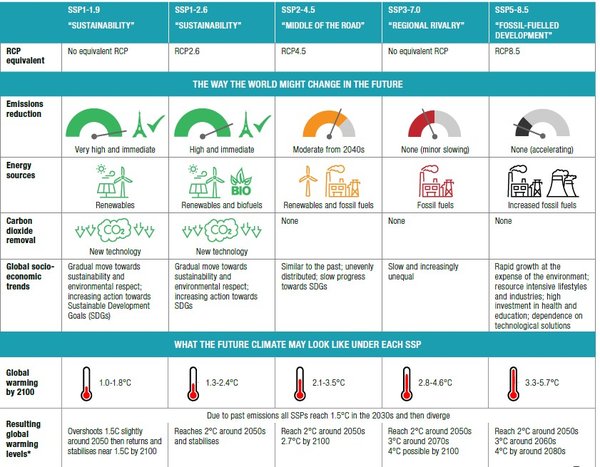
Figure: How do SSPs differ from RCPs?
- © NESP Climate Systems Hub 2024.NESP ssps vs rcps

Figure: How do SSPs differ from RCPs?
© NESP Climate Systems Hub 2024.
What about RCPS? Can I still use them in risk assessments?
Representative Concentration Pathways (RCPs) were developed for the previous generation of climate models used in CMIP5 and the IPCC Fifth Assessment Report (AR5).
Are they still useful for risk assessments?
The short answer: yes, RCPs are mostly fine for uses such as risk assessments
For new adaptation planning and policy development, it is best practice to focus on SSP‑based scenarios to ensure alignment with the most current climate science. RCPs remain useful for updating existing assessments, ensuring continuity with earlier work, or interpreting legacy studies.
Key notes for practitioners
- SSPs include the most current available climate projections and so should be used for any new risks assessments or adaptation plans and policies.
- SSPs should be used for more sophisticated analyses where outputs of climate models are used as inputs for further modelling
- RCPs are still useful for most risk assessments and adaptation plans, especially when updating existing assessments or plans or complying with policies that were originally developed using RCPs. They can be useful to ensure continuity or to compare older impact studies.
- Don’t mix SSPs and RCPs: variables and assumptions from the two types of scenarios are presented in different ways that will make results difficult to interpret.
- Make sure you clearly document assumptions if you are translating results from older studies to current planning contexts.