


Sydney's living seawalls
Flat seawalls abound around the coast and harbours of our cities but there is now a move to encourage biodiversity by creating habitat with 3D panels that feature designs inspired by the natural environment.
These ‘living seawalls’ have been developed by the Sydney Institute of Marine Science and were first installed in Sydney about five years ago. They have now been trialled in many places around the Sydney Harbour foreshore. They have also been installed in other parts of Australia (Port Adelaide, Fremantle, Townsville and the Sunshine Coast) and internationally (Gibraltar, Singapore, Wales).
By blending ecological concepts and engineering in creative design, ‘Living Seawalls’ panels are reviving urbanised coasts through the development of an affordable, adaptable and scalable method of ecologically enhancing artificial structures like seawalls, pontoons and marinas.
More than half of Sydney’s harbour foreshore is bounded by seawalls, leading to a loss of important habitats, such as mangroves, oyster beds and sandy beaches.
A collaboration between ecologists at the Sydney Institute of Marine Science, Macquarie University and the University of NSW; together with industrial designers at Reef Design Lab, has shown that marine construction can become part of the solution for healthy coastlines, rather than just a problem.
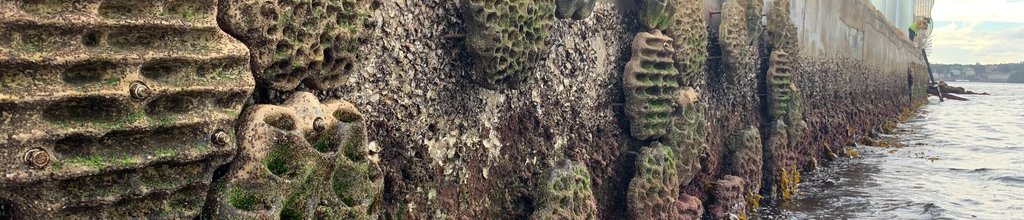
In a relatively short time, featureless seawalls in Sydney Harbour are now homes to an abundance of marine life including oysters, mussels, barnacles, limpets, and red and green seaweeds.
The living seawalls idea
The first living seawalls were installed in Sydney in 2018 at Sawmillers Reserve, McMahons Point; and Milsons Point, where the panels were retrofitted onto existing seawalls.
Co-leader of the Living Seawalls program, Melanie Bishop says the panel designs are a collaboration between ecological input and design knowhow around biomimicry. “We use shapes that you see in rocky shore ecosystems – crevices, rockpools, honeycomb weathering patterns, which is often where biodiversity is found.”
The designs, developed in collaboration with Alex Goad at the Reef Design Lab focus on recreating the geometries of habitat formed by species like mangroves, oyster reefs and seagrass beds. The mangrove panels, for example, are the shape of mangrove roots, while kelp holdfast panels replicate the kelp roots.
They are designed to increase the ecological value of artificial structures in the marine environment like seawalls, pontoons and marinas.
Living sea walls 1
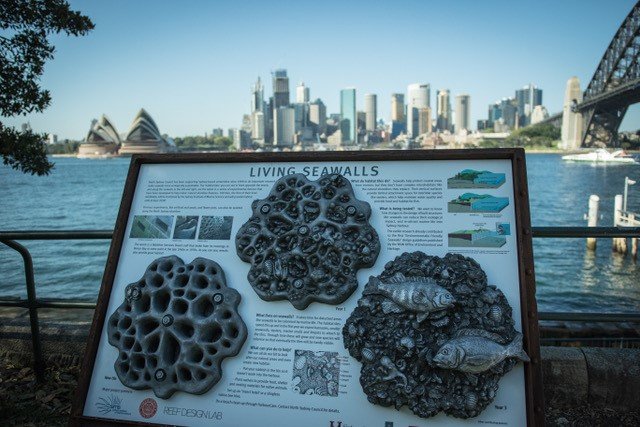
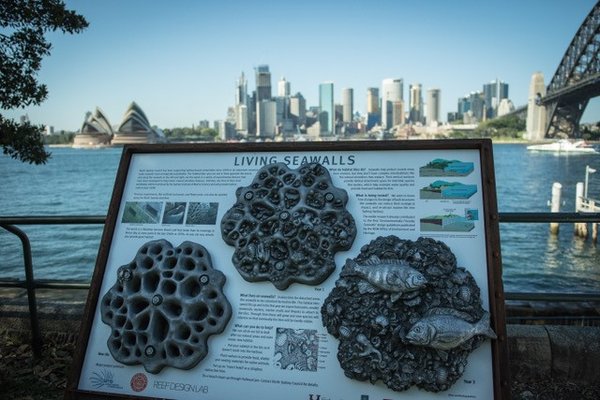
Public signage is important to inform and engage the community.
© Living Seawalls
WATCH: a video about Living Seawalls and how they make a difference for marine life
Impacts addressed
Living Seawalls panels are designed to not only reduce the environmental impacts of the current ocean sprawl, but also to benefit marine life.
The novel tiles mimic some of the microhabitats found in the rocky shore – rockpools, crevices and swim throughs, and help to retain moisture at low tide. Their modular structure allows critical habitats for marine life to be added to marine constructions.
The panels are fitted in scalable mosaics onto the vertical seawalls, where they increase the habitat area available for colonisation and growth of seaweeds, shellfish and other marine life. They also add protection from high temperatures and predators.
Monitoring of the panels installed after two years showed more than 100 species of invertebrates and seaweed had colonised the living seawall, with up to three times the number of species on the ‘rockpool’ panels than on the flat control panels.
Fish like to shelter in the habitat provided and benefit from the additional food sources found on the panels. More than 50 species of fish were found to be using the seawalls for habitat and food. A/Prof Bishop says this is similar to the number of species found at reference rocky reefs and far more than found on control seawalls.
Habitat enhancement
The panels, which are made from eco-blend cement and engineered to last at least 20 years, are designed digitally by industrial designers at the Reef Design Lab. The size and shape of the design features (e.g. rock pools and crevices) are informed by measurements taken from features on natural rocky shorelines.
Once a panel design is finalised, it is created using 3D printing technology, which allows the fine details of the natural shorelines to be recreated. A reusable mould is made from which concrete panels can be cast and manufactured in large numbers.
The 10 panel designs each target different features of natural shorelines that benefit diverse groups of marine organisms. The design, size and shape can be tailored for specific locations.
While most of the panel installations have been retrofitted to existing seawalls, they can also be integrated with new seawalls using mounting rods or frames. At Barangaroo, Sydney, 384 panels were fixed to stainless steel frames, which were then installed at three different depths beneath a board walk and attached to the board walk piles.
Start up funding helps to go global
Starting on a small scale with philanthropic funding from the Harding Miller Foundation to prove the concept and develop the modular panels, Bishop and her team then received a grant from the NSW Environmental Trust for three demonstration sites – Sawmillers Reserve, Balmain East and Rushcutters Bay.
Since then, the team has received a number of grants for rehabilitation of degraded habitat, as well as contracts to design solutions and sell panels to local governments around Australia and internationally, including Singapore, Gibraltar and Wales.
Is a living seawall the right solutions for you?
The modular panels work by providing shelter for marine borne larvae. They are not effective in severely polluted environments, because they need marine life to colonise them. As well, the area needs to be regularly inundated.
Other parameters that will affect success include the orientation of the structure and wave energy. Sites should be well flushed by tides or currents with evidence of some marine life. To benefit marine life, the panels must be underwater for at least part of the tidal cycle.
At the beginning of the project, a baseline survey is carried out, which includes information on the tide, salinity, temperature, contaminants, and species living in the environment. This enables any changes to be evaluated.
A set of ecological guidelines is available on the Living Seawalls website (see below).
Community involvement
Education and public engagement important are an important part of the Living Seawalls in Sydney. The North Sydney council has been very involved and commissioned sculptors to make attractive public signage, located near the seawalls.
The project team are involved in public events, displays at festivals, public talks etc. They are also working with schools, e.g. Sydney Secondary College, Balmain campus has developed a program for the students to monitor and evaluate marine life on their local installation. Bishop would like to design a citizen science project where the public could assist in collecting data.
Private property owners with waterfront frontage can install their own panels. A new initiative, where panels are suitable, is the ‘living boulder’ design.
A small kayak tour business -Sydney by Kayak, has installed one of the artificial rockpools, which is embedded in a nearby revetment. The company has now raised funds through its corporate paddle tours for monitoring and evaluation of the boulder, which adds water retaining habitat to trap and retain water throughout the tidal cycle.
Install your own living seawall
Private property owners with waterfront frontage can install their own panels. A new initiative, where panels are suitable, is the ‘living boulder’ design.
A small kayak tour business, Sydney by Kayak, has installed one of the artificial rockpools, which is embedded in a nearby revetment. The company has now raised funds through its corporate paddle tours for monitoring and evaluation of the boulder, which adds water retaining habitat to trap and retain water throughout the tidal cycle.
Caption 1: A white-faced heron (Egretta novaehollandiae) inspects a ‘living boulder’ in Sydney Harbour.
Caption 2: Public signage is important to inform and engage the community.