


At a glance
- With rising sea levels and ongoing ecosystem decline in the Swan Canning Estuary (Western Australia), this small-scale pilot study explores the potential of artificial shellfish reefs as a nature-based solution to reduce wave energy.
- A field trial near Point Resolution (City of Nedlands) showed the reef reduced significant wave height by 32% on average at low tide, resulting in an average wave energy attenuation of 54% and decreasing run-up. However, the effectiveness of the reef diminished at high tide due to water depth dependency.
- Insights from this trial and other reef studies at the UWA Oceans Institute inform future large-scale applications of the feasibility of artificial reefs in coastal and estuarine environments.
The need to slow erosion in the Swan Canning Estuary
Coastal inundation and erosion are exacerbated by rising sea levels and anthropogenic impacts and threaten many Australian shorelines, including the Swan Canning Estuary (SCE) in Perth. The Swan River passes through the center of Perth, where the city supports a population of 2.3 million people.
Since European settlement, the SCE has suffered ecological decline due to pollution, dredging, overfishing and extensive human activity. The Swan River faces significant erosion, primarily from wind-generated waves (1.3–1.7s periods), with boat wakes (2.2–6.7s periods) also contributing to shoreline degradation.
Traditional 'grey' solutions like seawalls and groynes are costly and can cause downstream erosion. In contrast, nature-based solutions like shellfish reefs offer a sustainable alternative by dissipating wave energy, adapting to sea-level rise and enhancing marine biodiversity.
This pilot study evaluates the feasibility of artificial reefs for coastal protection (via wave attenuation), providing insights into the challenges and viability of scaling this solution for habitat restoration and shoreline protection.
Addressing climate risks and impacts
Rising sea levels and increasing storm intensity pose ongoing threats to vulnerable shorelines. Research indicates that storm-driven wind waves accelerate shoreline erosion, habitat degradation, and estuarine ecosystem loss.
With projections of intensifying storms and sea-level rise inundating low-lying areas, proactive adaptation strategies are essential to mitigate impacts on the SCE.
An overview of the reef experiment
A submerged artificial reef (2.1 m long × 0.6 m wide × 0.3 m high) was temporarily deployed by hand at Point Resolution, a site exposed to both wind-generated waves and boat wakes.
Designed with internal voids to enhance wave energy dissipation (Figure 1), the reef's performance was monitored using 16 Hz pressure sensors. These sensors captured significant wave heights (Hsig) before and after the reef under varying tidal conditions, allowing for a transmission coefficient (Kt) to be calculated.
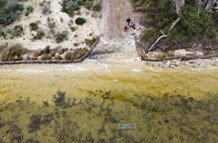
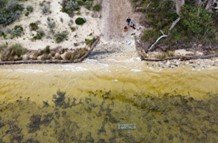
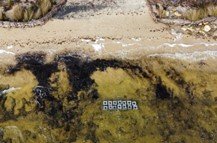
Due to a one-day permit, the reef was deployed in two positions: 0.6m depth to simulate high tide and 0.3m for low tide (Figure 2). Relocating it after 4pm as the tide receded allowed testing across the full tidal cycle within the limited timeframe (Figure 3).
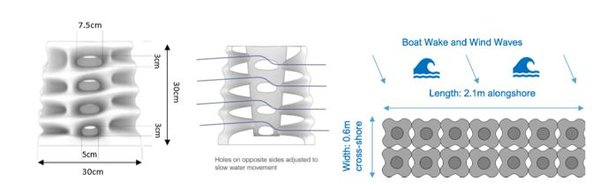
Fig1
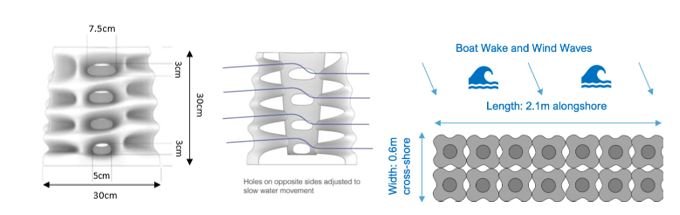
Figure 1. Diagrams show the reef module dimensions with 3cm inner voids to enhance dissipation, and a reef height of 30cm. 14 modules were adjacently placed into a 2.1m long and 0.6m wide reef.
© Harrington S. 2024.
wave trial Fig2a
wave trial Fig2b
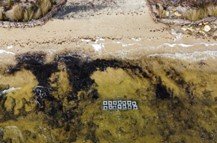
Figure 2. Reef deployment scenarios with sensors deployed at water depths specific to the reef location. Left) High Tide ~ 0.6 m and Right) Low Tide ~ 0.3 m.
© Harrington S. 2024.
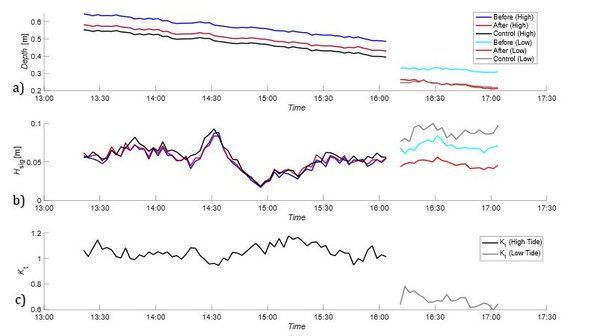
Fig 3 graphs
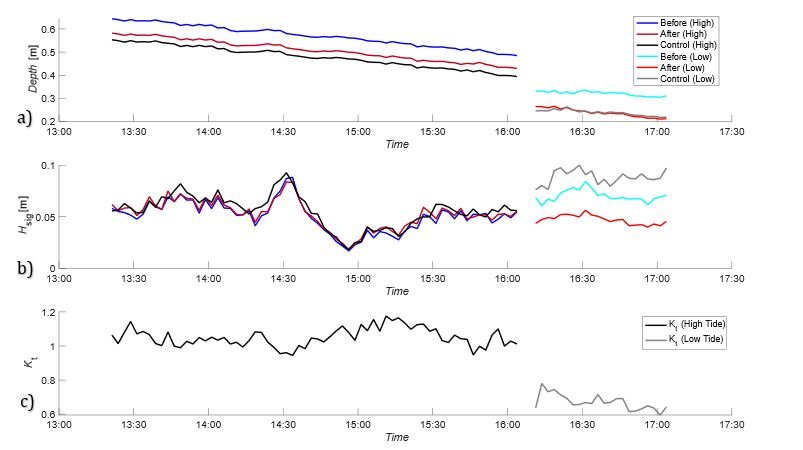
Figure 3. Tidal influence on a) Reef water depth, b) Hsig and c) Kt . The wave conditions were calculated with a 150 second bin interval over a time of 13:20-16:05 for the high tide scenario and 16:10-17:05 for the low tide scenario. There is a clear difference in attenuation from an average Kt = 1 at high tide to an average Kt = 0.68 at low tide.
© Harrington S. 2024.
Key findings
- Wind waves were attenuated 12% more effectively on average than boat wake waves, likely due to wind waves shorter wavelengths (higher frequencies).
- At low tide, with a water depth of 0.3 m (equal to the reef height), the reef was found to reduce significant wave height (Hsig) by 32% on average (Kt = 0.68) (Figure 3), equating to an average 54% reduction in wave energy
- At high tide, with water depth (0.6 m) double the reef height, wave attenuation was negligible (Kt = 1), highlighting the depth sensitivity of the reef’s performance (Figure 3).
- Wave run up was measured qualitatively with a drone and hunting cameras. Rough analysis of one of the frames at low tide, estimated the reef reduced the run up by 50 cm which is about 30%. No run up reduction was found for the high tide scenario.
Limitations and considerations
- The reef's performance significantly declined in deeper water, reducing effectiveness during high tides or storm surges. Scaling up (x2) would likely improve this but requires consideration of site-specific tidal conditions and approvals surrounding potential boating hazards.
- Uneven, rocky riverbed conditions made it challenging to interlock the reef modules securely, affecting stability (Figure 4). Future deployments should consider bathymetric scans to identify flat, suitable sites for greater stability.
- Ocean deployments, with stronger wave forces, would require greater structural stability. Scaling up reef modules (from 26 kg to 200 kg) enhances stability but necessitates barge installations.
- The small scale of this trial limits its direct applicability to large-scale projects. A 2-row configuration was tested due to logistical constraints, but multi-row setups (≥3 rows) have demonstrated superior stability and enhanced wave attenuation in laboratory studies.
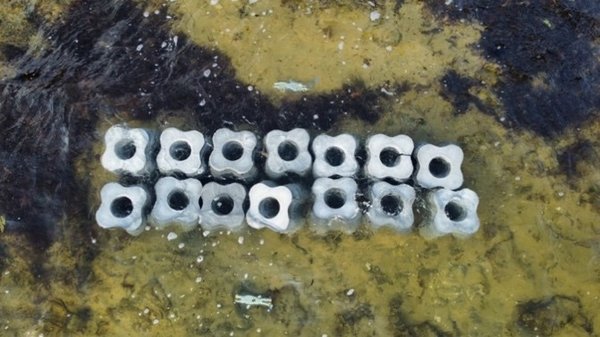
Fig 4
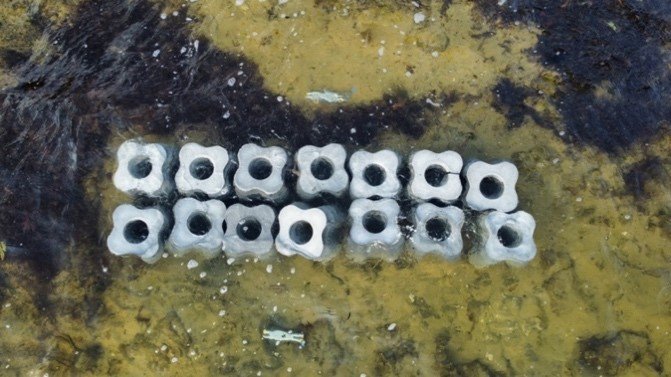
Figure 4. The low tide reef deployment shows “tipped over” modules due to a rocky riverbed.
© Harrington S. 2024.
Potential for adaptation
This trial demonstrates the potential of artificial reefs as a versatile tool for coastal protection. While this study focused on one reef design, other porous structures, such as the Bombora modules at CY O’Connor Beach, can also be effective. Artificial reefs can attenuate wave energy, mitigate erosion, attract marine life for eco-tourism, and support water quality improvement through shellfish filtration. Clear objectives are critical for optimising reef design and ensuring site-specific conditions align with the desired outcomes. Integrating features like shellfish colonisation, seagrass recovery, or mangrove integration could further enhance ecological and protective benefits, but success depends on careful consideration of local wave climates, tidal conditions, and the underlying priorities of key stakeholders.
Outcomes and recommendations
Artificial reefs can effectively attenuate wave energy in shallow water, offering a potentially viable alternative to traditional hard infrastructure. However, optimising reef performance requires site-specific studies to determine the ideal depth placement. This involves balancing effective wave attenuation during high tides and storm surges while maintaining sufficient submergence to support biological growth and optimise this nature-based solution.
- Further quantitative studies are recommended to assess the reef’s impact on wave run-up, providing a clearer understanding of its effectiveness in reducing coastal erosion.
- Long-term monitoring in the SCE is needed to assess biological colonisation and habitat restoration potential locally, however other studies show great oyster accumulation (Figure 5).
- Stakeholder engagement – including input from state departments, local councils and various environmental organisations – is beneficial for ensuring appropriate approvals and previous learnings are shared across the industry.
Fig 5
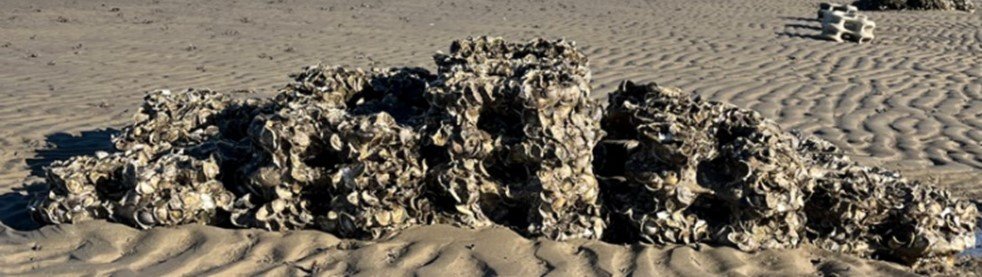
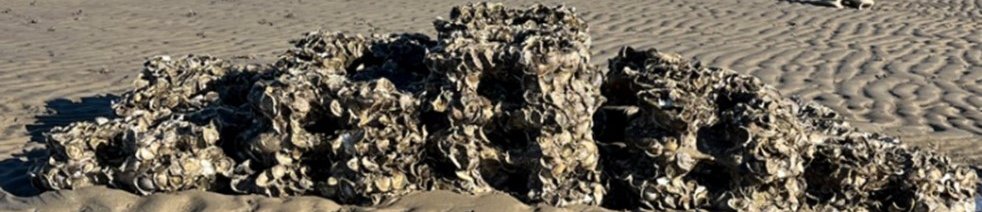
Figure 5. The same reef design tested in St. Andrews Bay, Florida, United States of America (USA). Image shows oyster growth after a few months of deployment for a Defence Advanced Research Projects Agency (DARPA) study. St. Andrews Bay has similar conditions to the Swan River although the USA modules were scaled up to 0.6 m for field deployment and various layouts were tested.
© Harrington S. 2024.
Conclusions
This pilot study demonstrates the feasibility of artificial reefs in attenuating wave energy in estuarine environments. While effective under specific conditions, future work should address limitations related to depth sensitivity and scaling to larger projects. This nature-based solution offers a promising pathway to reduce wave energy for coastal adaptation to sea level rise and ecosystem restoration.
To cite:
This case study was prepared by Stephanie Harrington, UWA. Please cite as: Harrington S. 2025. Field trial of wave transmission over an artificial reef in the Swan River, WA. Case study for CoastAdapt, National Climate Change Adaptation Research Facility, Griffith University, Gold Coast.