


At a glance
- Big Swamp is one of the most significant acid sulfate soil hotspots in New South Wales.
- Acid runoff from the former wetland - drained for agriculture - has had a significant detrimental impact on nearby waterways.
- In 2011, the local council, now MidCoast Council received a $2 million Federal Government grant to address acid runoff at Big Swamp.
- The Council engaged the University of New South Wales Water Research Laboratory to conduct a hydrological study of Big Swamp, and to develop models to identify the highest priority acid hotspots for remediation to have the biggest impact on improving water quality.
- A strategy to restore the wetland at Big Swamp was initiated, which significantly improved water quality while also regenerating the native habitat.
- Land identified as highest priority for remediation was purchased, and the acid runoff addressed by restoring the wetland.
- As well as improving water quality, the project has regenerated an ecologically diverse coastal wetland habitat with blue carbon potential.
Background and context
Big Swamp is a 2000 ha floodplain, located on the Manning River estuary near Taree on the mid-north coast of NSW. Formerly a shallow wetland habitat, from the early 20th century, Big Swamp was drained for farming through construction of an extensive system of drainage channels and floodgates.
Being drained exposed Big Swamp’s sulfidic subsoils to the air, which resulted in the acidification of the soil and surrounding waters, significantly degrading the land. Rainfall events in the catchment would create plumes of extremely acidic runoff that would enter and pass along the lower estuary of the Manning River, resulting in large scale fish kills and severely impacting the local oyster industry.
By the late 20th century, Big Swamp was recognised as one of the most significant acid sulfate soil hotspots in Australia.
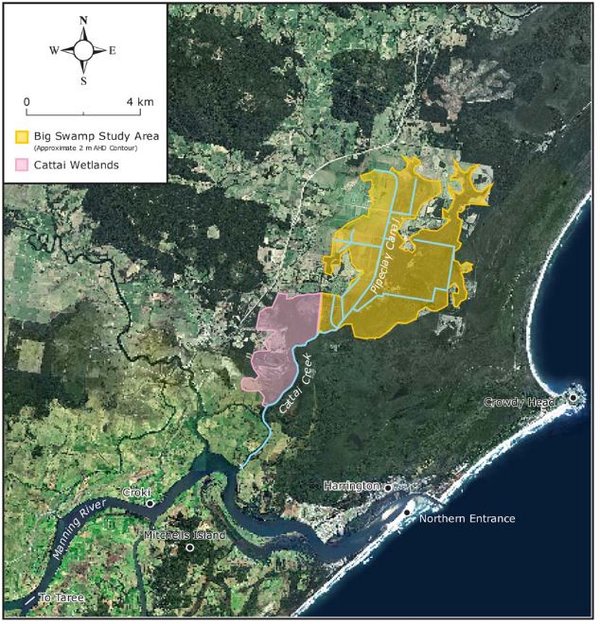
Big Swamp - study area map
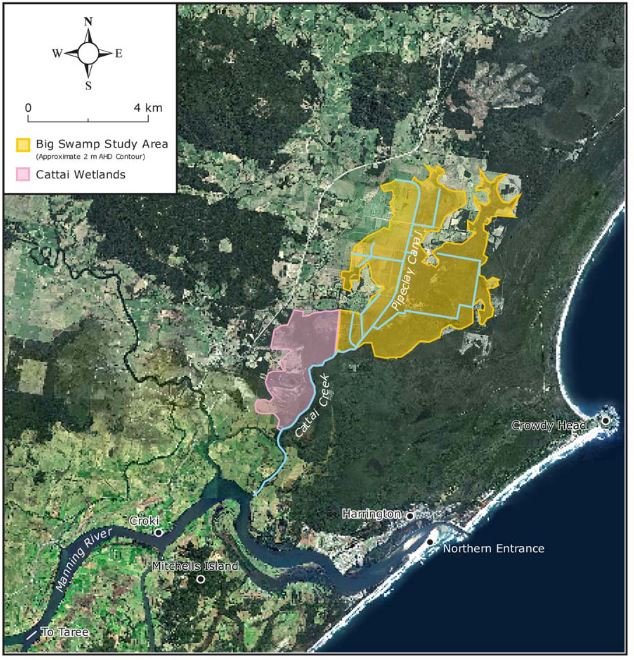
Big Swamp flood plain study area
© WRL 2014
Description of climate risks and impacts
Acid sulfate soils (ASS) are found widely across Australia, inland and along the coast. Australia has an estimated 58,000 km2 of coastal ASS, distributed around the country.
ASS form naturally in waterlogged land where organic matter, iron and sulfate in the soil have reacted to form reduced iron sulfide minerals. In their natural inundated state, ASS pose no threat. However, when exposed to the air – including in drained wetlands – these minerals can oxidise to form sulfuric acid, acidifying the soil to a pH below 4.
The acidity in the soil can leach into waterways, potentially impacting local groundwater and surface waterways. In Big Swamp, large acidic plumes with a pH as low as 2.7 have been recorded in the Manning River and these severely impact the river ecosystem.
Possible interventions to address the impact of ASS in drained coastal wetlands can include:
- introducing containment strategies to restrict the flow of acidic water from ASS-affected land into nearby water systems
- re-establishing the wetland, with tidal flushing, to curtail further acid production and neutralise the existing soil acidity through the inflow of buffering bicarbonates present in marine water.
Identification and/or implementation of adaptation actions
In 2011, Greater Taree City Council (now MidCoast Council, following a 2016 merger with neighbouring councils) received a $2 million Federal Government 'Caring for our Country' grant to improve water quality by addressing acid runoff from Big Swamp.
The Council contracted researchers from the Water Research Laboratory (WRL) at the University of New South Wales to conduct a hydrological study of the area. WRL was engaged by Council as an embedded project partner. The WRL researchers participated in activities ranging from community engagement to key decision making.
When the project began, Big Swamp was a varied site including pockets of natural habitat, drained forest and cleared drained land. WRL researchers conducted a fieldwork-intensive survey of soil and water sampling and analysis across the 2000 ha site, identifying acid hotspots and acid transport pathways. Based on this study, WRL identified priority parts of the site that were responsible for most of the acid runoff. The hydrological study highlighted an approximately 1000 ha area for project prioritization, which enabled Council to focus the project resources and land acquisitions on these areas to maximise the environmental impact.
In parallel with the field survey, Council and WRL consulted the local community and Indigenous groups. When the project began, there was significant community concern: this was later attributed to misconceptions about the scope and potential impacts of the proposal.
The project consultation activities began with the team organising a town hall event to convey project goals and consult the community. They also organised multiple small meetings with community members, typically involving 5-10 participants, to talk through the proposed works. The team also met with individual landholders on their properties, to walk the site and discuss the plans. Through this sustained and diverse approach, the project team was able to build strong community support.
Once the site analysis was complete, the WRL team concluded that the most effective option to address acid runoff from Big Swamp was to restore prioritised parts of the site as a tidal wetland. The planned major earthworks included infilling 15 km of drainage channels, decommissioning levees, reshaping the land to encourage re-flooding, and establishing a new river channel to re-establish tidal inundation while providing freshwater retention and flood mitigation.
Should they contain the acid runoff or rehabilitate the wetland?
A key decision for ModCoast Council was whether to try to contain the acid runoff at Big Swamp, or whether to attempt to address the water quality issue by rehabilitating the site as a functioning wetland.
Prior to Big Swamp, WRL researchers had successfully completed a series of wetland restoration projects of increasing size and complexity on ASS-affected land. Council had also recently undertaken its own smaller wetland restoration at nearby Cattai. Based on the successful outcomes achieved at these sites, and the site analysis conducted at Big Swamp, Council made the decision to acquire and restore prioritised parts of Big Swamp into wetland.
The most significant barrier to the project was for Council to negotiate with landholders to acquire priority areas of low-lying land that had been identified by the WRL analysis. Initially, the farmer that owned the key piece of land central to any rehabilitation works was unwilling to sell the land.
During the negotiations, WRL conducted a detailed field study tracking the aftermath of a localised rain event that flooded the small sub catchment of this key piece of land. The team tracked the resulting acid plume that moved into and through the river estuary, killing fish and oysters.
Following the analysis, which made front page news, there was a build-up of strong community pressure to address the problem. Ultimately, Council was able to successfully negotiate the voluntary sale of the land.
A project officer funded by the grant was instrumental in managing the procurement process, and then to oversee the day-to-day operations of the extensive project groundworks.
In addition to re-establishing the wetland, the project installed perimeter infrastructure such as flood gates, channels and levees to prevent adverse impacts to surrounding farmland. Only once the groundwork was complete was the tide allowed back into Big Swamp.
Of the 726 ha of high priority ASS-affected land purchased for the project, the team created an 80 ha tidal wetland including a new large tidal swale, and a 620 ha freshwater wetland.
Since the completion of the works, an additional 169 ha of land was purchased and incorporated into the wetland.
The Big Swamp project has significantly improved water quality in the catchment, while restoring 895 ha of degraded ASS-affected farmland into an ecologically diverse wetland.
In 2015, the success of the project was recognised with a Green Globe Award.
The next step in the project would be to restore the entirety of Big Swamp to wetland. Council has been in negotiation with the landholder to purchase the remaining 1000 ha of Big Swamp, to complete the wetland rehabilitation of this ASS hotspot.
Lessons learned
- The successful implementation of wetland restoration on degraded ASS farmland at Big Swamp, which pursued a strategy pioneered on smaller sites, further demonstrates the scalability of this approach to remediate degraded drained land afflicted with ASS. There is now a strong momentum for conducting similar remediation works in New South Wales, and growing interest in Victoria and Queensland
- Previous wetland rehabilitation projects were often undertaken with a single narrow purpose, such as addressing acid runoff or preserving a specific endangered plant or animal species. There is growing understanding that such projects can be managed to maximise a wide range of additional environmental benefits, tailored to the strengths of the individual site.
- Rather than attempting to return Big Swamp to precisely its form prior to its drainage, the team pursued a ‘rehabilitate forward’ strategy to gain the best outcome for the river in its present form. This strategy was widely consulted, which emphasised that the state of Big Swamp at the moment of European arrival was just a snapshot in the long and evolving indigenous history of the area.
- The hydrological study and area prioritization analysis conducted by WRL took a lot of resources in terms of time, cost and effort. However it was judged to be so effective that it has been rolled out to coastal floodplains in nine local government areas across New South Wales.
- Funding a full time project manager was a key aspect to the success of the project: from the complex land acquisition negotiations to on ground oversight of the extensive groundworks. This was important as it was imperative to get the groundworks right the first time – it is very challenging to redo or do additional groundworks once the tide is allowed onto the site.
- The time invested in gaining community support for the project was a significant advantage when it came to acquiring priority land to undertake the rehabilitation work.
- Effective communication of the successful implementation of each phase of the project was prioritised, with the strategy of ‘success building success’. Following the initial land acquisition, four further landholders sold plots of land to support the expansion of the project.
- Beyond the environmental benefits, the economic benefits are also clear. A cost benefit analysis conducted during the evaluation of a proposal to acquire the remaining 1000 ha private land in the Big Swamp area to expand the remediation, showed the financial benefits of the work outweigh the cost by 7 to 1.
To cite:
This case study was prepared by William Glamore, Water Resources Laboratory, UNSW. Please cite as: Glamore, W., 2024: Big Swamp: transforming degraded acid sulfate soil farmland into a functioning tidal wetland ecosystem. Case study for CoastAdapt, National Climate Change Adaptation Research Facility, Griffith University, Gold Coast.
Further information
- Atlas of Australian Acid Sulphate Soils. Atlas
- Acid Sulfate Soils Centre
- UNSW Water Research Laboratory Big Swamp project Report
- Big Swamp Rehabilitation Project Hydrological Study, pdf
- Institute of Public Works Engineering Australia, Big Swamp case study
- Coastal floodplain prioritisation study that outlines which LGAs are undertaking similar projects, Report