



At a glance
- Researchers have compared the financial and other costs and benefits of three potential modes of coastal retreat for a 1.7 km segment of sandy Hawai’ian coastline.
- Continued unmanaged reactive retreat was the least costly option, particularly for public finances, but came with a number of risks.
- All-at-once retreat gained the most beach area, but at significant financial cost.
- Threshold-based managed retreat can offer a cost-effective option for relocating threatened property and infrastructure while maintaining a sandy beach

When erosion strikes there are many risks
Like many sandy beaches around the world, Sunset Beach on O’ahu, Hawai’i, is experiencing increasing beach erosion exacerbated by sea level rise. As the erosion line moves inland, public and private infrastructure built on the dunes behind the beach, including beachfront homes, has begun collapsing onto the dwindling strip of public beach.
This unmanaged response to sea level rise poses public safety and environmental contamination risks, as well as resulting in the loss of the sandy beach. To mitigate these issues, managed community retreat from rising seas can be considered.
Using Sunset Beach as a case study, US researchers have compared the costs and benefits of three potential approaches to coastal retreat of property and infrastructure: managed all-at-once retreat; managed threshold-based retreat triggered property by property once the encroaching beach erosion line falls below a predetermined distance; and unmanaged reactive retreat once a property is severely damaged or lost to beach erosion.
The studied area is a medium-density settlement, with up to 88 parcels of land predicted to be impact by sea level rise by 2100. The area also features infrastructure including water mains and a section of highway including a bridge, but no sewer infrastructure.
The three retreat options were evaluated over an eighty-year period to 2100. Sea level rise projections were based on the upper limit of the likely range from the RCP8.5 business-as-usual scenario of the IPCC’s 5th Assessment Report, now considered an intermediate level scenario.
Evaluating extremes
The key advantage of all-at-once retreat – in which all property and infrastructure projected to be impacted by erosion line retreat by 2100 is proactively removed and potentially relocated, simultaneously and as soon as possible – is that it delivers the largest beach area over the considered timeframe. It also avoided the risks associated with built infrastructure collapse onto the beach.
The significant downside of all-at-once retreat was that it was considerably more expensive than other retreat options. The estimated $207-333 million cost (which varied depending on the coastal erosion projection model used) was six-fold higher than reactive unmanaged retreat. The main contributors to this high cost were the public expense of acquiring affected private property at current full market value, followed by the public expense of infrastructure retreat.
Unmanaged reactive retreat was the least financially costly option, with an overall estimated cost of $53-73 million. This approach was the most expensive for private property owners, however, with $24-43 million borne by property owners due to the near-complete loss of property value and the clean-up cost of collapsed structures (if enforced).
Reactive retreat provided the least beach area over the study period. It also comes with further loss of beach amenity – and significant risks to public and the environment – associated with built infrastructure collapsing onto the beach and releasing hazardous pollutants such as asbestos.
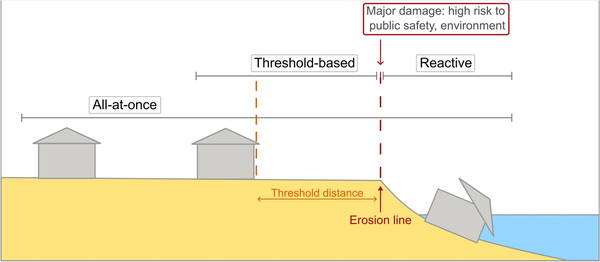
Depiction of retreat framework for the three retreat approaches: all-at-once, threshold-based, and reactive.
- © Reproduced from Setter et al. 2023 under Creative Commons 4.0Three options diagram
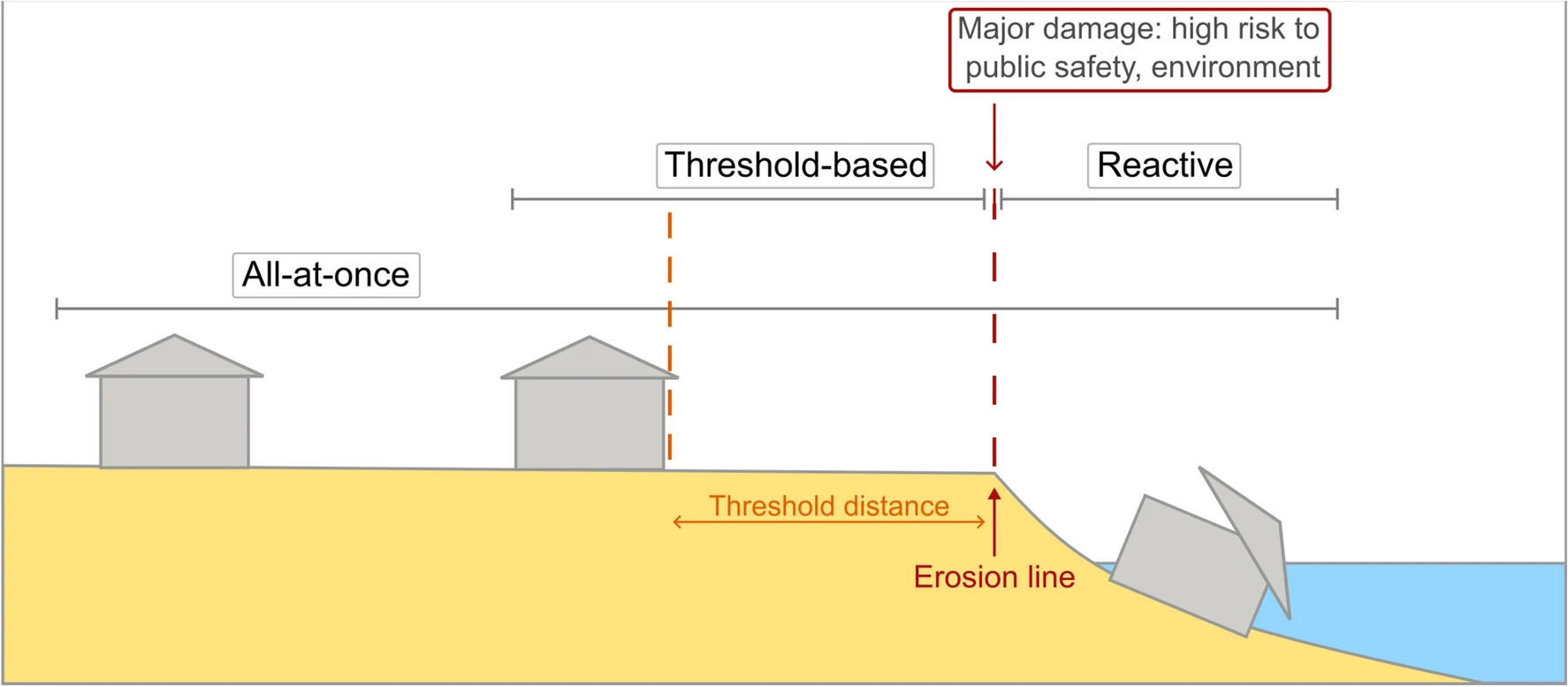
Depiction of retreat framework for the three retreat approaches: all-at-once, threshold-based, and reactive.
© Reproduced from Setter et al. 2023 under Creative Commons 4.0
A Goldilocks approach?
Threshold-based managed retreat from sea level rise – which the researchers modelled as a 6m distance between the infrastructure and the erosion line – avoided all the downsides associated with buildings collapsing onto the beach.
Notably, threshold-based managed retreat was found to be similar in overall cost to unmanaged reactive retreat, with an estimated $37-85 million cost. Compared to reactive retreat, a much lower proportion of this cost would be borne by private property owners, due to public acquisition of condemned properties. However, the public costs remain considerably lower than all-at-once retreat, with homeowners compensated for their dwelling and property landward of the sea level rise projection line, rather than receiving current full market value.
Although threshold-based retreat did not deliver as much total beach area as all-at-once retreat, it delivered more than reactive retreat and provided the biggest beach area gained per dollar.
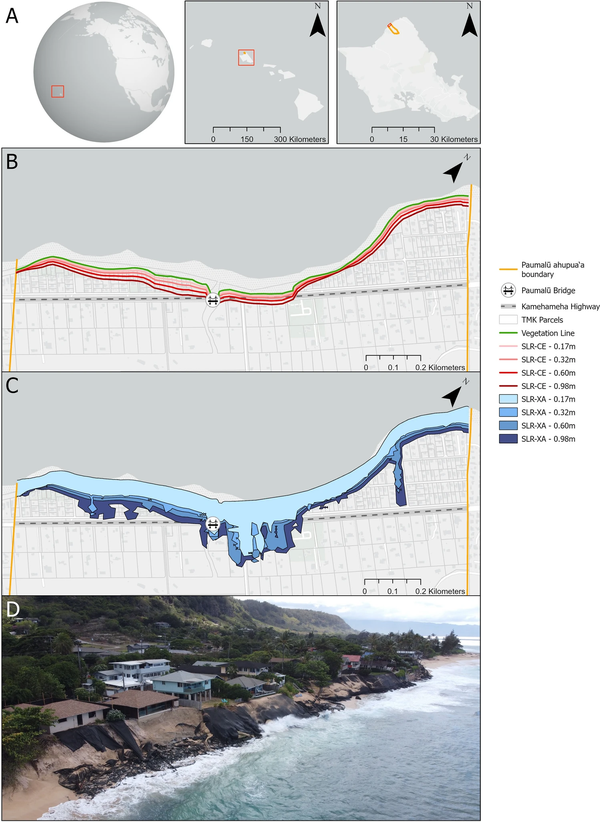
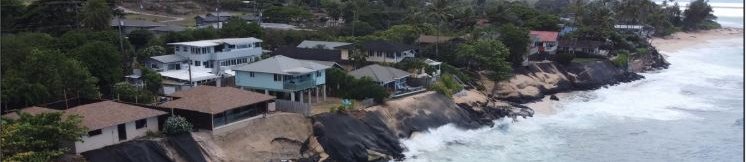
Study site of Paumalu ahupua‘a, located on the island of O‘ahu within the Hawaiian Islands. (A). An aerial image displays a segment of the case study area demonstrating the chronic erosion and efforts to prevent further erosion with geotextile materials (photo credit: Renee Setter; panel D). A comprehensive visualization of datasets used in this study, including coastal erosion (SLR-CE; panel B) and exposure area (SLR-XA; panel C) projections at varying SLR levels in the case study area. The most recently available 2021 vegetation line (B) is included to illustrate the highest wash of the waves. Local infrastructure datasets include the highway (Kamehameha Highway) and the bridge over Paumalu River.
- © Reproduced from Setter et al. 2023 under Creative Commons 4.041598_2023_38939_Fig1_HTML

Study site of Paumalu ahupua‘a, located on the island of O‘ahu within the Hawaiian Islands. (A). An aerial image displays a segment of the case study area demonstrating the chronic erosion and efforts to prevent further erosion with geotextile materials (photo credit: Renee Setter; panel D). A comprehensive visualization of datasets used in this study, including coastal erosion (SLR-CE; panel B) and exposure area (SLR-XA; panel C) projections at varying SLR levels in the case study area. The most recently available 2021 vegetation line (B) is included to illustrate the highest wash of the waves. Local infrastructure datasets include the highway (Kamehameha Highway) and the bridge over Paumalu River.
© Reproduced from Setter et al. 2023 under Creative Commons 4.0
Outcomes and next steps
- Communities should explore a threshold-based managed approach to coastal retreat in the face of sea level rise and sandy beach erosion, the research team concluded. Threshold-based retreat minimised public and environmental risk, maintained a sandy beach area, and was cost-competitive with other approaches to coastal retreat
- Threshold-based retreat could operate through a voluntary buyout process
- Communities should collaboratively consider the appropriate retreat trigger for their area, to retreat in a timely but not premature manner. Post-retreat plans for vacated land, such as dune restoration, should also be evaluated
- Future research is needed to compare modes of coastal retreat for other types of beach adjacent settlement, including urban areas, and areas with more infrastructure. More advanced modelling based on dynamic rather than fixed property market values, and extending beyond 2100, would also be valuable
To cite:
This case study was prepared by NCCARF. Please cite as: NCCARF, 2024: Comparing costs of three approaches to coastal retreat for beachside communities in Hawaii. Case study for CoastAdapt, National Climate Change Adaptation Research Facility, Griffith University, Gold Coast.