


At a glance
- As extreme events become more frequent or intense, environmental managers need to develop biodiversity management strategies that include post-fire and -flood assessments.
- This study used eDNA sampling, a non-invasive and highly sensitive method, to assess the impact of the 2019-2020 Australian megafires on the distribution of platypus across 159 watershed in southeastern Australia.
- Researchers were able to efficiently sample sites and detect changes in platypus occupancy. They could use this technique after the fires because they already had an extensive dataset of pre-fire samples.
- The study revealed a significant decline in platypus occupancy in areas affected by the fires, particularly in regions that experienced high-severity burns. Post-fire rainfall worsened conditions by washing ash and debris into waterways, harming aquatic ecosystems.
Biodiversity monitoring after bushfire
Environmental DNA (eDNA) sampling can be used to monitor significant fauna after an extreme event such as flood or bushfire. This new, but increasing used, technique was used by an research team led by University of Melbourne to understand the effects of the 2019-2020 Australian megafires on the distribution of the platypus (Ornithorhynchus anatinus), a species already noted to be in decline.
The fires began in August 2019, one of the warmest and driest years on record for Australia. By March 2020, the ‘Black Summer’ fires had burned an estimated 7-12 million hectares across southeastern Australia, including coastal areas that generally are not considered to be at risk from bushfires.
To broadly understand the impact of the fires on platypus, the researchers used eDNA sampling. The benefit of eDNA sampling is that it is non-invasive and highly sensitive to detecting platypus: it is also simple and efficient: sites are sampled in minutes.
Sites sampled across southeastern Australia
The researchers used an extensive dataset of pre-and post-fire eDNA samples within a Before-After-Control-Impact (BACI) study design.
They estimated changes in platypus occupancy at both fire-affected and non-fire-affected sites over time (1-2 years) and also examined how these changes were affected by factors like fire severity and post-fire rainfall (60 days after the burn).
The study area across southeastern Australia covered 159 watersheds that had significant variation in rainfall, temperature, vegetation, and terrain.
Site were selected because they had been sampled for eDNA between 2-12 months before the fires. After the fires, sampling was 1-year post-fire from March–November 2020 and 2-years post-fire from March–June 2021. Sampling took place at 285 unique sites, but the analysis focused on 187 sites with both pre- and post-fire data. ‘Burnt’ sites were classified by whether fire was present within the watershed or a site was within the burnt area.

platypus map_covariate I
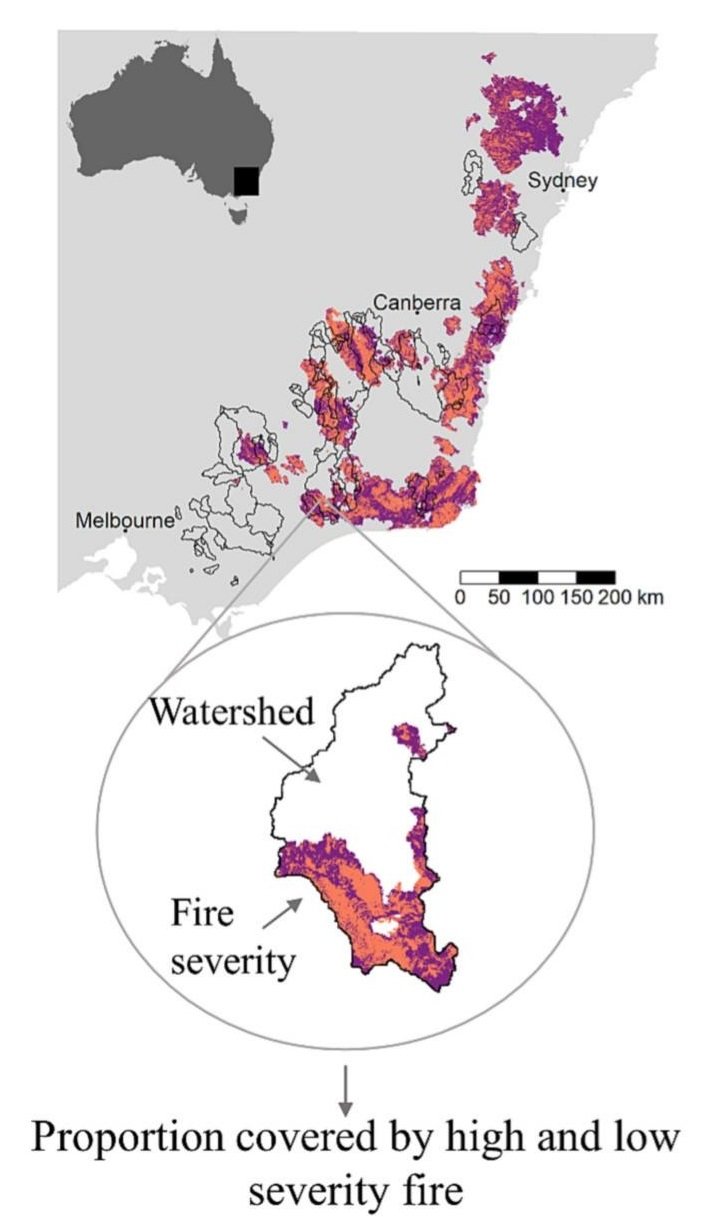
Map of study sites and fire severity
© McColl-Gausden et al. 2023. Reproduced under CC BY 4.0.
Findings showed a major decline, especially for some
The findings were stark: platypus occupancy decreased significantly at sites impacted by the fires, especially at sites that had experienced high-severity burns. For some areas, rainfall soon after the fire exacerbated the situation: ash and debris were washed into waterways increasing nutrients and sediments and lowering oxygen concentrations—conditions that are detrimental to aquatic fauna, either directly or indirectly by reducing their invertebrate prey.
The study has important implications for management and conservation. As extreme weather events become more frequent due to climate change, there is a need for more comprehensive post-fire assessments – also supported by effective biodiversity management strategies – that consider the impacts on aquatic fauna, particularly for vulnerable species such as playtpus.