



At a glance
- A framework has been developed that can predict the timing, location and severity of storm-induced beach erosion and coastal flooding events around Australia.
- The model combines information about coastal bathymetry, wave and water level forecasts, and beach and dune topography, to generate a rolling 7-day forecast of beach erosion or coastal flooding caused by storms.
- The framework was developed in consultation with potential end users in emergency management roles, to deliver hazard forecasts tailored to support emergency event decision makers.
- Pilot phase storm hazard forecasts, currently being generated for parts of the West Australian and New South Wales coastlines, can be found at https://coastalews.wrl.unsw.edu.au
- The next generation of the system will be tested in Victoria and will be designed to improve forecast accuracy by incorporating additional information, such as current satellite data of shoreline position and beach topography.
- Discussions are underway to establish the pathway for incorporating the system into Australia’s national hazard warning infrastructure.

Highs and lows of storm hazard prediction
When an east coast low struck eastern Australia in June 2016, the University of New South Wales research team – who had been engaged in the long-term study of Sydney’s Collaroy-Narrabeen beach – knew what was coming. Up to a week in advance of the extreme weather event, the team anticipated that extensive beach erosion and damage to coastal infrastructure would accompany the storm. Beyond informally notifying the local council, however, the team had no established way of alerting authorities of the expected severity of the event.
The team’s prediction proved to be correct, with the storm causing extensive but localised erosion and infrastructure damage along more than 2,000 km of southeast Australia’s coastline.
Prompted by their technical capability to forecast the storm erosion event, but lack of mechanism to notify emergency managers in local councils and the emergency services, the UNSW Water Research Laboratory team began developing an experimental national-scale storm hazard early warning framework.
The researchers teamed up with the University of Western Australia and Bureau of Meteorology to develop a system capable of forecasting the timing, location and severity of storm-induced beach erosion and coastal flooding around Australia.
Storm versus beaches
The group has developed a multiscale approach to forecast beach erosion and coastal flooding.
At a broad regional scale, to generate a rolling 7-day hourly forecast of storm hazards at every 100 m around the Australian coastline, a computationally efficient approach was required.
To predict coastal flooding hazard events at regional scale, the system compares the topographic profile of beaches at points spaced 100 m apart around the coastline, to existing forecast data on total water level around the coast. The system identifies the time, location and extent to which water is predicted to overtop the pre-storm dune crest during a storm, to generate a regional scale coastal flooding forecast.
To predict coastal erosion hazard events at regional scale, a new forecast system was developed that calculates the dune impact exposure to incoming waves (by comparing predicted water level to the height of the dune toe); the cumulative wave energy of the storm; and the dune stability factor based on the topographic beach profile. By comparing these factors against predetermined threshold values at every 100 m along the shore, erosion hazard scale predictions – from minor beach narrowing through to dune retreat – are generated.
If significant erosion or flooding is predicted, the framework is triggered to generate more precise local-scale forecasts at predetermined coastal locations of high value or vulnerability. These local forecasts are generated by computationally intensive numerical modelling of the storm event, to quantitatively predict the erosion and flooding hazard at these places.
The framework was designed to generate hazard warnings that would be fed to existing emergency management teams in local government and the emergency services, and was developed in consultation with these end users. Emergency managers might, for example, use the forecast location, timing and extent of the storm hazard to direct targeted sandbagging efforts, to arrange evacuations or road closures, or to direct utility companies use to shut down or divert beachfront gas lines, telecommunications, electricity and sewer lines in the impacted area.
Based on end user discussions, the system was also configured conservatively, to minimise the number of hazard events that the system fails to predict at the expense of generating a few false alarms.
Online portal
A two-year detailed evaluation of the storm hazard early warning framework is currently underway along a 350 km sections of Western Australia coastline and 450 km of the New South Wales coastline.
The coastal hazard forecasts for these areas are currently communicated via a dedicated online portal. The portal displays a regional summary of beach erosion and coastal flooding hazard for the next 7 days, and a map showing a looping graphic of wave height and direction (see Figure 1)
When no storm is forecast, the regional summary page presents all relevant information. When a storm is forecast within the 7-day window, users can click on the map to access more detailed location-specific data on waves, water levels, and beach erosion and flooding hazards.
Users can also click the info tab, which explains the hazard warning levels for beach erosion and coastal flooding.
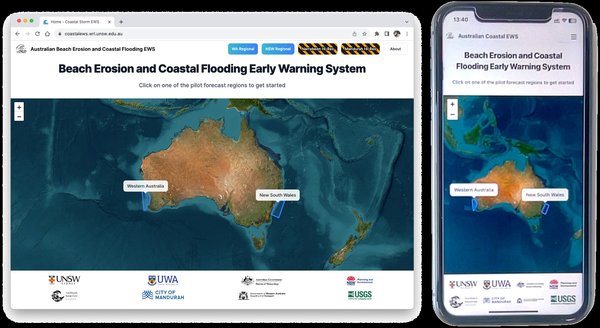
Figure 1. Online portal and phone app for the early warning system for beach erosion and coastal flooding.
- Turner et al. 2024.Figure 6 - landing page combined

Figure 1. Online portal and phone app for the early warning system for beach erosion and coastal flooding.
Turner et al. 2024.
Future forecasts
When the forecasting system was tested against historical pre- and post-storm beach survey data collected over an 11-year period at Sydney’s Collaroy-Narrabeen beach, the system is correctly predicted all 43 major storm events. It also generated five false alarms, in line with the conservative hazard warning thresholds selected.
The key source of uncertainty in the forecasting framework, and of inaccuracy in the hazard forecasts generated, is system’s information on shoreline position, beach width and dune shape. The system currently derives this information from aerial LIDAR survey, but this data is collected infrequently and can be multiple years out of date.
The team is developing a next generation of the system that captures current beach morphology from satellite imagery. Satellites now image the coastline with at least biweekly frequency. If a storm event is predicted, the system imports the latest satellite data for the affected region, from which to generate its beach erosion and coastal flooding forecast. A trial of this system along a section of Victorian coastline is now planned.
Discussion is also underway with the national-level hazard warning coordination group, to establish the pathway by which the coastal storm hazard early warning capability could be developed into a fully operational national system, adopted and run by a federal agency. The capability would be added to existing hazard alert systems and procedures.
To cite:
This case study was prepared by NCCARF.
Please cite as: NCCARF, 2024: National early warning system for storms. Case study for CoastAdapt, National Climate Change Adaptation Research Facility, Griffith University, Gold Coast.