


At a glance
- Scientists and Malgana rangers combined scientific methods with Indigenous cultural knowledge to design and trial effective seagrass restoration techniques in Western Australia.
- Field-based workshops on-Country enabled hands‑on training, knowledge exchange and relationship building, strengthening cultural understanding and restoration capacity.
- The project developed scalable restoration methods, improved community understanding, and created cultural, social, and employment benefits.

Healing Country through restoring seagrass
Seagrasses are declining globally, largely due to anthropogenic activities, including the impacts of climate change. Reversing this decline by restoring natural ecosystems is challenging and can take decades of sustained effort. Adoption of Indigenous co-governance and management arrangements is an emerging approach to environmental management in Australia and other regions, which provides opportunities for collaborative research and more effective restoration.
A significant heatwave in 2010 –11 affected terrestrial and marine ecosystems along Australia’s west coast, resulting in damage and loss of about 1300 km2 of seagrasses in Shark Bay. Natural recovery has been slow, prompting the need for assisted recovery. However, researchers need more knowledge about the restoration potential of seagrass meadows in Shark Bay to design and implement adaptive management strategies to address the loss and respond to future extreme events.
The granting of Native Title in 2018 and the subsequent establishment of Malgana Aboriginal Corporation (MAC) and its associated ranger program provided an opportunity to develop a partnership between researchers from the University of Western Australia (UWA) and rangers from the MAC.
“When we first started, there were no protocols about how to engage with this Mob; they didn’t have Native Title then. We first met them at a science fair in Shark Bay, in an outdoor setting. We were all just sitting around talking – we realised we shared a common passion to conserve a healthy Shark Bay ecosystem.”
Dr Elizabeth Sinclair, UWA.
After this impromptu meeting, a joint application to the National Environment Science Plan (NESP) secured a grant of $200K to carry out a joint seagrass restoration project. The initial goal was to research and develop the best methods to assist in the recovery of seagrass at Shark Bay.
Malgana Sea Country, most of which is included in the UNESCO World Heritage Site, supports high biodiversity, including 28 species of sharks, more than 1500 fish species, and 12 species of seagrass.
Large temperate seagrasses – Amphibolis antarctica (wire weed) and Posidonia australis (ribbon weed) – are the dominant species, creating about 4300 km2 of persistent meadows. Both species were devastated in the heatwave, with the flow-on effect of declining health in culturally significant animal species and the closure of some commercial aquaculture and fisheries.
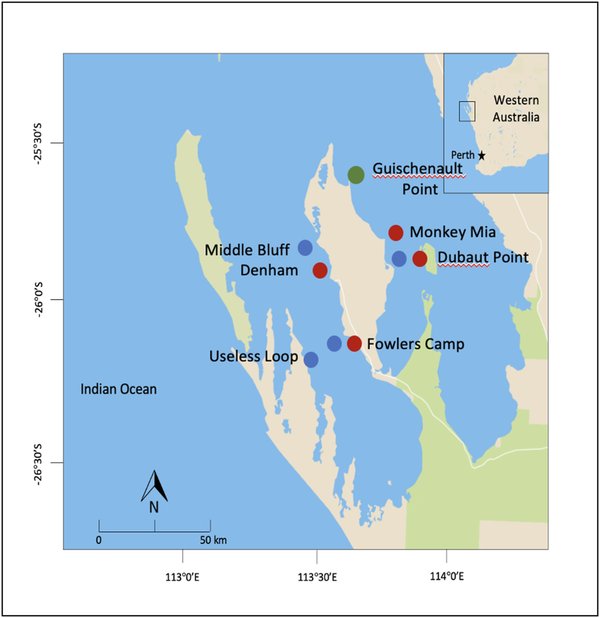
Seagrass restoration sites in Shark Bay by transplanting (blue circles), assisted natural recovery through engineering substrate and sediment stabilisation (red circles), and seed-based restoration (green circle). Inset: Location of Shark Bay in Western Australia.
- CC BY-SA 4.0 licenceMap of Shark Bay
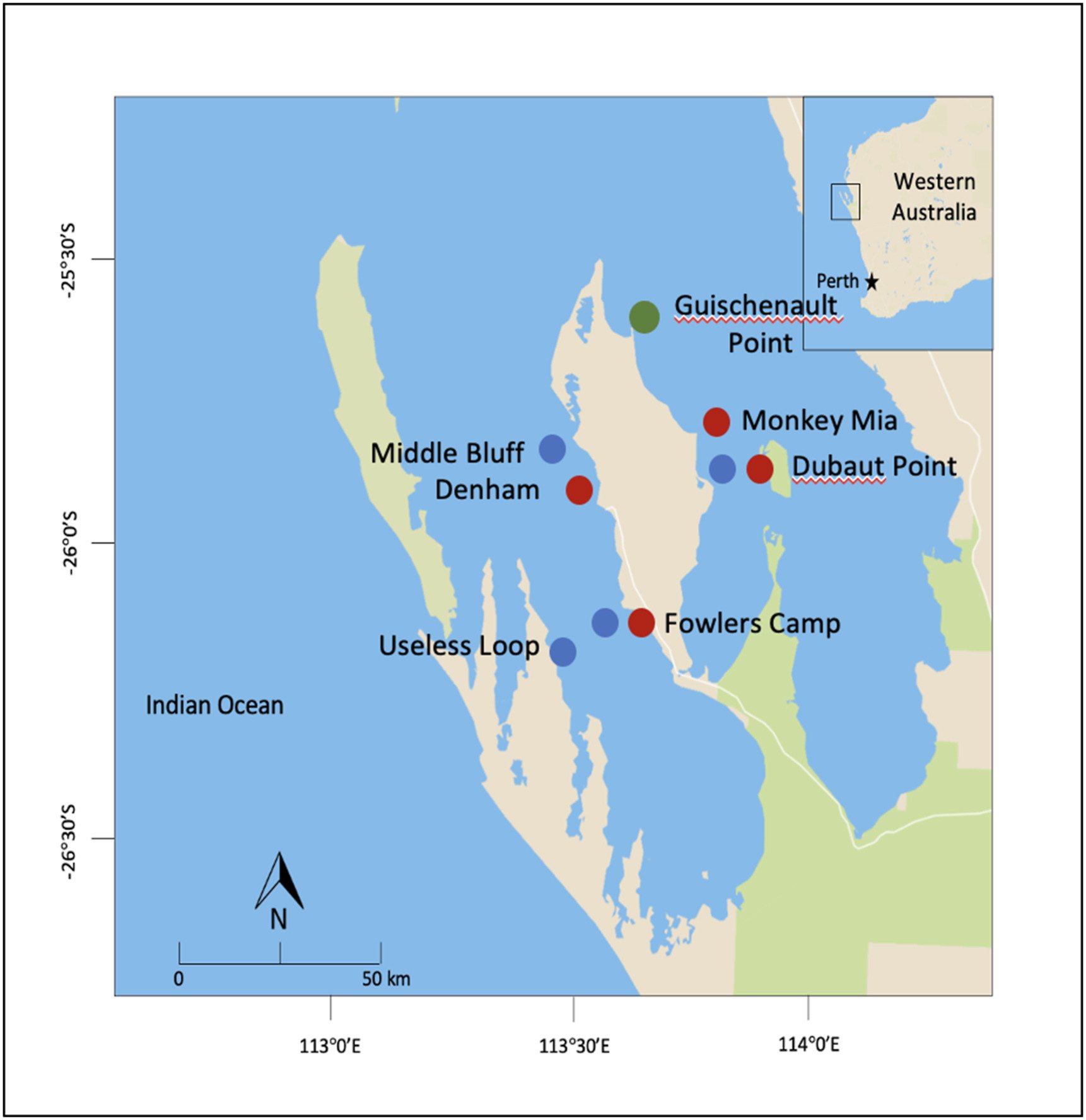
Seagrass restoration sites in Shark Bay by transplanting (blue circles), assisted natural recovery through engineering substrate and sediment stabilisation (red circles), and seed-based restoration (green circle). Inset: Location of Shark Bay in Western Australia.
CC BY-SA 4.0 licence
Field-based workshops
Workshops on Country formed the foundation of the partnership. The team adopted an approach that recognised and valued everyone’s different areas of knowledge and understanding, focusing on creating a shared vision to care for and restore Sea Country.
The initial planning conversations and knowledge-sharing workshops were informally structured to allow time to develop relationships and share knowledge of Country, history, biodiversity, culture and language through storytelling and personal experiences.
In the training activities, the team shared knowledge about local species, how to collect and transplant adult seagrass plants, and tested some new methods to reduce the need for SCUBA divers.
Success in the field
Success in collaboration and knowledge sharing included:
- using informal workspaces to remove potential learning and sharing barriers
- finding the right person with authority to speak
- ensuring culturally and gender‑balanced workgroups
- maintaining flexibility, as cultural practice usually takes priority over work milestones
- supporting informal knowledge sharing through storytelling, artistic expression, visual productions, and conversations
- developing factsheets that incorporate culture and language.
Revegetation methods
The team developed revegetation methods designed to overcome the challenges of working in remote areas with reduced technology, higher costs and fewer people.
Transplanting adult shoots
Researchers demonstrated how to collect, prepare and transplant adult shoots, which were harvested by SCUBA divers or snorkellers along the growing edge of local meadows.
Snorkellers or divers planted the collected shoots in less than 1.5m depth next to the local source meadows.
Using seed
For the seagrass Posidonia australis, an existing meadow was identified to demonstrate how to collect mature fruit and extract viable seed in a way that minimises impact to the established meadow. An existing method, developed for 'Seeds for Snapper’ program, was used to collect, extract and sow viable seeds, demonstrating an effective, low impact method. However, few Posidonia seeds are produced annually in Shark Bay, so this method would not be scalable this area.
how this method is now being scaled up off Monkey Mia.
And also, what's planned for 2026 in this restoration area.
Assist natural recovery using 'Amphibolis antarctica' seedlings
This low-impact restoration method uses hessian bags and customised ‘seagrass snaggers’ to assist recruitment of naturally dispersing seedlings. The bags were filled with local beach sand, released from boats and arranged in a line by snorkellers, perpendicular to the direction of water flow. Seedlings that washed naturally into the nearby shallows or onto the beach were collected and dispersed at restoration sites or physically attached to the snaggers.
The natural hessian bags were heavy and difficult to handle. Researchers considered altering the shape of the bags, especially when monitoring showed that three months after deployment, few seedlings had attached. The design was improved to reduce sediment movement, avoid the bags being buried, and provide additional substrate for dispersing seedlings to attach.
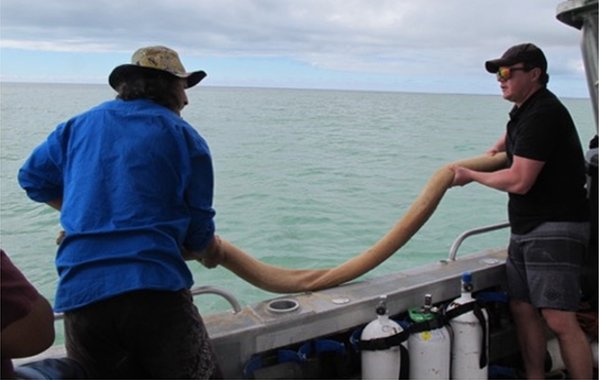
Deploying snaggers over the side of the vessel at a restoration site.
- CC BY-SA 4.0 licencedeploying snaggers
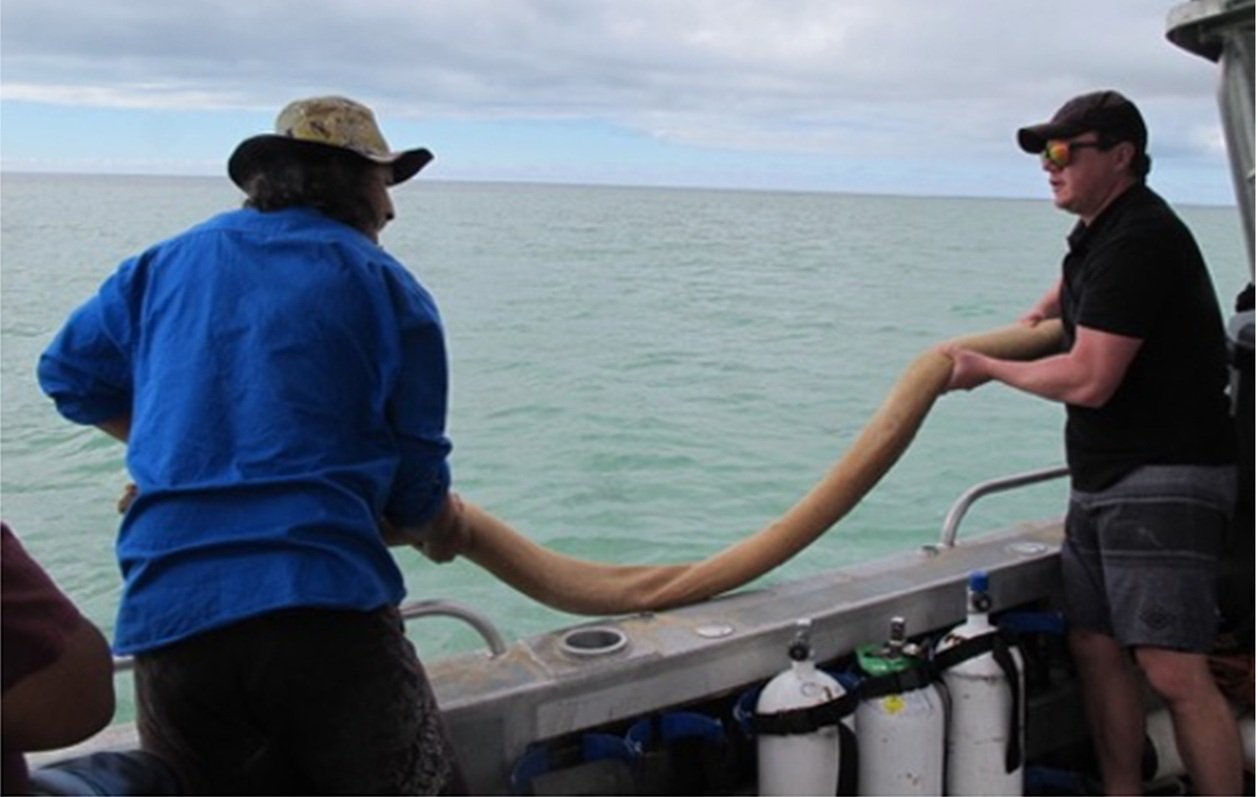
Deploying snaggers over the side of the vessel at a restoration site.
CC BY-SA 4.0 licence
Monitoring
Monitoring involved periodically assessing survival (presence of visible green shoots above the sediment) and growth (number of shoots). Swim-overs were conducted – at sites where hessian bags and seagrass snaggers had been deployed – to assess burial, seedling attachment and use by other species.
Biodiversity assessments through fish and benthic macroinvertebrate surveys were conducted as measures of return of ecosystem function. Different-aged restoration sites were used to compare growth and change in diversity over time.
Monitoring of the older transplant sites showed that at least five years are needed for restoration sites to approximate the shoot density and structure of a natural mature meadow, and that transplants grow faster and have more shoots in deeper water.
The biodiversity assessment helped participants improve their familiarity with local fish and macroinvertebrates.
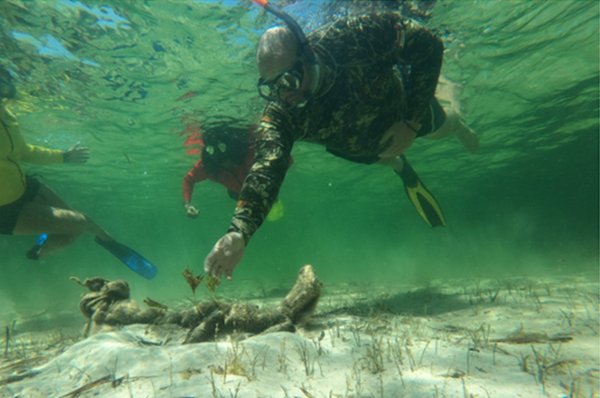
MAC Rangers monitoring the snaggers.
- CC BY-SA 4.0 licencesnorkellers
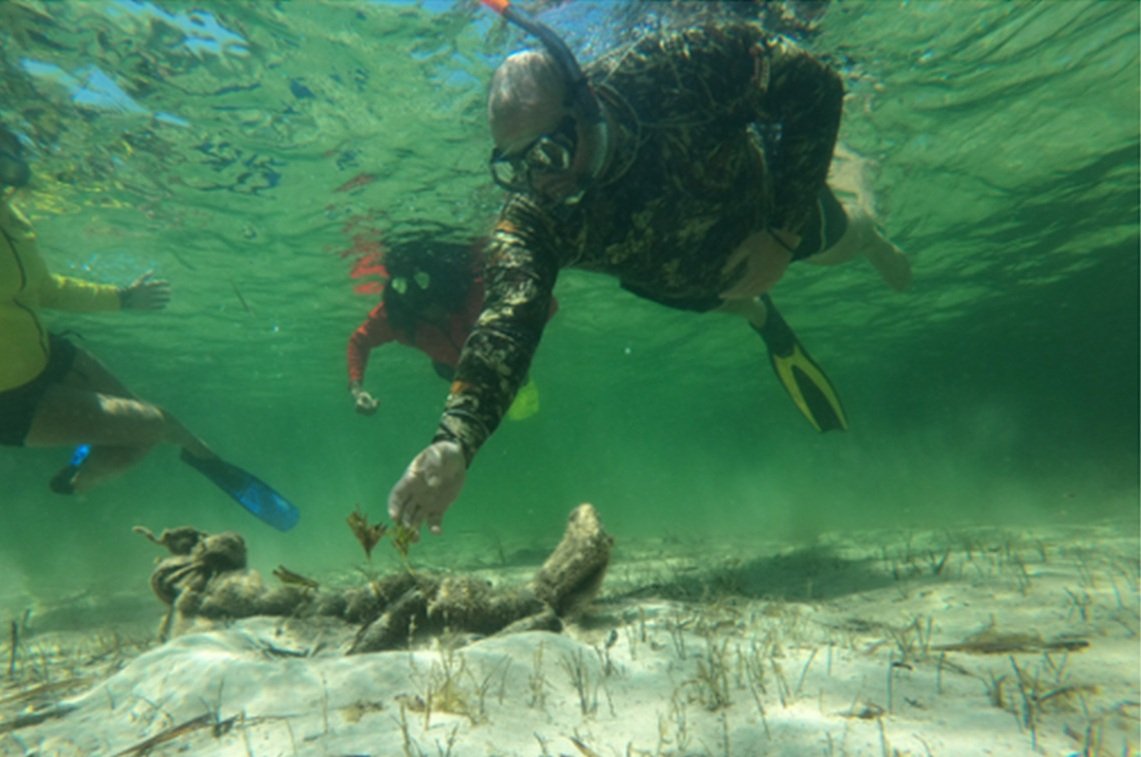
MAC Rangers monitoring the snaggers.
CC BY-SA 4.0 licence
At the end of the project funding, the Wirriya Jalyanu (seagrass) Festival provided an opportunity to share knowledge from the project with the wider community.
The festival theme of ‘Art meets Science’ meant knowledge was shared in different ways by scientists, MAC rangers and other Malgana community members. Activities included public talks, a language and art workshop for children and a student art competition.
Challenges
Several challenges emerged during the project
- Logistics.
A practical challenge across the team was the distance from Shark Bay: for both the Perth-based researchers and for the rangers, many of whom were not living on Country, and were spread over 1300 km, from Carnarvon to Albany. - Continuity and building relationships.
The project team found it difficult initially to identify the right person to contact within the newly established Malgana Aboriginal Corporation.
The ranger coordinator was central to coordinating on-Country activities.
“Maintaining those connections is challenging from a distance, but critical to keep things going. Securing continuing funding is vital to maintain momentum and support for the ranger program.”
Dr Elizabeth Sinclair
- Funding.
Sustained funding is required for regular monitoring to document natural recovery and restoration success. This would also enable development of an annual schedule of restoration activities that help build seasonal local economies and increase the ability to restore seagrass at larger scales.
Benefits
Workshopping new scalable seagrass restoration methods and sharing the knowledge more widely with the local community has been valuable in improving understanding and caring for the remote World Heritage Area for those who live there.
Indigenous ranger partnership programs, such as this seagrass restoration project, enable a reawakening and sharing of knowledge that is in danger of being lost. The funding provided employment for the Malgana rangers to return to Country, strengthening their cultural connections and identity as well as caring for country.
The training has also provided ongoing work opportunities for some of the participants who are now employed as divers and working in a new business to restore the sea cucumber trade.
Cultural and social benefits from the partnership approach are hard to quantify but include developing a culture of mutual respect and connection to Country.
To cite:
This case study was prepared by NCCARF. Please cite as: NCCARF 2025. Healing together through restoring seagrass in Shark Bay. Case study for CoastAdapt, National Climate Change Adaptation Research Facility, Griffith University, Gold Coast.