



At a glance
A community-based program in Tweed Shire aimed to reduce off-leash dog impacts on wildlife and public safety by changing social norms through social marketing, engagement hubs, and enforcement.
A program review found it achieved a 30% increase in leashing compliance, which has exceeded the 20% target. Also,177 fines have been issued, with fear of fines emerging as a strong motivator.
Lessons learned included that social norms and perceived enforcement drive behavior change; ongoing challenges include limited off-leash areas and low general community awareness of leashing rules.
Take the Lead program aims to change social norms of dog owners
Take the Lead is a community-based behaviour change program in Tweed Shire that aimed to reduce the threat of off-leash dogs to people, wildlife, and other pets in designated on-leash areas.
Targeting community awareness and behaviour, the program aimed to change the attitudes, perceptions, and behaviours of local dog owners through social marketing, public engagement, and enforcement strategies. The program used a collaborative co-design process with the local community, council and other key stakeholders to ensure it resonated locally.
The overall program ran in several stages from 2021-23. The program was conducted with support from social marketing agency Social Deck and funded by a grant from the NSW Environmental Trust.
The program aimed to create a measurable change (20% increase) in dog owners using leads when walking their dogs, and avoiding high conservation value habitat.
The program was implemented in four beach locations, designated to have High Conservation Value on-leash beach locations, specifically South Kingscliff Beach, Casuarina; Dreamtime Beach, Fingal Head; Cudgera Beach, Hastings Point; and Wooyung Beach.
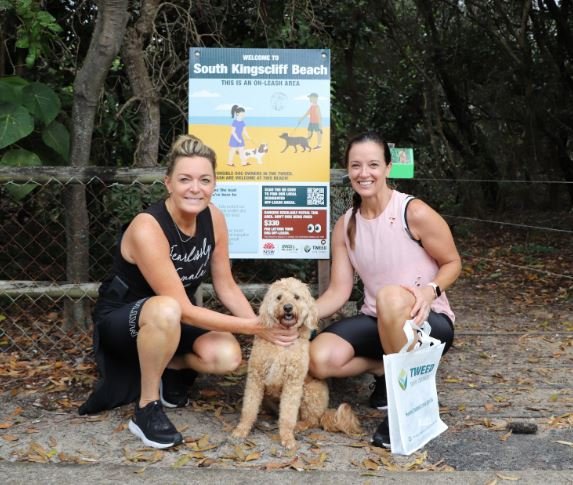
One of the community signs that helps with information about the location of the off-leash area.
- © Tweed Shire CouncilKingscliff beach
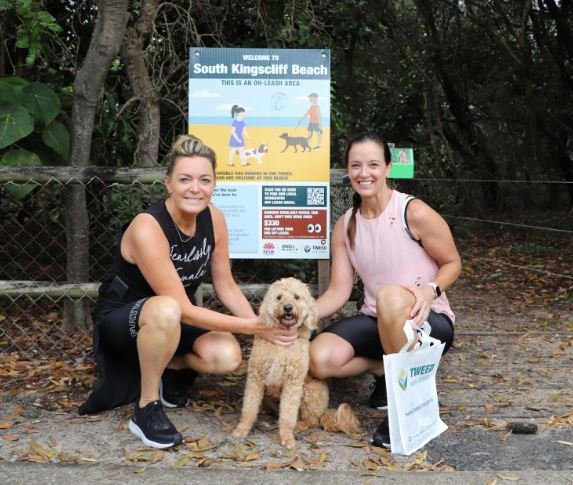
One of the community signs that helps with information about the location of the off-leash area.
© Tweed Shire Council
Three key interventions
The Take the Lead Stage 2 program was implemented using three key interventions:
- A social media campaign (commitment, incentives and communication) with community voices and images to promote messages about:
- the desired leashing behaviours
- enforcement blitzes, outcomes of the blitzes and fine amounts
- the QR code to designated off-leash areas
- off-leash areas and fines, to shift social norms through increased awareness and knowledge.
2. ‘Doggy engagement hubs(communication and prompts) at the entrances to the four priority beach locations with:
- community signage and a QR code that clearly shows the location of the designated on-leash areas
- dog water bowl/fountain
- dog poo bags and bins.
3. Increased enforcement activities through monthly ranger and police targeted compliance patrols in the four priority locations. The fines were $330.

The user journey for the Take the Lead program.
- © Tweed Shire Councildog - user journey
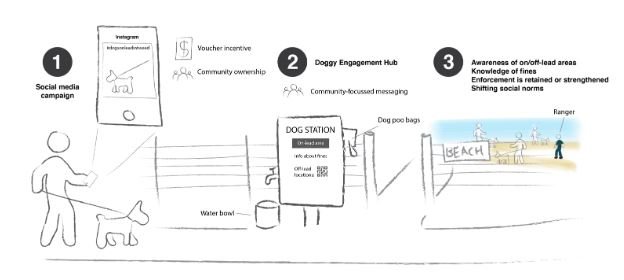
The user journey for the Take the Lead program.
© Tweed Shire Council
Evaluation methods
Evaluation methods included:
- analytics from the social media campaign, the QR code on the community sign and the dog mapping tool
- observations of dog-leashing behaviour pre- and post-interventions to measure change
- surveys with people as they were leaving the intervention areas
- an online survey of mostly dog-owners.
Control locations
As part of the experimental design, two on-leash control locations were selected outside the Tweed Shire at beaches at the southern end of the Gold Coast: Currumbin and Tullebudgera. These two locations were used to help determine if changes in the rates of leashing are due to the behaviour change interventions, or other factors.
Key insights from the program
Key insights from the program are listed below
- The program had a significant positive impact on people’s leashing behaviour. The percentage of dogs observed on-leash in the four priority intervention locations increased by 30% (10% above the program target of 20% increase).
- Increased enforcement activity and messages about the likelihood of getting a fine, increased dog walkers perceived likelihood and consequences of being fined.
- Rangers and police conducted 32 x 4 hour targeted enforcement activities across the four priority locations, handing out a total of 177 fines at $330 per fine ($58,410).
- 17% of survey respondents had been fined themselves and/or knew someone who had been fined during the past 6 months for having a dog off-leash in a local on-leash area. This is an increase from just 2% during the pilot program (during which no targeted enforcement activities were undertaken).
- Survey respondents thought that there was a 1 in 3 chance (mean= 34%) that a person walking their dog off-leash in an on-leash area would be caught and fined.
- 20% of online survey respondents reported an increase in the number of rangers, compared with just 6% after the pilot program.
- Respondents who had seen an intervention beach sign, reported a higher fine estimate (median = $300) than those who had not seen a sign (median = $280): actual fine was $330.
- Respondents reported seeing more advertising of Council enforcement patrols on Facebook and in the local paper and the social media post promoting targeted enforcement activity results and number of fines was by far the most engaged with – it was shared, commented and liked more than 30,000 times.
- In free text responses, many respondents referred to the fear of fines as a motivation for keeping their dogs leashed in on-leash areas.
Increase in correct leashing behaviour
- Awareness of the program led to increased likelihood of correct leashing behaviour.
- 50% of respondents reported seeing new information or activity in the intervention locations during the past 6 months.
- Of respondents who had seen at least one element of the program, 19% indicated that they now keep their dog leashed more often in on-leash area and 19% of respondents indicated that the program information and activities has encouraged them to exercise their dog more often in designated off-leash areas.
- The most common reasons that people reported for not changing their behaviour having seen the program materials were an inadequate number of off-leash areas and a belief in their individual responsibility/capability to keep their dog in control (and that others should do the same).
- When excluding those who said they already always keep their dog leashed, 67% said that the new information and/or activity would or may encourage them to keep their dog leashed in local on-leash areas.
- 62% of online survey respondents reported that they had seen social media posts about the program in the last six months and 90% of intercept survey respondents reported that they had seen new signages. This demonstrates the importance of reaching people via different channels.
- When specifically asked about the ‘doggy engagement hubs, and shown an example image, 31% of online survey respondents indicated that they had seen the signs.
Increase in knowledge of leashing requirements
- Knowledge of leashing requirements increased for some sectors of the dog walking community.
- Dog walkers that participated in intercept surveys had very good knowledge (100%), that the areas they were walking in was an on-leash area. 67% of respondents reported they had seen the new signage which may have contributed to the increased knowledge.
- However, based on online survey responses, general community knowledge of leashing requirements is still quite low with less than half of online survey respondents correctly identifying designated on leash areas on the map. Respondents were most knowledgeable about leashing requirements at South Kingscliff beach. This area also showed the greatest increase in compliance during the pilot.
Social norms are important
- Social norms play a role in people’s leashing behaviour.
- Respondents estimate that 50% of dog owners let their dogs off the leash in on-leash areas, indicating that people believe that at least half of dog walkers do not comply with leashing laws.
- Respondents who reported that they had let their dog off-leash in on-leash areas reported a significantly higher estimate of others letting their dog off-leash than those who reported compliance. Indicating that those who don’t comply with the law are more likely to think others also do not comply.
- 37% of respondents thought that ‘most people don’t like it’ when dogs are let off-leash however those that let their dog off-leash are more likely to believe that ‘most people don’t really mind’.
- Respondents also noted respect for other beach users and the rules as a reason for being more likely to keep their dog on-leash.
The most common suggestions from respondents to improve compliance were to create more off-leash dog parks and improve the ones already available and further increase enforcement activity.
To cite:
This case study was prepared by NCCARF. Please cite as: NCCARF, 2025: Take the Lead: management of off-leash dogs on beaches. Case study for CoastAdapt, National Climate Change Adaptation Research Facility, Griffith University, Gold Coast.