



At a glance
- Tasmania’s extensive coastline (≈4,900 km) represents around 8% of Australia’s total coast and provides critical breeding, nesting and roosting habitat for a diverse community of resident and migratory shorebirds, seabirds and penguins.
- Long-term, standardised surveys since the 1980s have mapped more than 9,000 nests and colonies across over 450 beaches, providing an evidence base for understanding population trends and informing coastal management decisions.
- Human disturbance is the primary threat to beach‑nesting species, particularly from dogs, 4WDs, habitat fragmentation, invasive species and coastal urban expansion, with impacts most severe during the peak breeding season (September–March).
- Tasmania is a global stronghold for several species, including Eastern Hooded Plovers, Australian Pied Oystercatchers, Fairy Terns, Little Terns and Little Penguins, making effective, data‑driven coastal management essential for their ongoing conservation.

Tasmanian coast is critical habitat for shorebirds and seabirds
The Tasmanian mainland and all offshore islands have a total coastline of approximately 4900 km, which is longer than the coastlines of Victoria and New South Wales combined; Tasmania’s coastline is approximately 8% of the total Australian coastline (~60,000 km).
The coast provides critical habitat to a community of resident and migratory shorebirds and seabirds. These species nest from September to March; their nests, eggs and chicks are well camouflaged, and all species face a number of threats arising from human recreational activities in coastal areas that are at their most frequent and most intense during the Summer months, coinciding with the birds’ breeding seasons.
Long-term [decadal-scale] data sets and syntheses for resident and migratory shorebirds around Tasmania that provide context for mapping surveys are available for the northwest, the kanamaluka/Tamar Estuary (Cooper et al. 2024 and its references), northeast and southeast (Hansen et al. 2014, Taylor et al. 2014, Woehler 2021a).
Surveys provide population data
Dedicated surveys for Hooded Plovers commenced in Tasmania in 1982, with some surveys opportunistically including other resident shorebirds. Detailed GPS-based surveys and mapping commenced in the late 1990s as GPS technology became cheaper and more accurate.
These surveys mapped nests or breeding territories of shorebirds, and the locations of colonies of Fairy and Little Terns for details of regional surveys and syntheses. Surveys are undertaken only during the breeding season (September to March) and all survey data are collected by one person to eliminate all inter-observer variabilities, which can easily mask population trends.
Repeated visits to many beaches allow for analyses of population data over time, but the survey effort is not distributed equally around the state, with more remote beaches less frequently visited. At a minimum, the survey objective is an approximate 5-yearly rotation for beaches to be surveyed and their breeding shorebirds and terns mapped. Some beaches are surveyed annually (typically those closer to Hobart and easily accessible beaches), but some beaches on the west coast require considerable logistical support.
More than 450 beaches have now been surveyed and more than 9000 nests and colonies have been mapped. These data and all analyses are shared with community groups, Local Governments and State agencies involved in coastal management and conservation efforts. Sharing ensures all decisions are informed by data, and that all management efforts are evidence-based.
Focal species
Threats to beach-nesting shorebirds and seabird in Tasmania are many, and in many cases, cumulative and synergistic (Woehler 2021b). The primary threat is disturbance from human activities during the breeding season, when disturbance results in incubating or brooding birds leaving the nest and/or chicks to draw potential predator (people) away from eggs and chicks. This response results in hypo- or hyperthermia of the eggs and chicks, and will rapidly lead to death.
In Tasmania, the greatest threats to shorebirds originate from dogs and 4WDs on beaches. Habitat fragmentation and alienation (invasive weeds and human recreational activities), and urban expansion in coastal areas are adversely affecting resident shorebirds, terns and penguins, reducing the habitats available to them for nesting, roosting (resting) and moult. Dogs chase shorebirds and seabirds, taking eggs and chicks. There have been many attacks by dogs on Little Penguins around Tasmania (Blamey et al. 2024).
Eastern Hooded Plover
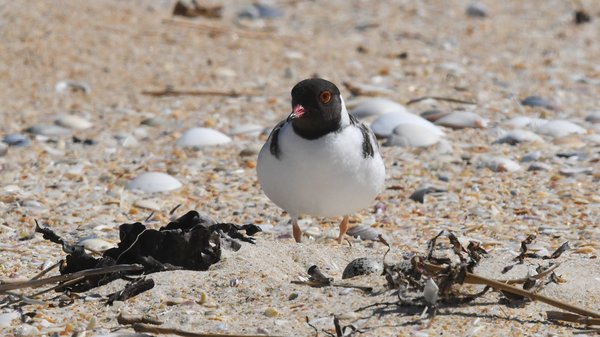
Hooded Plover at its nest
- © E.J. Woehler04. Hooded Plover 02699
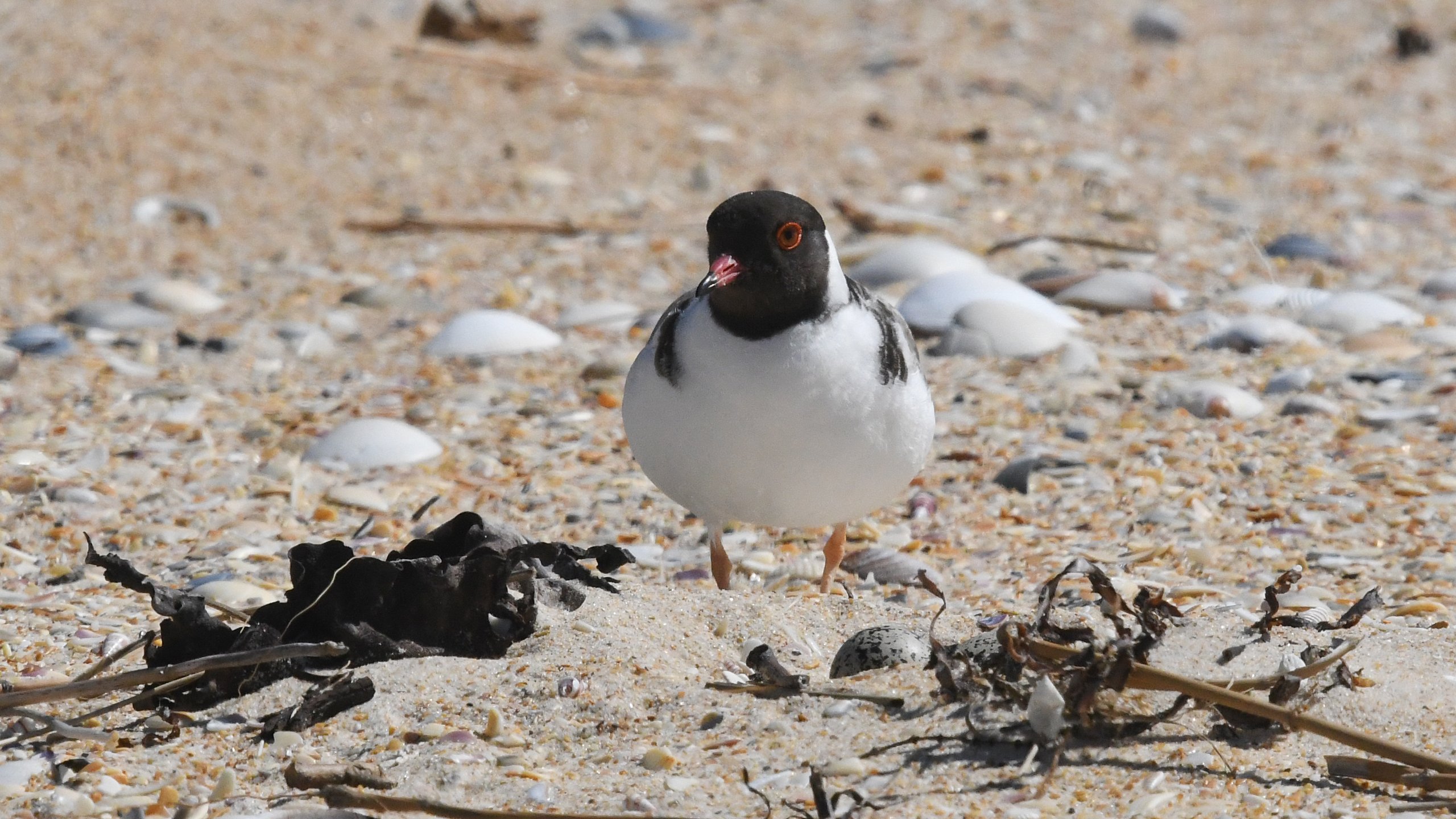
Hooded Plover at its nest
© E.J. Woehler
Eastern Hooded Plovers (Thinornis rubricollis rubricollis) are endemic to southeastern Australia. Individuals can live for more than 18 years, and they are a sandy-beach obligate species. Two subspecies are recognised – a western sub-species (in Western Australia) with an estimated population of 2500 birds, and an eastern sub-species (3000 birds estimated) in New South Wales, Victoria, Tasmania and South Australia.
Tasmania is a stronghold for the species, with more than 65% of the population present in Tasmania (Maguire et al. 2021). The sub-species is a listed Threatened species in Tasmania, and in 2014 was listed as a Threatened species under the EPBC Act 1999.
Hooded Plovers typically lay three small, well-camouflaged eggs in a shallow bowl-shaped depression in the sand above the High Water Mark, relying on this camouflage to protect their eggs and chicks. Their eggs easily sit in a teaspoon. Their chicks are unable to fly until ~five weeks of age.
Red-capped Plover
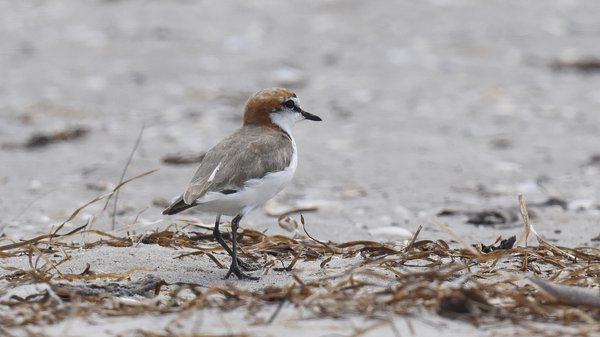
Male Red-capped Plover
- © E.J. Woehler05. Red-capped Plover 51339
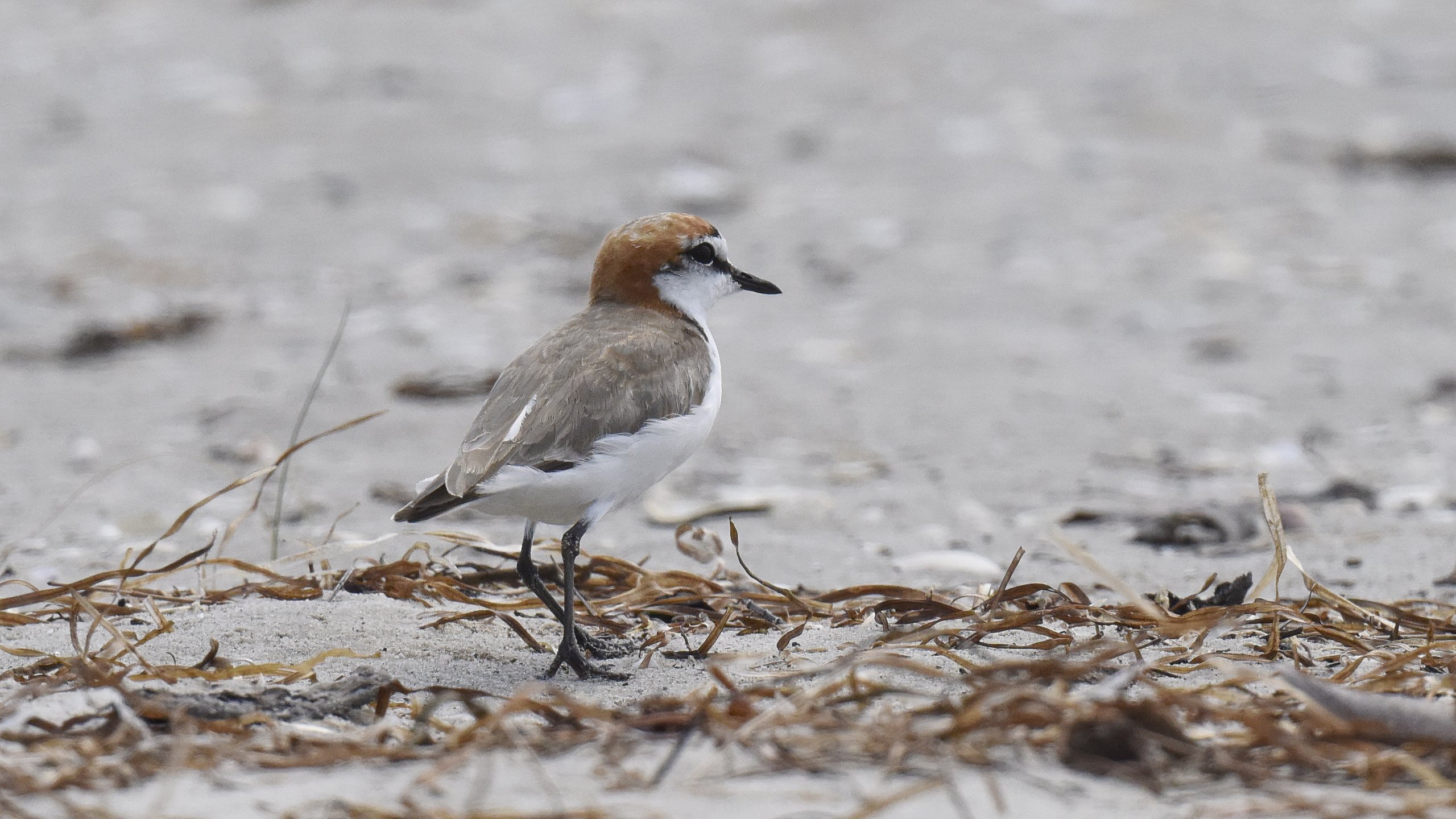
Male Red-capped Plover
© E.J. Woehler
Red-capped Plovers (Charadrius ruficapillus) are endemic to Australia, and can live for more than 20 years. There are no Tasmanian population estimate available as the species is a generalist, and is distributed widely statewide.
While many breed on beaches alongside Hooded Plovers and Pied Oystercatchers, individuals also breed on inland salt pans where the habitat mimics coastal habitats. As with Hooded Plovers, their numbers are decreasing on many beaches and losses accelerating; their populations are believed to be decreasing more rapidly than Hooded Plovers on many beaches.
The species is not listed under State or Federal legislations. Like Hooded Plovers, they typically lay two small, well-camouflaged eggs in a shallow bowl-shaped depression in the sand above the High Water Mark, relying on this camouflage to protect their eggs and chicks.
Australian Pied Oystercatcher
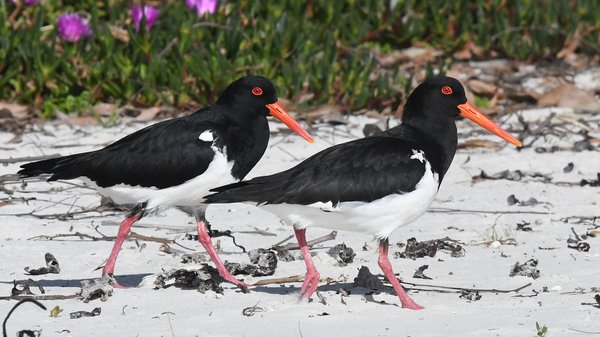
A breeding pair of Australian Pied Oystercatchers
- © E.J. Woehler06. Pied Oystercatcher 02883

A breeding pair of Australian Pied Oystercatchers
© E.J. Woehler
The Australian Pied Oystercatcher (Haematopus longirostris) is endemic to Australia and southern Papua – New Guinea (Taylor et al. 2014).
The current population estimate is approximately 11,000 birds, with Tasmania supporting more than 30% of the global population. Single-day coordinated surveys show that southeast and northwest Tasmania support close to 10% and 20% of the global population, respectively. The oldest known Pied Oystercatcher is 36 years old.
Currently, the population in Tasmania appears to be stable, and some regional populations appear to have benefited from efforts to improve water quality in some estuaries. Pied Oystercatchers typically lay two large, well-camouflaged eggs in a bowl-shaped depression in the sand above the High Water Mark. Their eggs are larger than a chicken’s egg. Their chicks are unable to fly until about seven weeks of age.
Sooty Oystercatcher

A breeding pair of Sooty Oystercatchers
- © E.J. Woehler07. Sooty Oystercatcher 41387
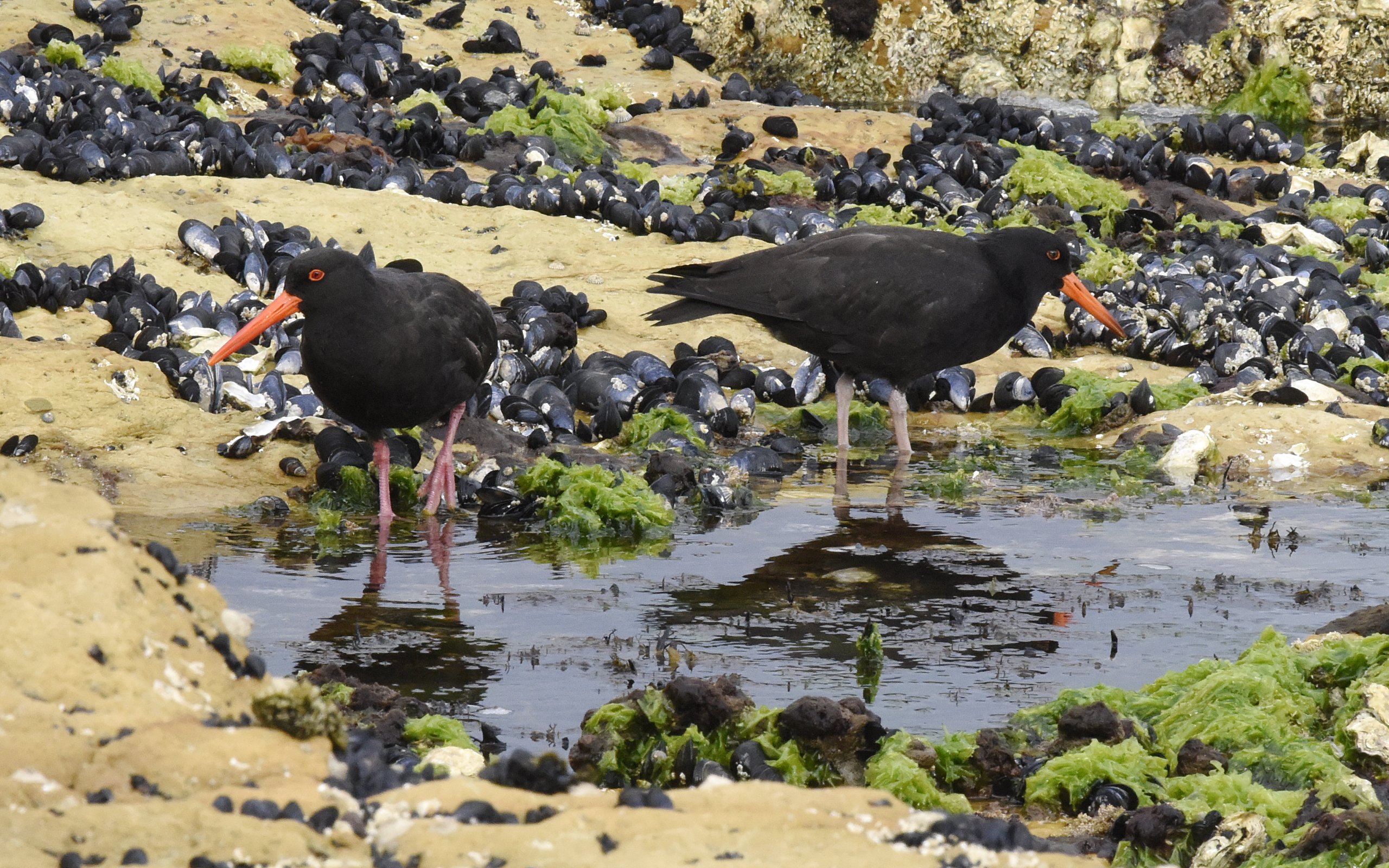
A breeding pair of Sooty Oystercatchers
© E.J. Woehler
Sooty Oystercatchers (Haematopus fuliginosus) are far less conspicuous than the closely-related Pied Oystercatchers. Sooty Oystercatchers can live to more than 25 years. They breed mainly on offshore islands and on rocky foreshores, joining Pied Oystercatchers during the Winter months to form mixed-species flocks on sandy beaches before returning to their territories in early Spring.
There are no estimates of the current breeding population in Tasmania due to the relative inaccessibility of some of their breeding islands; estimates of their total population are based largely on Winter counts (Hansen et al. 2014). Sooty Oystercatchers also lay two large, well-camouflaged eggs in a bowl-shaped nest; their nests are located in gravel, on ledges or vegetation if present. The chicks are unable to fly until about seven weeks of age.
Fairy Tern
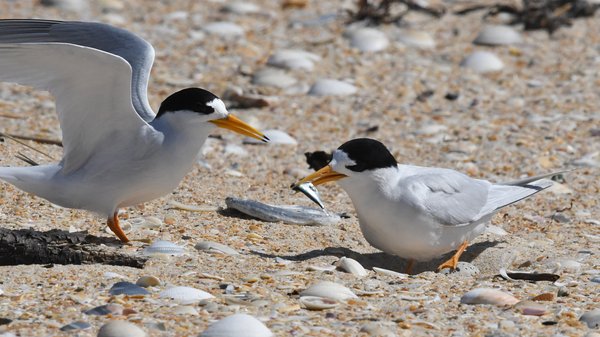
A breeding pair of Fairy Terns at nest
- © E.J. Woehler08. Fairy Tern 02666

A breeding pair of Fairy Terns at nest
© E.J. Woehler
Fairy Terns (Sternula nereis) are a small seabird found in Australia, with sub-species in New Zealand and New Caledonia. In Australia, Fairy Terns are listed as Vulnerable under the EPBC Act 1999. The population in eastern Australia is decreasing rapidly, as the species is highly sensitive to human disturbance (Greenwell et al. 2021).
Fairy Terns are colonial breeders, and will generally return to the same colony site from the previous year if breeding was successful. Unsuccessful breeding may see a site unused for several years, presenting challenges in managing and protecting nesting sites that may be used ephemerally. Fairy Terns lay two small, well camouflaged eggs and their chicks can fly approximately six weeks after hatching. The oldest known Fairy Tern in Australia is more than 24 years old.
The Tasmanian breeding population is estimated at typically c.100 pairs, but episodic influxes have been observed, when breeding numbers can double (Woehler et al. 2024). The reason(s) for these influxes are unknown, and present additional complexity for coastal managers and agencies. The limited data indicate that at least 25% of the sites documented in the 1980s around Tasmania are no longer used by Fairy Terns, due primarily to urban expansion and increased levels of human recreational activities.
Previously unknown breeding sites have been discovered during recent surveys, many in more remote areas, and it is unclear if these sites are newly occupied by displaced breeding terns or whether they had been overlooked in previous inventories (Woehler et al. 2024)
Little Tern
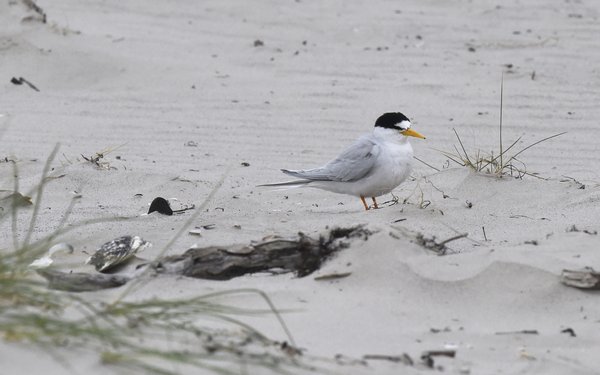
A breeding Little Tern
- © E.J. Woehler09. Little Tern 28261

A breeding Little Tern
© E.J. Woehler
Little Terns (Sternula albifrons) are listed as Endangered in Tasmania due to the very small size of the annual breeding population, estimated to be typically fewer than 10-20 pairs (Mahon et al. 2021). Little Terns appear very similar to Fairy Terns, and will often breed in association with a Fairy Tern colony; mixed Fairy Tern x Little Tern breeding pairs and hybrids have been reported.
As with Fairy Terns, Little Terns are particularly sensitive to human disturbance, and will abandon nesting if disturbed, particularly early in their breeding season. Recent surveys have recorded higher numbers in Tasmania than in the past, but whether this is due to increased effort and coverage of the surveys, or reflects a real increase in numbers in Tasmania is presently unknown.
Little Terns lay two small, well camouflaged eggs and their chicks can fly approximately six weeks after hatching. The oldest known Little Tern in Australia is more than 26 years old.
Little Penguin

Little Penguin
- © EJ Woehler10. Little Penguin 07289
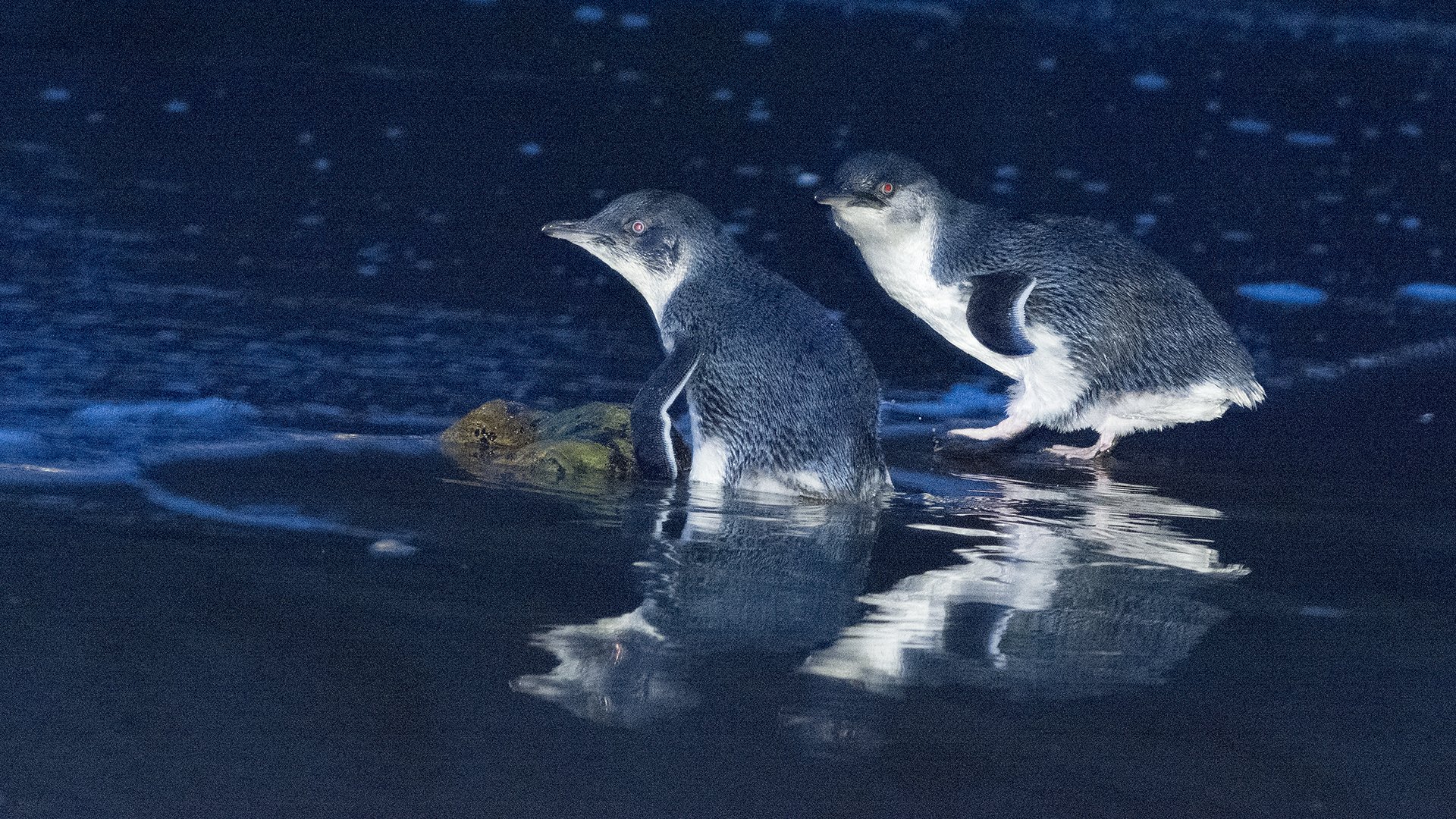
Little Penguin
© EJ Woehler
Little Penguins (Eudyptula minor) are found around the southern Australia coast from around Sydney to Perth. It is believed that Tasmania and the Bass Strait islands are the stronghold for the species (Marker et al. 2024). Little Penguins typically nest close to the coast under vegetation, rocks and human infrastructure.
Recent observations have shown a relaxation of their breeding schedule throughout Tasmania, with Winter breeding now recorded. Changes in breeding phenology has resulted in penguins being ashore for greater periods of the year, potentially increasing their risk of predation, particularly by dogs.
Little Penguins lay two eggs but rarely manage to raise both chicks.
To cite:
This case study was prepared by Dr Eric J, Woehler, OAM.
Please cite as: Woehler, E..J., 2024: Holistic management and conservation of beach-nesting shorebirds and seabirds in Tasmania. Case study for CoastAdapt, National Climate Change Adaptation Research Facility, Griffith University, Gold Coast.
References
Blamey L.K., C. Bulman, G.N. Tuck, E..J Woehler, P. Marker, R. Monash and T.A. Patterson, 2024: Evaluating risks to seabirds on the urban-coastal interface: modelling dog attacks on little penguin (Eudyptula minor) populations in Tasmania. Aquatic Conservation: Marine and Freshwater Ecosystems 34, e4113. https://doi.org/10.1002/aqc.4113
Cooper R., B. Cooper and E.J. Woehler, 2024: Migratory shorebirds of kanamaluka/Tamar Estuary. In: The State of Birds in 2023 in the kanamaluka/Tamar Estuary, pp 10-23. BirdLife Tasmania and the Australasian Wader Studies Group, Hobart, 128pp. [awaiting URL from TEER https://www.teer.org.au
Greenwell C.N., E.J. Woehler, D. Paton, F. Paton, N. Dunlop, P. Menkhorst, M. Carey and S.T. Garnett, 2021: Australian Fairy Tern Sternula nereis nereis. In Action Plan for Australian Birds 2020. (Garnett ST, Baker GB eds) pp. 327-330. CSIRO, Melbourne.
Hansen, B.D., C.D. Minton, A.E. Harrison and R. Jessop, 2014: Conservation assessment of the Sooty Oystercatcher Haematopus fuliginosus. International Wader Studies 20, 161-172. https://www.waderstudygroup.org/article/1634/
Maguire G.S., E.J. Woehler, G. Ehmke, M.A. Weston and S.T. Garnett, 2021: Eastern Hooded Plover Thinornis cucullatus cucullatus. In Action Plan for Australian Birds 2020. S.T. Garnett and G.B. Baker (eds) pp. 250-254. CSIRO, Melbourne.
Mahon P., A. McDougall, E.J. Woehler, P. Menkhorst, M. Carey and S.T. Garnett, 2021: Tasman Little Tern Sternula albifrons placens. In Action Plan for Australian Birds 2020. S.T. Garnett and G.B. Baker (eds) pp. 319-322. CSIRO, Melbourne.
Marker P.F., A.B. Wind and E.J. Woehler, 2024: Guidelines for works in, and management of, Little Penguin habitat. BirdLife Tasmania. 37pp. https://wildcaretas.org.au/wp-content/uploads/2024/05/Marker-et-al-2024-Guidelines-Little-Penguins-27-May-2024.pdf
Taylor I.R., O.M.G. Newman, P. Park, B. Hansen, C.D. Minton, A. Harrison and R. Jessop, 2014: Conservation assessment of the Australian Pied Oystercatcher Haematopus longirostris. International Wader Studies 20, 116-128. https://www.waderstudygroup.org/article/1628/
Woehler E.J. 2021a: Contemporary population estimates for Eastern Hooded Plover Thinornis cucullatus and Australian Pied Oystercatcher Haematopus longirostris in Tasmania. Tasmanian Bird Report 41, 19-23.
Woehler E.J. 2021b. An overview of the major threats to resident and migratory shorebirds and small terns in Tasmania. Tasmanian Bird Report 41, 35-45.
Woehler E.J., M. Bennett, E. Lin and D. Williams, 2024: Status of Australian Fairy Tern Sternula nereis nereis in Tasmania, 2023/24. Tasmanian Bird Report 43, 57-65.