


Stormwater drain was affecting the dune, which protected a road
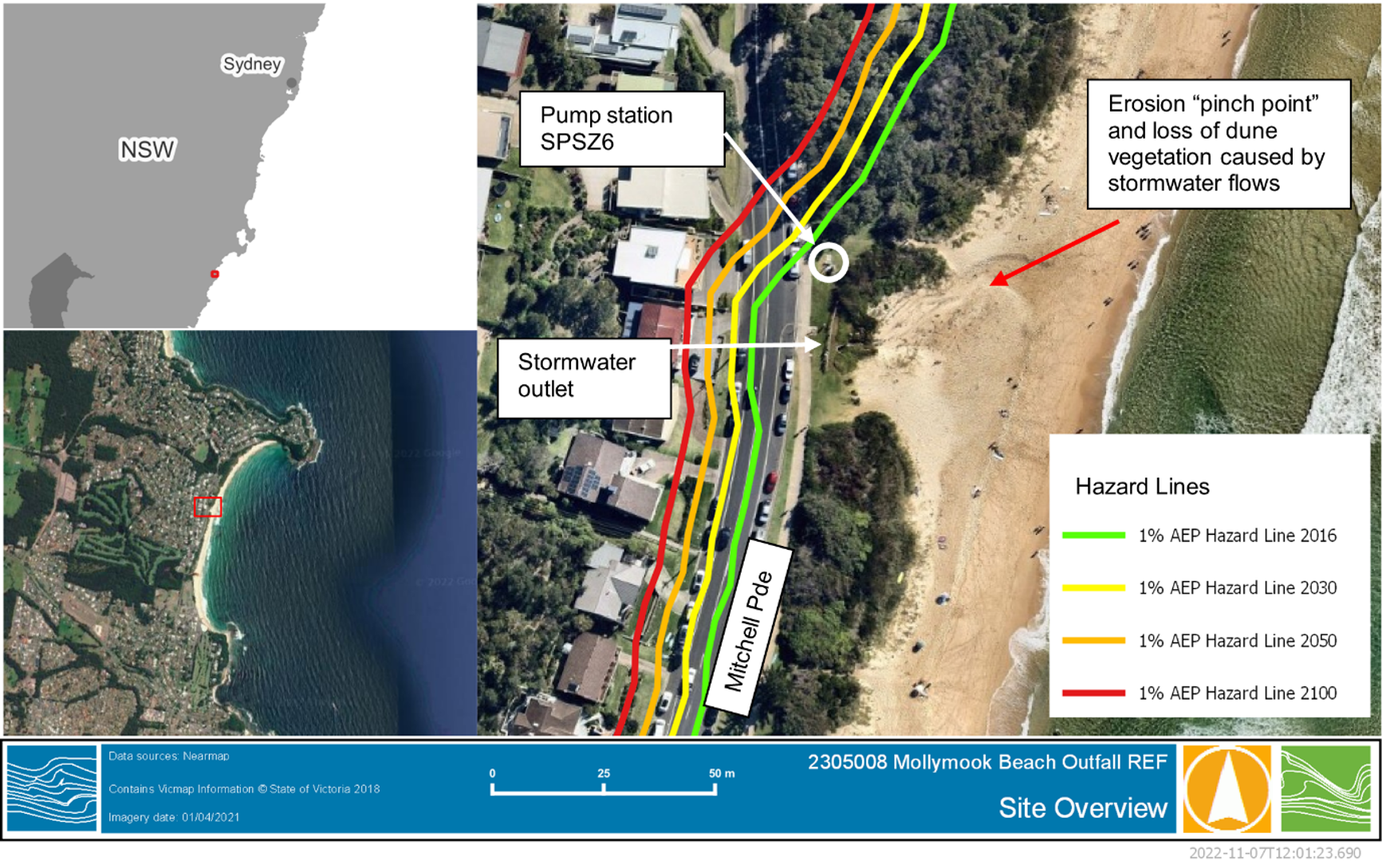
Shoalhaven City Council’s Coastal Zone Management Plan (CZMP) was certified in 2018. The plan identified the Mitchell Parade stormwater outlet in Mollymook as a high priority action for the council. The stormwater outlet created a local weak point in the dune, which threatened the nearby road. Coastal hazard line mapping showed that the hazard lines were being pushed landwards around the stormwater outlet, also putting properties at risk and a nearby sewerage pump station at extreme risk.
The stormwater outlet discharging onto Mollymook beach was contributing to erosion of the beach and the local dune system. Stormwater discharges regularly flowed across the beach, scouring beach sands, lowering the natural level of the incipient dune, and preventing dune vegetation from establishing. The stormwater outlet had resulted in a localised erosion 'pinch point' and increased the risk of coastal hazard exposure.
Shoalhaven_6
Mollybook Beach outfall
© Shoalhaven City Council
Coastal protection options
The council engaged a specialist coastal engineering consultant (Water Technology) to investigate short and long-term measures to protect the properties at risk and stabilise the dunes. The consultant proposed a transitional option to protect the pump station, stormwater outlet and the adjacent road with a ‘stormwater entrainment structure’ at the beach outlet to mitigate erosion, supplemented by dune building and restoration works.
Water Technology then developed the design solution for the transitional risk mitigation option of stormwater entrainment and beach nourishment. This included preliminary and detailed design requirements, and environmental assessment in the form of a Review of Environmental Factors (REF). The council tendered for construction in late 2022 and appointed the preferred contractor Soil Conservation Service in April 2023. Water Technology were contracted for the engineering audit and certification. Upgrades were installed in May 2023 to address the erosion and coastal hazard risk. The upgraded infrastructure will help provide a dune system that is more resilient to erosion, thus providing protection for the nearby infrastructure while also providing improved habitat for native species.
The upgraded stormwater outlet has a new headwall that minimises its presence on the dune, creating a more natural appearance and a stronger dune system. Geotextile Sand Containers were used, together with rock bags to create a training structure which would reduce the impact from the stormwater outlet on the dune system.
After the upgraded stormwater outlet was built, the council engaged land management consultants, Southern Habitat on the dune rehabilitation. This involved installing 1000 tube stock around the outlet, minor weed control, installation of jute matting around the outlet and a hessian sand trap along the roadside fence, maintenance works for the plants and turf for six weeks, and installation of Council signage along the fence line.
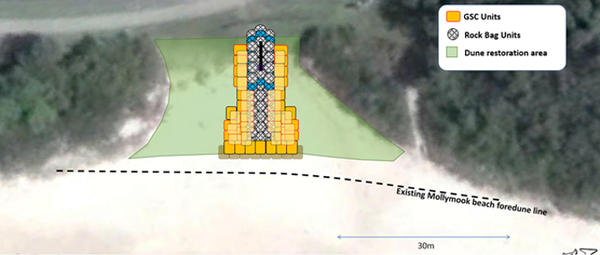
Shoalhaven_2
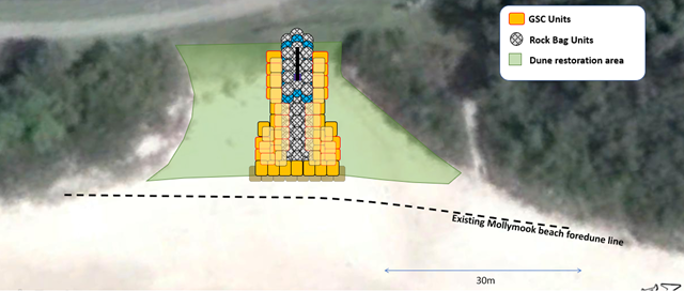
Detailed design of the stormwater drain
© Shoalhaven City Council
Outcomes and next steps
Long term environmental outcomes are considered to be positive. The outcomes of the project represent a balanced approach that covers quadruple bottom line dimensions of cultural, economic, environmental and social factors.
- The stormwater management works are directing stormwater flows across the beach and minimising scour of the beach and the nearby dune system.
- The coastal protection works (such as beach nourishment and dune building) will provide an increased erosion buffer at what is considered to be a highly vulnerable pinch-point (and one that will only become more exposed over time due to sea level rise and net shoreline recession). Improved vegetation cover will help reduce sedimentation and erosion, as well as improving local biodiversity.
- There are no expected adverse impacts on marine or terrestrial flora or fauna.
The project has also delivered positive social outcomes through improvement of the unsightly stormwater outlet; reducing the flooding risk to the sewerage pump and Mitchell Parade; and the improvements to the dunes post construction.
Importantly. the project was delivered within the planned budget allocation. The capital cost estimate provided in the Mollymook SPS Coastal Protection Options Assessment (Water Technology/ SCC 2020) was close to the actual cost.
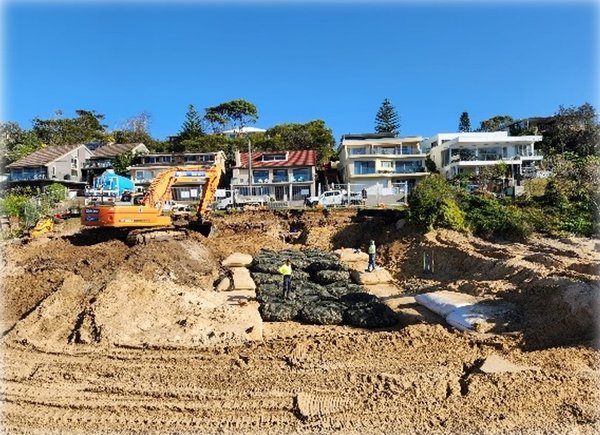
Shoalhaven_4

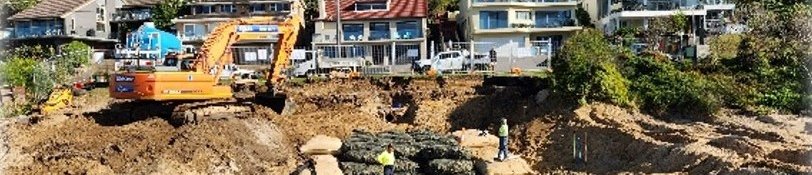
Undertaking works of at Mollymook Beach
© Shoalhaven City Council
Lessons learned
Navigating the environmental planning and assessment process was tricky and so, to ensure the works aligned with the correct approval pathway through the environmental planning instruments, Council undertook broad consultation with internal and agency stakeholders. This meant that before the work began, council was confident that the works would comply with the applicable legislative requirements.
In terms of community consultation, Council determined that this project fitted with the ‘inform’ level of the IAP2 framework. Their rationale is that the project to fix this stormwater drain is an identified action – and reduction of a coastal hazard—in the Coastal Zone Management Plan that had already underdone extensive consultation.
However, it remained essential that the community was kept informed throughout the project to ensure that community questions were anticipated, and their expectations were met. This was done through methods such as notification of works signage and e-mails to key stakeholders, project page updates on council’s website utilising QR codes and the construction site, social media posts, and community newsletters.
To cite
This case study was prepared by Nigel Smith from Shoalhaven Council. Please cite as: Smith, N, 2024. Upgrading stormwater management to reduce erosion in Shoalhaven. Case study for CoastAdapt, National Climate Change Adaptation Research Facility, Gold Coast.