


At a glance
- Between 2019 and 2021, the beach at Wye River on Victoria’s surf coast receded at an accelerated pace, increasing the vulnerability of both natural and built infrastructure.
- Initial beach nourishment provided a buffer but, by itself, was not sufficient to address ongoing rates of erosion. A geocontainer revetment (retaining wall) and groynes were installed as a matter of urgency.
- In the short-term, these protective measures have been successful in retaining the shoreline and supporting sand retention, allowing time for strategic adaptation planning for long-term management of the site.
The setting
The Wye River (Eastern Maar Country) coastline is dominated by west-south swell waves from the Southern and Indian Oceans, with Cape Otway and a local headland to the south partially protecting the bay. The area is also exposed to less frequent but intense easterly wave events driven by local winds across Bass Strait.
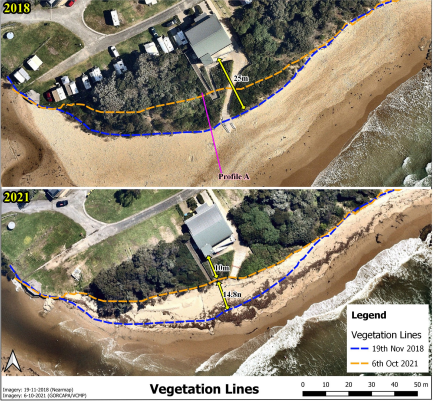
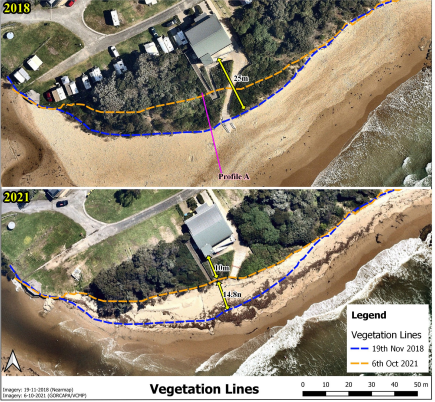
Between winter 2019 and 2021, the Wye River foreshore receded landward by 14.8m. The reduction in sand dune buffer from 25m to 10m increased the vulnerability of dune vegetation and nearby properties to erosion, including the Surf Life Saving Club building and local caravan park.
Since 2017, significant change in the alignment of the Wye River mouth channel from west to east was the key factor driving localised erosion. However, when storm events coincided with high tides, it accelerated the landward movement of the shoreline’s position. These small intermittently closed estuaries with pocket beaches are highly dynamic and prone to event-based changes in estuary mouth position and beach morphology. Therefore, we decided not to try to establish the cause of the river mouth migration due to the complexity in establishing direct causality.
Tracking the erosion
Regular drone monitoring by the Great Ocean Road Coast and Parks Authority, in collaboration with the Victorian Coastal Monitoring Program, tracked the evolution of the erosion (Figure 1). The following was observed:
- a maximum recession of ~14.8m between 2019 and 2021
- a maximum erosion rate between two surveys of 0.11m/day (between 24 May 2021 and 11 June 2021)
- the most significant recession area was in front of the Wye River Surf Life saving Club (SLSC) building
- a substantial loss of established vegetation (primarily invasive tea tree and other non-endemic species)
- significant damage to beach access infrastructure and the Wye River SLSC’s disability access ramp.
Short-term erosion management actions were undertaken using the strategic options for hazard risk management outlined in the Victorian Marine and Coastal Policy 2020 that opts for nature-based solutions and soft engineering options over hard engineering solutions.
Vegetation lines between 2018 and 2021
- © Great Ocean Road Coast and Parks AuthorityFigure 1. Vegetation lines 2018 and 2021
Vegetation lines between 2018 and 2021
© Great Ocean Road Coast and Parks Authority
Beach nourishment
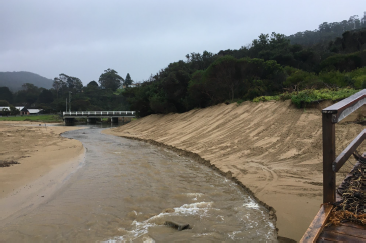
The beach nourishment program involved four discrete nourishment events over a three-month period: the first deposited 400m3 and the remaining three 800m3 each (Figure 2). Due to site and logistical constraints, which restricted the use of imported sand, excess sand was scraped from the western foreshore to nourish the eastern portion of the beach.
Although the sand enrichment established a first line of defence, this approach proved unsustainable, triggering the need for short-term protection actions with more longevity. These actions, in tandem with a fifth nourishment of 800m3, included:
- A 100m long seawall at a height of 1.2m using 0.75m3 geo-containers to reinforce the foreshore
- Three geocontainer groynes to force the migration of the river away from the eastern foreshore.
Beach nourishment efforts in 2021.
- © Great Ocean Road Coast and Parks AuthorityBeach nourishment efforts 2021
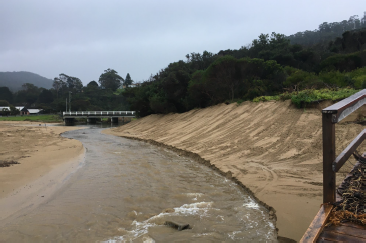
Beach nourishment efforts in 2021.
© Great Ocean Road Coast and Parks Authority
A short-term solution allows for planning
The actions carried out have retained the shoreline position, forced the river mouth to migrate west and allowed sand to accumulate within the groynes during calmer conditions.
While strategic coastal adaptation work will need to direct long-term site management, interim management may require additional beach nourishment to maintain a hazard buffer and associated beach amenity. Aerial data captured every six weeks through the Victorian Coastal Monitoring Program will inform evidence-based site decisions.
Unless the shoreline begins to recede and the geofabric containers fail, the Great Ocean Road Coast and Parks Authority will not commence site scale adaptation planning until tey have completed a regional scale coastal adaptation and resilience plan (currently under development).
This plan will establish a regional level vision and identification of values, hazards, and vulnerabilities. All adaptation work will be developed in accordance with the newly developed Victorian Resilient Coast guidelines (DEECA 2023) which build on the planning and decision pathways in the Marine and Coastal Policy 2020 to enable coastal managers to implement place-based, best practice and long-term coastal hazard risk management and adaptation.
Future actions
Although the geocontainers have been successful so far, the Adaptation Action Compendium (BMT 2023) that accompanies the VRC Guidelines (DEECA 2023) confirms that they are not suitable in high wave energy environments for extended periods of time. Geocontainers are mostly effective on sheltered coastlines with moderate wave energy or in the lower-energy environment of estuaries. Accordingly, the Authority will shift from deploying geocontainers to alternative actions (e.g. rock bags) to manage future erosion crisis scenarios that trigger a short-term protection intervention.
To cite:
This snapshot was prepared by Leia Howes-Ward, Climate Action and Resilience Manager, Great Ocean Road Coast and Parks Authority. Please cite as Howes-Ward, L, 2024. Geocontainers provide breathing space at Wye River. Case study for CoastAdapt, National Climate Change Adaptation Research Facility, Gold Coast.