



Coastal zones need innovation for a sustainable future
Coastal communities are facing unprecedented risks due to population growth, urbanisation, and climate change. To address these risks to ensure a positive future for these communities requires new ways of thinking and doing – it requires innovation. Innovation can support positive transformational change.
Innovation is now required to address the unsustainable use of coastal resources and to respond to coastal hazards. Yet it is unclear how such innovation will deliver the changes necessary to reduce vulnerability and improve coastal sustainability: there has been limited research concerning the nature of innovations in coastal areas and what would support innovation to be successful.
Innovation is now required to address the unsustainable use of coastal resources and to respond to coastal hazards.
The research approach
Coastal and community key informants in Australia’s most rapidly growing coastal communities were interviewed by researchers from the University of the Sunshine Coast. These key informants came from sectors where responding to vulnerability (physical and social) is a core aspect of work. Interviews discussed vulnerability, coastal governance, innovation, and community need; and from these discussions, the researchers identified the status of innovation, its enablers and barriers.
Innovation: status, barriers and enablers
The current status of innovation
Despite the high levels of individual capacity held by vulnerability managers, and the presence of good-practice policy, most innovations are limited in scale and insufficient for transformative change. Most are minor modifications to practice: they aim to improve service delivery or services provided, rather than planning or activating the conceptual, policy or systemic change argued vital in enabling transformation.
Innovations observed in the coastal communities sought to maintain or return to a ‘pre-vulnerable’ state through risk-based management. Few innovations related to the environment, and those that mentioned environment referred to monitoring and target setting rather than addressing environmental decline. Of respondents, 20% said they hadn’t observed any innovations in their community.
In short, innovations ranged from non-existent, to incremental, but rarely – systemic. Where innovation sits along this continuum is both a function of capacity for, and barriers to, innovation.
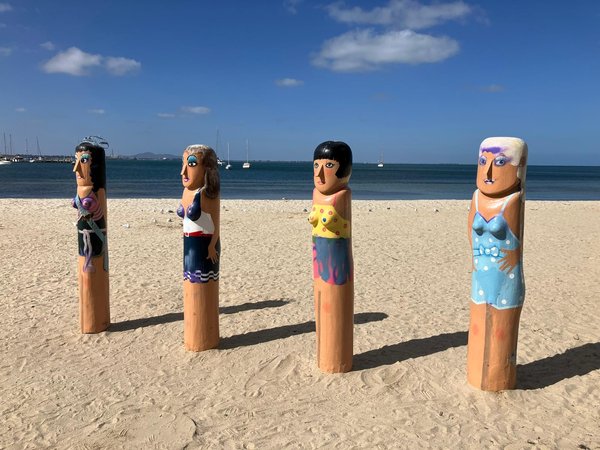
Innovation occurred when there was flexibility and autonomy in connection, collaboration and collective action
- © NCCARFinnovation_women art

Innovation occurred when there was flexibility and autonomy in connection, collaboration and collective action
© NCCARF
Barriers and enablers for innovation
Barriers to innovation were immense and reflected familiar barriers to best practice governance and change generally (see figure): from the fragile dynamic nature of coastal ecosystems to global forces of colonialism, capitalism and globalisation.
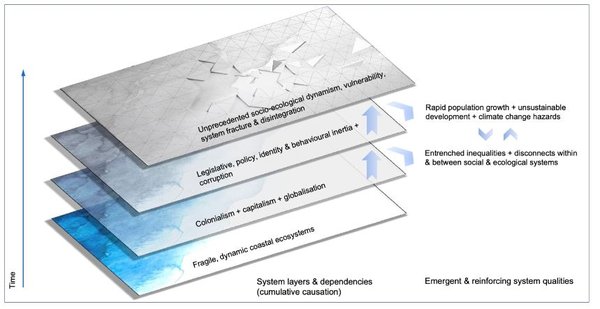
Historic and cumulative drivers of inequality and vulnerability, and feedback loops, in coastal Australia.
- © Elrick-Barr et al. 2024.Figure
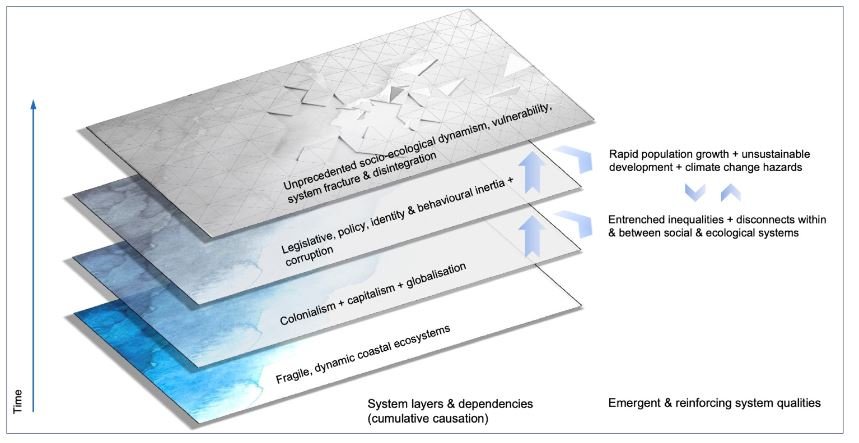
Historic and cumulative drivers of inequality and vulnerability, and feedback loops, in coastal Australia.
© Elrick-Barr et al. 2024.
Innovation success occurred when individuals had:
- substantial experience and knowledge (demonstrable past success, life experience/ knowledge)
- extensive social networks (political, within institution, cross-institutional)
- strong resource mobilisation skills (financial, intellectual, knowledge/data)
- personal qualities including self-belief and a drive for improvement.
Limited experience within an organisation reduced innovative capacity, however social skills and personal qualities had a mediating effect.
At the organisational level, innovation occurred when there was flexibility and autonomy to connect organisations/groups that do not traditionally collaborate, to change the way resources are distributed and facilitate collective action towards common goals (e.g., sustainability).
Outcomes and next steps
The study uncovered attributes that support innovation – including individual and community capacity, and the ability to work across sectors to achieve common goals.
By uncovering the attributes and conditions that support innovation and identifying where individuals and organisations have transcended barriers, it is hoped further investment will be provided to address needs in vulnerable coastal communities.
Lessons learned
A focus on responding to physical coastal vulnerability, whilst neglecting social vulnerability, affects cross-sectoral collaboration. For integration to work requires a long-term vision of the coast; one that addresses its social and ecological conditions more comprehensively, to develop solutions that are systemic, rather than single sector/impact.
To cite:
This case study was prepared by Carmen Elrick-Barr.. Please cite as: Elrick-Barr, C, 2024: Innovation is needed to reduce coastal vulnerability. Case study for CoastAdapt, National Climate Change Adaptation Research Facility, Griffith University, Gold Coast.
Further information
- Elrick-Barr CE, Thomsen DC, Smith TF (2024) Governance innovations in the coastal zone: Towards social-ecological resilience, Environmental Science and Policy, 153: 103687. https://doi.org/10.1016/j.envsci.2024.103687
- For more information on the project for which this study was a component see: https://usc.edu.au/coastalgovernance