


At a glance
- The CoastWA Training Series is a State Government initiative developed in collaboration with the Western Australian Local Government Association to build capacity in Coastal Hazard Risk Management and Adaptation Planning (CHRMAP).
- Delivered through modular online and in-person sessions, the series equips Local Governments, land managers and stakeholders with practical skills for developing and implementing CHRMAPs.
- Covering topics from coastal processes to community engagement, the training provides enduring resources to support informed decision-making across Western Australia’s coastline.

Local governments lead day-to-day coastal management
In Western Australia, local governments are responsible for day-to-day management of the coast, coastal land use planning, and developing and implementing coastal hazard risk management and adaptation plans (CHRMAP).
Local governments are supported by CoastWA, the State Government’s strategic program to address the growing impacts of coastal hazards including grants, technical support and strategic projects.
The CoastWA Training Series has been developed as a partnership between the Department of Planning, Lands and Heritage (DPLH), Department of Transport and Major Infrastructure (DTMI), and the Western Australian Local Government Association (WALGA).
Identifying training needs
In late 2022, WALGA undertook a survey of coastal and estuarine local governments. One of the key survey findings (second only to the need for more funding) was the need for training for local government officers involved in coastal hazard risk management and adaptation planning.
To better understand training needs and preferences, a second short follow-up survey was conducted.
Key findings of the survey included the following.
- Strong support, particularly from regional local governments, for a training program.
- Preference from regional local governments for online training and slight preference from metropolitan local governments for in-person training.
- No strong preference for training duration i.e. full or part day.
- Potential attendees came from a variety of backgrounds (environment, engineering or planning) and as a result, there was a range of existing knowledge and preferences for different topics.
- Topic preferences ranged from coastal processes, coastal engineering, economics, planning and risk assessment.
The program was funded by CoastWA under the CoastWA Community Engagement, Training, and Education Strategy and was delivered as a collaboration between DPLH, DTMI and WALGA.
resources from the CoastWA training series are all available online.
Program development
From the results of the survey, four key principles were identified to guide the development of the training series.
1. Something for everyone
Given the varied backgrounds of potential attendees and the diverse skills needed for CHRMAP, the training program needs to address a wide range of topics and skills.
Given the significant interest of regional local governments and the vast WA coastline, training should be relevant for the varied coastal environments and must be available for regional officers to attend online.
2. A modular approach
Shorter, discrete modules were considered better for online learning.
Participants should be able to select the most relevant modules without necessarily committing to them all.
Knowledge experts should be engaged to develop individual modules instead of one consultant attempting to cover all topics.
3. Empowering local government officers
Many aspects of CHRMAP are undertaken by qualified consultants engaged by Local Governments.
The training should equip officers with the knowledge and skills to be able to develop scopes, engage with consultants, and understand and review technical outputs.
4. An enduring resource
Due to high staff turnover in local government, the training materials should be able to exist as a stand-alone, ongoing resource that can be used as a refresher or for new staff.
The program was funded by CoastWA under the CoastWA Community Engagement, Training, and Education Strategy and was delivered as a collaboration between DPLH, DTMI and WALGA.
Implementation - the first year
In the first year, three modules were delivered.
- Module 1 -Coastal processes and how they affect shorelines
- Module 2 - Coastal protection works
- Module 3 - Benefit distribution analysis. These topics were selected based on preferences indicated in the survey.
These topics were selected based on preferences indicated in the survey.
Each module was scoped, and individual requests for quotes were issued. A coastal engineering consultancy (MP Rogers) was appointed for the first two modules, and an economic consultancy (Aither-Ricardo) for the third.
Each module included an in-person session (3 hours), a separate online session (2 hours), and the development of accompanying resources, such as recorded videos, PowerPoint slides, and fact sheets.
Accompanying resources were made publicly available online.
All training modules were well attended, however there was a clear preference for attending online rather than in-person.
The highest attendance was for the Coastal processes and how they affect shorelines module, reflecting the broad applicability of the topic.
| In person | Onlines | Total | |
|---|---|---|---|
| Coastal processes and how they affect shorelines | 18 | 89 | 103 |
| Coastal protection works | 13 | 74 | 87 |
| Benefit distribution analysis | 18 | 65 | 83 |
Most attendees were from local government (146), many from state government (114), as well as representatives from some non-governmental organisations (13).
Overall satisfaction was high across all the sessions with an average satisfaction rating of 8.65 (on a scale of 1-10).
Importantly, the training improved attendees’ understanding of the topics with an average rating across all the sessions of 8.26. In addition, attendees said the training exceeded their expectations with an average rating of 8.58.
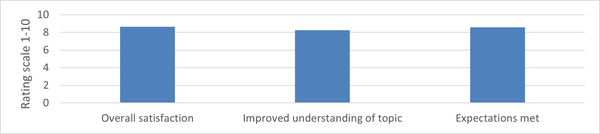
Figure 1: Attendee ratings for overall satisfaction, improved understanding of topic and whether expectations were met (scale 1-10).
Figure 1 WA training
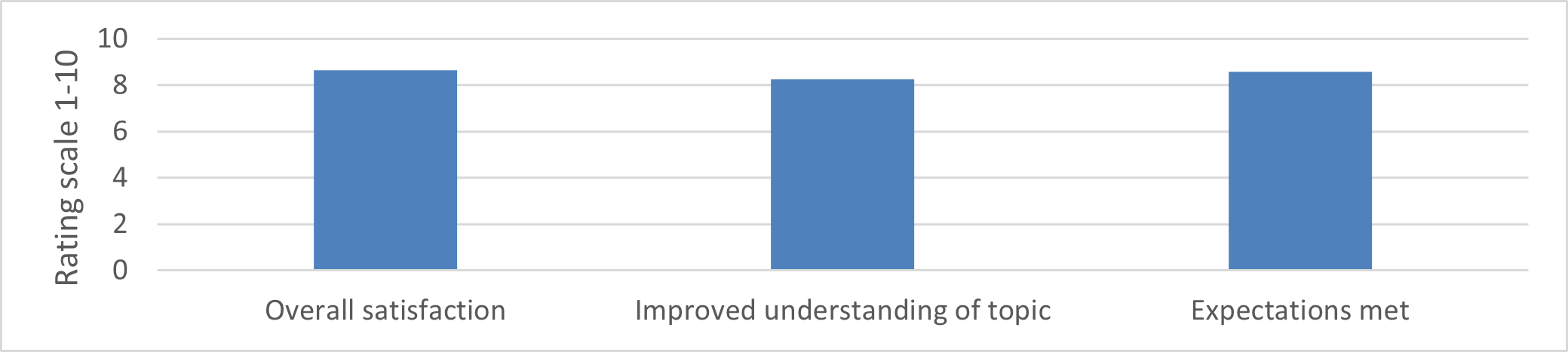
Figure 1: Attendee ratings for overall satisfaction, improved understanding of topic and whether expectations were met (scale 1-10).
"An extensive subject with basics covered in tight timeframes. Great presented, simple vocabulary and understandable."
"The training was great, it covered a lot of good and relevant topics. The presenter did a great job and presented very well. Appreciated having an online session instead of having to be there in person."
"I thought it was really useful. The case studies at the end were an excellent way to demonstrate the concepts that had been discussed."
Implementation - subsequent years
An additional six modules have been delivered (nine modules in total), with further modules planned for 2026.
Levels of attendance and satisfaction ratings continued to remain high, but in-person attendance was further reduced. Further trials have been:
- a hybrid option where the same session could be attended in-person or online rather than having separate in-person and online sessions
- two online sessions, with no opportunity to attend in-person
- ??a hybrid with ??
- a networking lunch as part of the in-person only workshop: this resulted in increased attendance.
| Module | Year | Trainer | Online delivery | In-person delivery | Hybrid delivery |
|---|---|---|---|---|---|
| Coastal hazard assessments | 2024 | MP Rogers & Associates | X | X | |
| Vulnerability analysis and risk evaluation | 2024 | MP Rogers & Associates | X | ||
| CHRMAP implementation | 2024 | Shape Urban | X | X | |
| CoastAdapt refresh | 2025 | Griffith University | X | ||
| Adaptation options analysis | 2025 | MP Rogers & Associates | X | ||
| Community and stakeholder engagement | 2025 | Shape Urban | X |
Across all modules available on the website between 2023 and 2025, there have been over 1,200 views of the videos demonstrating that the training modules continue to be a resource for coastal managers, government agencies and community stakeholders beyond the initial workshops.
Conclusion and insights
The CoastWA training series was well received and has proven to be a valuable resource for coastal land use managers. Several learnings can be taken from the delivery of the program.
- The training needs survey was beneficial for determining trainee preferences and potential topics, informing the development of the program.
- The modular approach allowed the program to build in stages with three modules delivered per year. This allowed the program to be continually adapted in response to attendee feedback and was beneficial for work planning and aligning with annual budgets.
- Across all modules and sessions, the most common and consistent form of feedback was for the inclusion of real-life examples and case studies to continue to be included in the training.
- The most common form of attendance was online, even for metropolitan Local Governments who initially indicated a slight preference for attending in-person. Hybrid approaches and online only approaches were trialed with success.
- While online attendance was preferred due to logistics and convenience, in-person sessions had better engagement between the trainer and attendees and improved learning outcomes. The introduction of elements such as networking, workshopping and field trips could be used to increase in-person attendance