

Coastal and freshwater wetlands in Western Australia (WA) cover 2.5 million hectares of the state, spanning multiple climatic, geomorphic and hydrological zones, according to the 2023 report, Blue and Teal Carbon Assessment at a Local Scale: Western Australia.
The report, completed by Deakin University’s Blue Carbon Lab, assessed the economic value of the ecosystem services provided by WA blue and teal carbon habitats. The research included the assessment of two coastal wetland case studies, the Cane River estuary and the Cossack region, in the Pilbara of northern WA.
The analysis found that the mangrove, saltmarsh, and tidal mudflat habitat in the two areas collectively sequestered almost 6,000 tonnes of blue carbon per year, and had a total ecosystem service value of almost $2.5 billion per year.
The report highlighted the broad benefits that WA’s coastal wetland habitats provide, but also identified knowledge gaps – such as limited regional scale spatial data for WA’s wetland ecosystems – that should be filled to enable effective coastal management and informed wetland conservation and restoration work.
Some of these gaps are being filled by a second Blue Carbon Lab project, Western Australia Blue, a three-phase 3.5-year programme investigating blue carbon opportunities from coastal wetland conservation and restoration in the state.
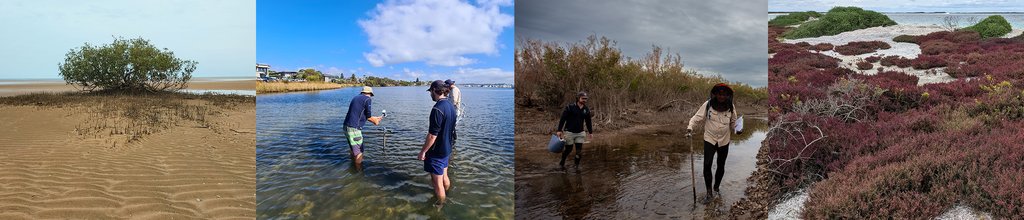
Members of the project team met with Onslow Indigenous Sea Rangers and local landowners in 2022 to discuss the potential for projects on coastal restoration and blue carbon. This visit included training on blue carbon sampling.
During the first phase of the project, conducted during 2023, researchers collected 124 blue carbon sediment cores and associated vegetation data from 43 mangrove, saltmarsh, and seagrass habitat sites along the Western Australia coastline where data had been lacking. Analysing the cores’ carbon content will underpin the project’s second phase, a modelling study to assess the size of the blue carbon opportunity in WA. The final phase will identify sites that could be suited to a range of coastal wetland restoration methods, and carry out a pre-feasibility assessment to guide blue carbon restoration project selection.
Other blue carbon studies underway in WA include a seagrass meadow restoration trial at Shark Bay using seagrass seedlings planted into sand-filled hessian tubes, which is led by the University of West Australia. Shark Bay’s 480,000 ha seagrass meadow is the world’s largest seagrass habitat, but a marine heatwave in 2010-2011 damaged or killed seagrass in over a quarter of the habitat. Following the trial, a $2 million project in which 100 ha of seagrass would be restored by divers from a local Indigenous-owned sea cucumber company has been awarded a BHP grant.
Indigenous business Tidal Moon leads one of the world’s largest seagrass restoration projects in Shark Bay, Western Australia. The project aims to recover part of 100,000 ha damaged by a 2011–2012 heatwave.
A 100-hectare pilot will be completed in 2025, with potential to scale. This pioneering initiative, led by Indigenous divers, offers a new model for climate action and biodiversity recovery, including the development of Indigenous-led blue carbon and biodiversity credits.
To cite:
This case study was prepared by NCCARF.
Please cite as: NCCARF, 2024: Blue carbon opportunities along the vast and diverse West Australian coastline. Case study for CoastAdapt, National Climate Change Adaptation Research Facility, Griffith University, Gold Coast.