

How does saltmarsh restoration impact the habitat around the restored wetland – including adjacent marine habitat such as seagrass, which is another form of blue carbon ecosystem? Studying the broader impacts of saltmarsh restoration is a core aim of the Pitt Water-Orielton Lagoon blue carbon project in Tasmania.
Around the 1960s, the Pitt Water-Orielton Lagoon – located near Richmond, north-east of Hobart – was cut off from tidal flows of the adjacent Coal River by the construction of a levee, to dry off parts of the wetland for sheep grazing. Sections of saltmarsh habitat isolated from the river’s tidal flushing effect have gradually been dying back.
Since 2020, the natural resource management organisation covering southern Tasmania, NRM South, has led an Australian Government funded project to restore a 65 ha section of the wetland, and to study the impacts of the work.
In 2022, the project received additional funding as one of the five demonstration projects to receive an Australian Government Blue Carbon Ecosystem Restoration Grant.
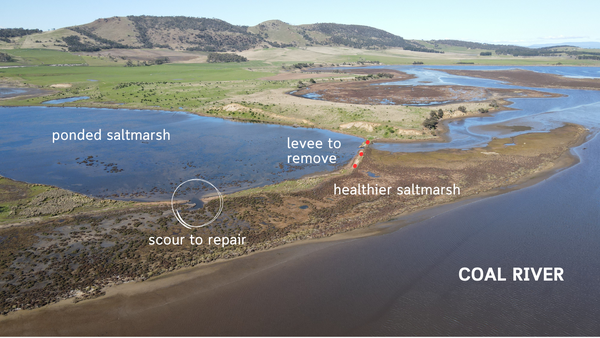
The Blue Carbon Ecosystem Restoration project is helping find out more about the diverse benefits of restoring a large area of stranded temperate saltmarsh community, including what happens to adjacent areas of habitat such as seagrass, or surrounding vegetation and ecological communities.
- © NRM Southpb_before

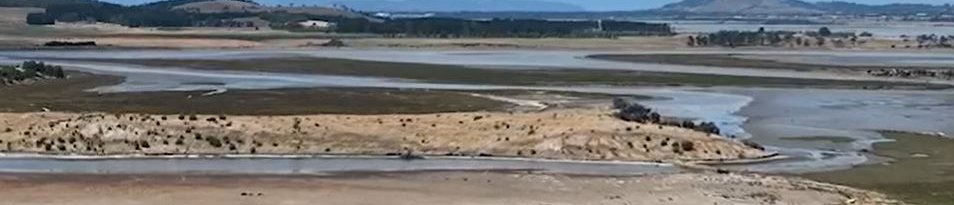
The Blue Carbon Ecosystem Restoration project is helping find out more about the diverse benefits of restoring a large area of stranded temperate saltmarsh community, including what happens to adjacent areas of habitat such as seagrass, or surrounding vegetation and ecological communities.
© NRM South
Work at the site has included baseline environmental monitoring of flora, fauna, and water quality prior to levee removal; weed control; revegetating areas adjacent to the wetland with native woody plants and grasses; and installing fencing to exclude stock.
In April 2024, the levee was completely removed and natural water flow resumed across the site.
To measure how the levee removal impacts the wetland and adjacent habitats, NRM South is working with the University of Tasmania and consultancy Blue Carbon Services to undertake ongoing environmental monitoring of the site and its surroundings.
A key project aim is to identify the range of benefits that result from restoring stranded saltmarsh, including the flow-on impacts to surrounding terrestrial and marine habitat including seagrass.
The findings from Pitt Water-Orielton Lagoon could influence blue carbon habitat restoration in Tasmania more broadly. The Tasmanian Government’s draft Emissions Reduction and Resilience Plan – Agriculture, released in September 2024, notes that future opportunities to support increased carbon storage could include “developing strategies to guide work by the government, business and industry to better understand and address the risks, barriers and co-benefits of carbon farming and blue carbon initiatives in Tasmania”.
To cite:
This case study was prepared by NCCARF.
Please cite as: NCCARF, 2024: Blue carbon and beyond: studying the broader benefits of saltmarsh regeneration in Tasmania. Case study for CoastAdapt, National Climate Change Adaptation Research Facility, Griffith University, Gold Coast.