



At a glance
- Local governments are pivotal in creating healthy, safe, and climate-resilient communities, influencing planning, infrastructure, and public health systems.
- Key needs include strong climate leadership, governance clarity, sustained funding, resilient infrastructure, accessible climate data, and support for mental wellbeing.
- Opportunities include collaborative governance, community engagement, climate literacy, and partnerships to build a climate-ready economy and social cohesion.
- Seven complimentary and connected guiding principles were identified: work together; share knowledge; re-imagine urban spaces; protect nature; strengthen food systems; put health at the centre; and commit long-term

The Tasmanian Councils Supporting Climate Healthy & Resilient Communities project
Local governments increasingly play a vital role in shaping healthy, safe and resilient communities. A Tasmanian Climate Healthy Communities project has identified how councils can support health and resilience. This statewide initiative clarifies local government roles and sets a roadmap for building climate-ready, healthy communities.
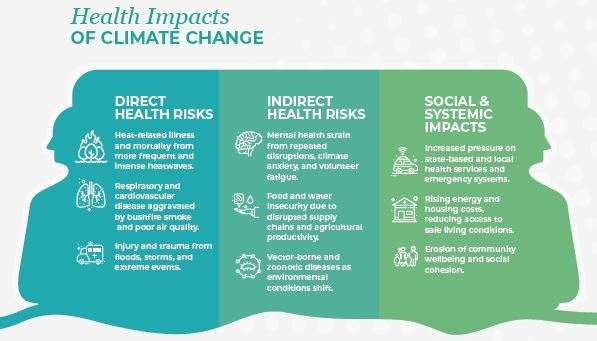
The project outlined the direct and indirect impacts on health.
CC health impacts
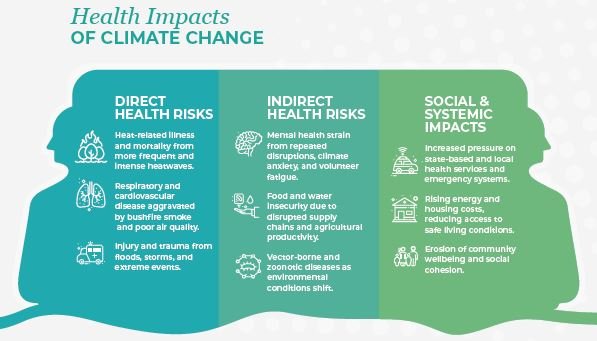
The project outlined the direct and indirect impacts on health.
The project undertook extensive consultation with 21 councils and stakeholders across the state. This explored how climate change is affecting communities, what roles councils currently play, and where systems need to be improved or better supported.
The process combined insights from elected members, council staff and community with climate projections, health impact data and state policy frameworks about public health, emergency management, planning and climate action.
This helped to identify a systems approach to governance, infrastructure resilience, social vulnerability, and data accessibility.
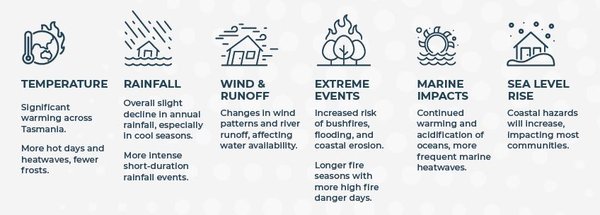
The project identified six key climate impacts for Tasmania using data provided by University of Tasmania (UTas).
Projected impacts
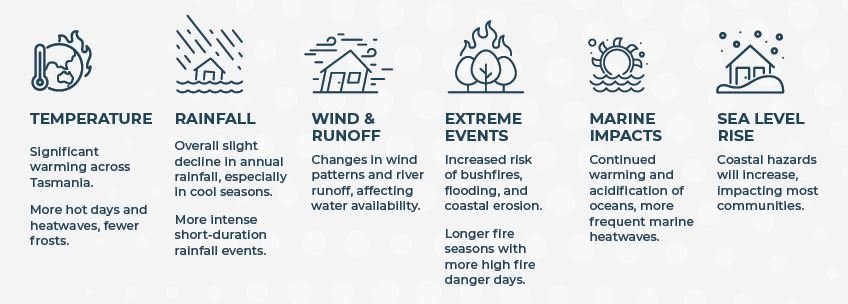
The project identified six key climate impacts for Tasmania using data provided by University of Tasmania (UTas).
“Councils are intrinsically impacted by the effects of climate change – more so that any level of government in Australia. This blueprint will provide local government with the tools and partnerships required to protect community health and resilience now and for generations to come.”
Mayor Christina Holmdahl, West Tamar Council
Funded by a Tasmanian Government Healthy Focus Grant, the prroject was hosted by West Tamar Council. The initiative was delivered by the Northern Tasmanian Alliance for Resilient Councils - a self funded, proactive collaboration of the eight northeast councils - in partnership with University of Tasmania Menzies Institute and the Tasmanian Department of Health.
- The technical report, Tasmanian Council Supporting Climate Healthy and Resilient Communities. 2023-2025 technical report.
- The Shared Blueprint for Tasmania Councils
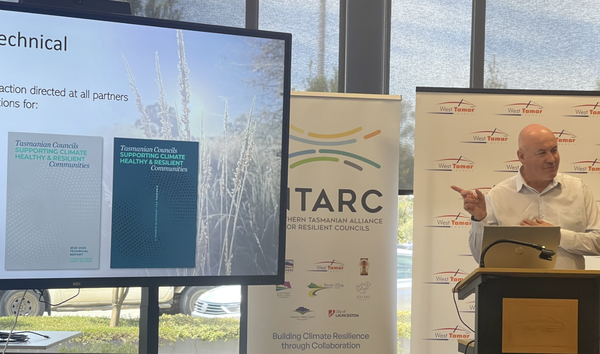
The launch of the blueprint: John Brown, Break O'Day Council General Manager and NTARC Chair.
- © Katrina GrahamJohn Brown Break O Day
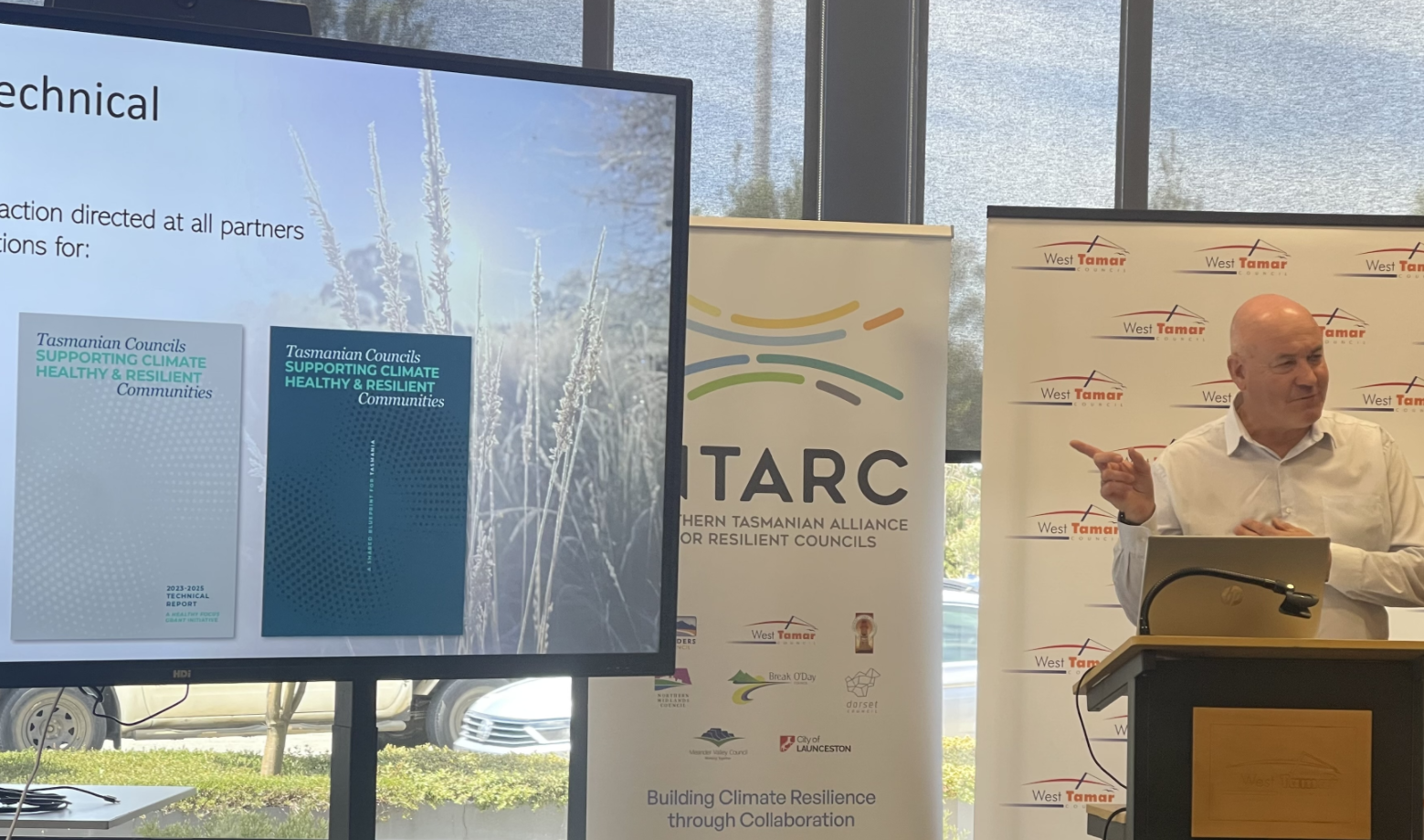
The launch of the blueprint: John Brown, Break O'Day Council General Manager and NTARC Chair.
© Katrina Graham
Key findings: Council needs, opportunities and resources
Community and council needs: what communities and councils told us
Across ten regional workshops and more than two hundred individual insights, a clear picture emerged of what councils and communities require to act with confidence.
Local governments and communities identified several core needs for building climate resilience.
The strongest need is clear climate leadership, with councils expected to provide strong decision making, clear prioritisation and increased support for mainstreaming of climate considerations across council decision-making.
Councils also need stronger climate governance, systems, guidance and sustained funding to upgrade assets, align policies and support vulnerable communities.
Another priority is creating climate-ready settlements through resilient planning, infrastructure, green spaces, safe mobility, secure water and local food systems.
Councils also require accessible, localised and reliable climate data to support day-to-day operations, long-term investment and land-use planning. This could be supported by alongside better translation of science into practical local action.
Also heard was the community need for support for social connection and mental wellbeing, with rising climate anxiety, trauma and fear of displacement.
Opportunities for thriving resilient communities: where and how councils can lead
Tasmania’s councils already demonstrate strong local leadership and innovation, but the opportunity lies in scaling what works.
Participants identified opportunities for councils to turn climate risk into resilience. Key among these is collaborative climate governance, where councils develop shared policies, pool expertise and coordinate regional adaptation to improve consistency and reduce duplication.
They also supported strengthening community engagement and climate literacy, using education, storytelling and arts-based approaches to build participation and pride.
Councils can further support a climate-ready economy through procurement, partnerships and regulation that help local businesses adapt and innovate.
Participants recognised that overall, councils are well placed to build trust, strengthen social cohesion and unite communities around shared resilience and protection of place.
Resources local governments can leverage: what we already have
Tasmania’s local government sector already holds many of the building blocks for climate health action.
Councils have strong foundations for climate resilience, including governance authority, technical expertise in planning, engineering, environmental health and emergency management, and responsibility for key community assets. They also have trusted communication channels that help communities prepare for and reduce climate risks.
Councils are embedded in local networks, they can activate community groups, support wellbeing and enable community-led resilience during disasters. Collaboration also a major asset, with existing partnerships across councils, government, NGOs and industry that can be expanded.
Levers such as leadership, funding, decarbonisation initiatives and procurement can further accelerate climate-health outcomes. Overall, councils are well positioned to lead resilience but need clearer roles, stronger alignment and increased capacity to realise their full potential.
What this means: what is needed to act at scale
Tasmania’s councils already have the systems, skills and relationships needed, in addition to developing local and regional climate responses since 2000.
- Leadership and governance clarity. Roles, accountabilities and decision rights for climate–health are not consistently codified, leaving action discretionary and vulnerable to political cycles. Councils want climate–health embedded in corporate risk, strategic planning and reporting, supported by a shared approach and framework, supported by guidelines and practice notes rather than ad-hoc projects.
- Settlements and infrastructure designed for a past climate. Roads, stormwater, buildings and public places are under increasing strain from extreme weather and a changing climate. Councils are seeking standards, datasets and tools to integrate forward-looking climate science into land-use and asset decisions, with health and liveability as explicit outcomes and co-benefit investments prioritised.
- Data is scattered and hard to apply locally. Multiple datasets exist but are difficult to access, reconcile or apply with confidence. Councils called for a quality-assured, decision-ready statewide platform, with clear liability guidance, visualisation tools and plain-language interpretation, to support planning, environmental health and community communication.
- Community wellbeing, mental health and social resilience. Community health issues already include climate anxiety, volunteer fatigue and uneven social capital are now tangible community health issues. Councils recognised challenges relating to psychosocial preparedness and recovery planning and opportunities to address be delivered through Tasmanian government supported libraries, community centres and neighbourhood houses, in partnership with Primary Health Tasmania and NGOs.
- Collaboration and resource sharing. Regional coordination is essential to address capacity constraints, especially in smaller councils. Alliances such as NTARC, CCA and STCA can pool expertise, harmonise policy and lift consistency without sacrificing place-based practice. EHOs strongly endorsed a cross-council climate–health network to exchange data, case studies and guidance.
Seven principles
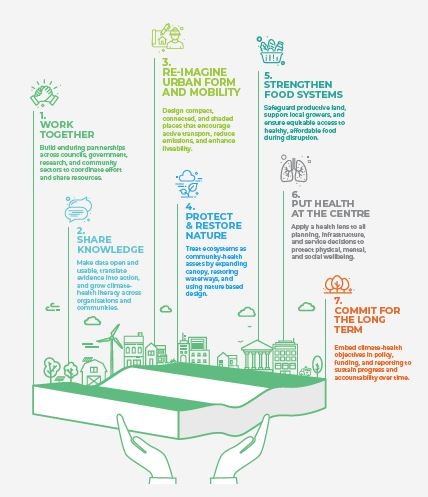
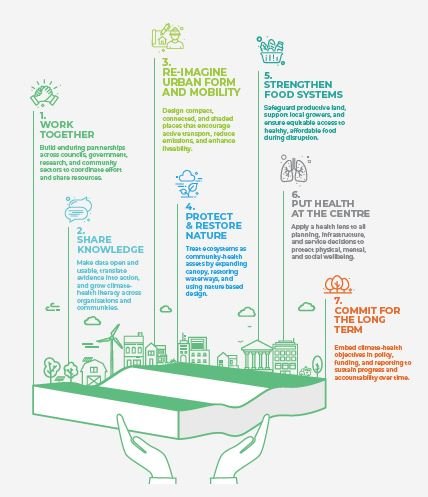
Seven principles were developed through the project. These guide how councils and partners translate this pathway into practice. They represent a shared foundation for building healthy, connected, and climate-ready communities.
Seven principles
Seven principles
- Work together. Build enduring partnerships across councils, government, research, and community sectors to coordinate effort and share resources.
- Share knowledge. Make data open and usable, translate evidence into action, and grow climate-health literacy across organisations and communities.
- Re-imagine urban form and mobility. Design compact, connected, and shaded places that encourage active transport, reduce emissions, and enhance liveability.
- Protect and restore nature.Treat ecosystems as community-health assets by expanding canopy, restoring waterways, and using nature based design.
- Strengthen food systems. Safeguard productive land, support local growers, and ensure equitable access to healthy, affordable food during disruption.
- Put health at the centre. Apply a health lens to all planning, infrastructure, and service decisions to protect physical, mental, and social wellbeing.
- Commit for the long term. Embed climate-health objectives in policy, funding, and reporting to sustain progress and accountability over time.
The 'Shared Blueprint' for Tasmania
The project developed a 'Shared Blueprint', which highlights that climate-related health impacts stem from both direct exposures (including heat stress, injury, air-quality impacts) and indirect stresses (including mental health impacts, food insecurity, community disruption). Councils influence many of the local systems that affect health, such as land-use planning, emergency management, environmental health services, community infrastructure and community cohesion.
The blueprint was developed through extensive consultation with 21 councils across the state that explored how climate change is affecting communities, what roles councils currently play, and where systems need to be improved or better supported.
The process drew together information from staff experiences, climate projections, health impact data and state policy frameworks about public health, emergency management, planning and climate action. This helped to identify a systems approach to governance, infrastructure resilience, social vulnerability, and data accessibility.
Importantly, the blueprint provides a road map and an evidence-based action framework to guide and support councils in working with their communities to support climate healthy and resilient outcomes.
To cite:
This case study was prepared by NCCARF. Please cite as: NCCARF, 2025: Tasmanian councils' blueprint for healthy communities. Case study for CoastAdapt, National Climate Change Adaptation Research Facility, Griffith University, Gold Coast.